
Unprecedented observations of comet 3I/Atlas on December 19 promise data on origins in other star systems

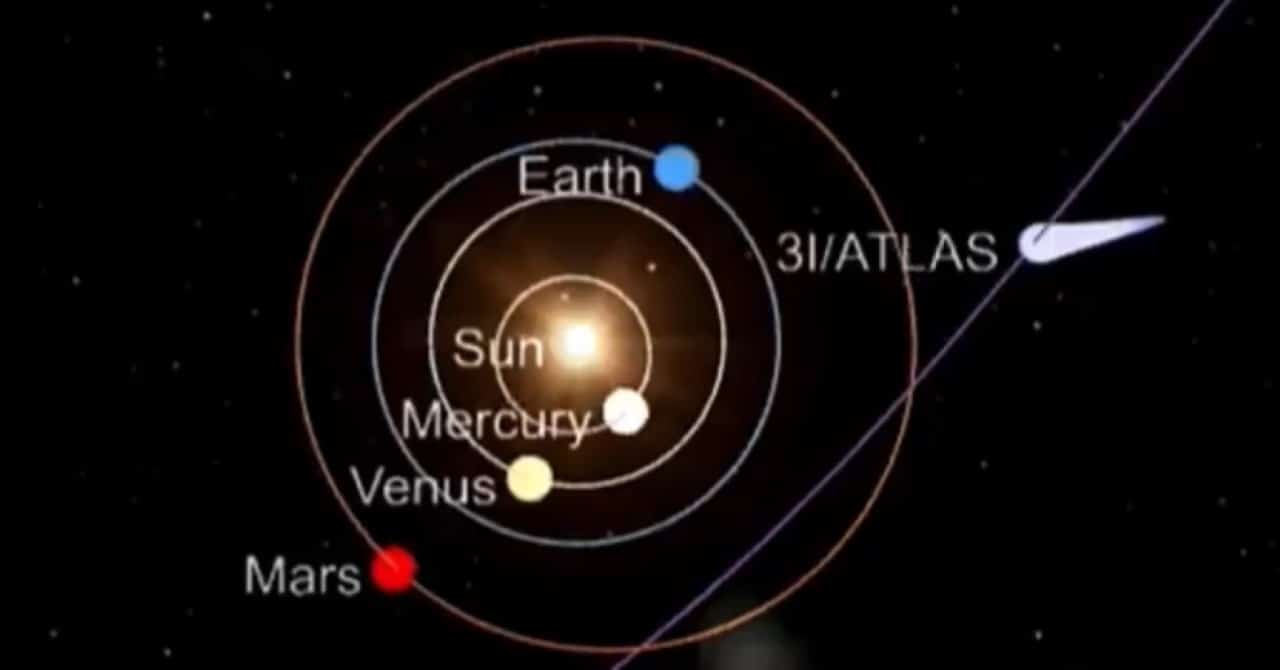
Astronomers from space agencies such as NASA and ESA are following comet 3I/Atlas, detected on July 1, 2025 by the ATLAS telescope on Chile. The object, originating outside of Sistema Solar, follows a hyperbolic trajectory and will pass 270 million kilometers from Terra on December 19. Essa approach allows data collection without risk to the planet.
The comet, the third confirmed interstellar, travels at about 60 km/s and exhibits typical cometary activity such as a dust coma and gas tail. Observações recent Hubble reveals core measuring 440 meters to 5.6 km in diameter.
Its composition includes high levels of carbon dioxide and water ice, differing from local comets.
- Higher speed than predecessors: 60 km/s versus 26 km/s of 1I/’Oumuamua.
- Changes in the coma: reddish color evolving since July.
- Radio emissions: detected by MeerKAT at frequencies of 1.665 GHz.
Trajectory and planetary passages
Comet 3I/Atlas entered Sistema Solar from the direction of Sagitário and reached perihelion on October 30, 2025, 210 million kilometers from Sol. Nessa phase, passed 29 million kilometers from Marte, allowing images from the Mars Reconnaissance Orbiter probe.
Now on its way out, the object heads to pass through Vênus on November 3, 2025, 97 million kilometers away. Solar gravity influences its gradual deceleration.
Experts predict that, after December, the comet will head to Júpiter in March 2026, 54 million kilometers away, where the Juno probe will collect additional data.
Comet 3I/ATLAS will make its closest approach to Terra on December 19, passing approximately 268 million kilometers from our planet.pic.twitter.com/KFsmWzjdPk
— JAMES WEBB (@jameswebb_nasa)October 28, 2025
Chemical composition revealed
Analysis of James Webb Space Telescope indicates a CO2-dominated coma, with traces of methanol and hydrogen cyanide detected by ALMA. Esses compounds suggest formation in the cold environment of another star system.
The core releases 5 billion tons of material per month, forming a tail of ions deflected by the solar wind.
- Estimated diameter: between 440 meters and 5.6 km, based on Hubble images from July 21 and November 30, 2025.
- Early activity: observed since May 2025, at 6.4 astronomical units from Sol.
- Coma color: reddish from dust, similar to 2I/Borisov.
Recent images and preliminary data
Hubble captured the comet on November 30, 2025, 286 million kilometers from Terra, showing a teardrop-shaped coma with a blue glow. ESA’s Juice probe recorded views in November, despite thermal challenges during Sistema Solar’s inner traverse.
Data from Psyche, in September, mapped solar reflections 53 million kilometers away. The Perseverance rover in Marte detected it as a faint spot on October 4.
These images confirm the absence of post-perihelion fragmentation, with the body intact.
Amateur astronomers can observe it with 7.6 cm aperture telescopes in the pre-auroral sky starting December 12, in the constellation Leão.
Opposition occurs on January 22, 2026, when it will be visible all night, although fainter.
Comparison with previous visitors
3I/Atlas differs from 1I/’Oumuamua, detected in 2017 without a visible coma, and 2I/Borisov, from 2019 with more conventional features. Sua velocity and radio emissions highlight it as a unique case for studies of interstellar diversity.
Observations of Nordic Optical Telescope on July 2, 2025 confirmed activity with a diffuse appearance.
Studies of Toni Santana-Ros in August noted reddening of the coma throughout July, indicating superficial evolution.
- 1I/’Oumuamua: speed 26 km/s, without tail.
- 2I/Borisov: 32 km/s, composition similar to solar comets.
- 3I/Atlas: stable brightness, no explosions detected until August 2025.
Preparations for the key date
On December 19, ground-based and space-based telescopes will intensify monitoring to measure the exact speed, composition and interaction of the tail with the interstellar medium. The absence of a new moon favors visibility.
The Rede Internacional of Alerta of Asteroides coordinates observations for precise astrometry.
Minor Planet Center plans global campaign for orbital data.
These efforts aim to refute hypotheses of artificial origin, as suggested by some, and confirm cometal nature.
Anomalies and scientific debates
The comet displays jets of up to 3 million kilometers, defying ejection models based on its size. Avi Loeb, from Harvard, questions whether post-perihelion maneuvers indicate non-gravitational acceleration, similar to ’Oumuamua.
Jason Wright, of Penn State, argues for natural explanations such as irregular sublimation of ice.
NASA concluded natural interstellar origin in a recent briefing, after 20 coordinated missions.
Public visibility and access
To observers, the comet appears at magnitude 11, requiring specialized equipment. Aplicativos like TheSkyLive track your position in real time.
In March 2026, the passage through Júpiter will offer a new window for studies of gravitational interaction.
The object will leave Sistema Solar without returning, leaving a legacy of data on planetary formation in other systems.



