
Comet 3I/ATLAS is the third interstellar object captured in X-rays by XMM-Newton, revealing invisible gases in the Solar System

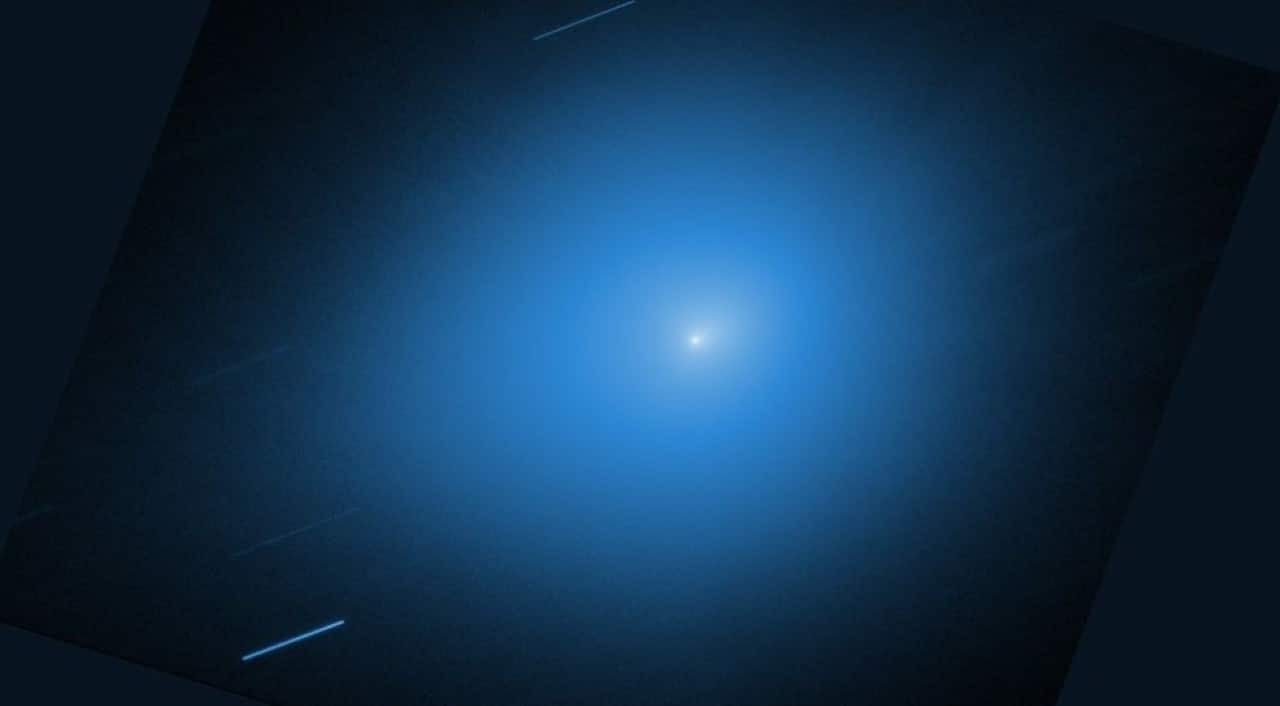
The Agência Espacial Europeia space observatory XMM-Newton (ESA) has obtained the first X-ray images of the interstellar comet 3I/ATLAS, a mysterious visitor to our Sistema Solar. Esta unprecedented observation, carried out on December 3, 2025, at a distance of 282-285 million kilometers from Terra, represents a milestone in the search for objects that originate outside our star system. The data collected by XMM-Newton is crucial to understanding the comet’s chemical composition and how it reacts to the surrounding space environment.
3I/ATLAS is only the third interstellar object ever recorded in our Sistema Solar and was first spotted in July 2025 by the ATLAS observatory. Sua closest approach to Terra is scheduled for December 19, 2025, when it will pass within 1.79 astronomical units of our planet, providing a rare opportunity for detailed study. Analysis of X-ray emissions provided by the ESA observatory offers unique insight into the gases surrounding the comet, information that would be unattainable through conventional optical telescopes.
The X-ray glow phenomenon is a direct result of the interaction of the solar wind, a flow of charged particles emitted by the Sol, with the gases expelled by the comet’s nucleus. Cientistas hope this data will complement observations made by other instruments, such as NASA/ESA/CSA’s Telescópio Espacial James Webb. Esta combination of techniques will help refine current models about interstellar objects and their dynamics within our Sistema Solar.
EPIC-pn camera captures first light
The XMM-Newton telescope dedicated approximately 20 hours of observation to comet 3I/ATLAS, using its EPIC-pn (European Photon Imaging Camera) camera, the most sensitive X-ray instrument on board. The resulting image displayed the comet glowing in low-energy X-rays, with the red color highlighting the object’s emissions and the blue marking areas of lower X-ray incidence.
Our@ESA_XMMhas observed comet#3IATLASin X-ray light!
— ESA Science (@esascience)December 12, 2025
When gas molecules streaming from a comet collide with the solar wind they produce X-rays, seen here as the red glow of 3I/ATLAS 👉https://t.co/Hv0Dv3AAg9
Blue marks empty space with little X-rays, while the black…pic.twitter.com/oblPMYz64Q
Researchers point out that these X-rays may originate from the interaction of the solar wind with volatile gases, such as water vapor, carbon dioxide or carbon monoxide, substances that have already been identified in other comets. The successful observation using XMM-Newton confirms the scientific community’s predictions about the behavior of these celestial bodies. The ability to detect emission at these energies is critical to distinguishing 3I/ATLAS from comets originating from our own Sistema Solar.
Revealing invisible gases by conventional methods
One of the biggest differences in X-ray observation is its ability to identify gases such as hydrogen and nitrogen, which are almost impossible to detect by telescopes that operate in the optical and ultraviolet light bands, such as the Telescópio Espacial Hubble. The difficulty in detecting these gases with traditional instruments makes XMM-Newton data an invaluable resource for astrochemistry. The signatures of these elements can provide essential clues about the comet’s exotic origin, helping to profile its formation in a different star system.
The composition of previous interstellar objects, such as the enigmatic 1I/’Oumuamua, detected in 2017, had already raised the hypothesis that these travelers could be formed by exotic ices. Muitos scientists believe ‘Oumuamua could have been composed of nitrogen or hydrogen ice. In-depth analysis of 3I/ATLAS X-ray data will help confirm or refute these theories.
Study of cosmic visitors and the composition frontier
Continued research into interstellar objects is vital to understanding the diversity of materials that make up the galaxy, going beyond the celestial bodies formed in the vicinity of Sol. Comet 3I/ATLAS offers a sample of material that formed in a completely different stellar environment. X-ray analysis is a powerful tool for measuring the amount and type of gases released by the comet.
- X-ray emission is directly linked to the rate of sublimation and the volatile composition of the comet.
- Detailed studies of this emission allow us to estimate the production of water and other molecules in the vacuum of space.
- Comparing 3I/ATLAS with comets from our Sistema Solar, such as those from Nuvem from Oort and Cinturão from Kuiper, will reveal the differences in their chemical signatures.
- The results obtained by XMM-Newton will complement future missions and observations from other space agencies, such as ESA’s JUICE space observatory.
Complementing data with multiple spectral bands
The strategy of using XMM-Newton in conjunction with observations from optical and infrared telescopes such as James Webb maximizes the scientific yield of the 3I/ATLAS passage. Enquanto XMM-Newton focuses on high-energy emissions and more elusive gases, visible and infrared light telescopes provide details about the comet’s nucleus and coma. Essa synergy is critical to creating a three-dimensional model of the comet’s structure.
The X-ray data is essential for mapping the comet’s dynamic interaction with the solar wind, allowing astrophysicists to calculate the intensity of the outgassing. The observation is a demonstration of the usefulness of XMM-Newton, an observatory designed to study the most energetic phenomena in the universe. The fact that it captured the interstellar comet’s faint X-ray signal is a testament to its sensitivity and precision.
The contribution of 3I/ATLAS to planetary science
The 3I/ATLAS study transcends mere astronomical curiosity, offering valuable insights into the formation of planetary systems in other regions of Via Láctea. The comet’s composition, revealed in part by X-rays, acts as a time capsule, preserving the chemistry of the interstellar medium where it originated. The presence or absence of certain elements and molecules can indicate whether it came from a metal-rich star system or a more primitive region.
Additionally, analysis of the X-ray tail helps researchers understand the rate of erosion of the comet as it travels through Sistema Solar. The strength and geometry of the X-ray tail provide information about the density and speed of the solar wind at the observation point, which varies as the comet moves. The XMM-Newton data will be incorporated into large astronomical databases to be used by researchers around the world.
Tracking interstellar objects and technological evolution
The detection and tracking of 3I/ATLAS, the third known interstellar object after ‘Oumuamua and 2I/Borisov, underscores the advancement of celestial tracking technologies such as the ATLAS observatory. The ability to detect these visitors, which move in hyperbolic trajectories and are not gravitationally bound to Sol, has improved significantly in recent years. The X-ray observation by XMM-Newton represents a step forward in the physical characterization of these objects.
Astronomers can now expect X-ray observations to become a standard tool in analyzing future interstellar objects, complementing visible, infrared and ultraviolet light data. Integrating these different spectral perspectives is the key to fully unlocking the secrets of the composition, origin and evolution of these celestial bodies. The passage of 3I/ATLAS in December 2025 offers a peak of data that will be analyzed for years.
Chemical composition and the search for new ice
The search for exotic ices, such as nitrogen or hydrogen ice, in interstellar objects remains a central topic in research. While telescopes such as the James Webb are efficient in detecting more complex molecules, X-rays are particularly useful for detecting the presence of lighter elements and in gaseous forms. The XMM-Newton science team will look for specific signatures that could indicate the presence of these rarer ices in 3I/ATLAS.
The hypothesis that interstellar objects may be formed by hydrogen or nitrogen ices is based on models of planet formation in other stellar systems, which suggest the possible ejection of bodies rich in these elements. The X-ray observation from 3I/ATLAS is a fundamental piece of this puzzle, as it helps to determine the emission rate and proportion of each gas expelled by the comet.



