
Interstellar comet 3I/Atlas approaches Earth on December 19: what will happen on this day

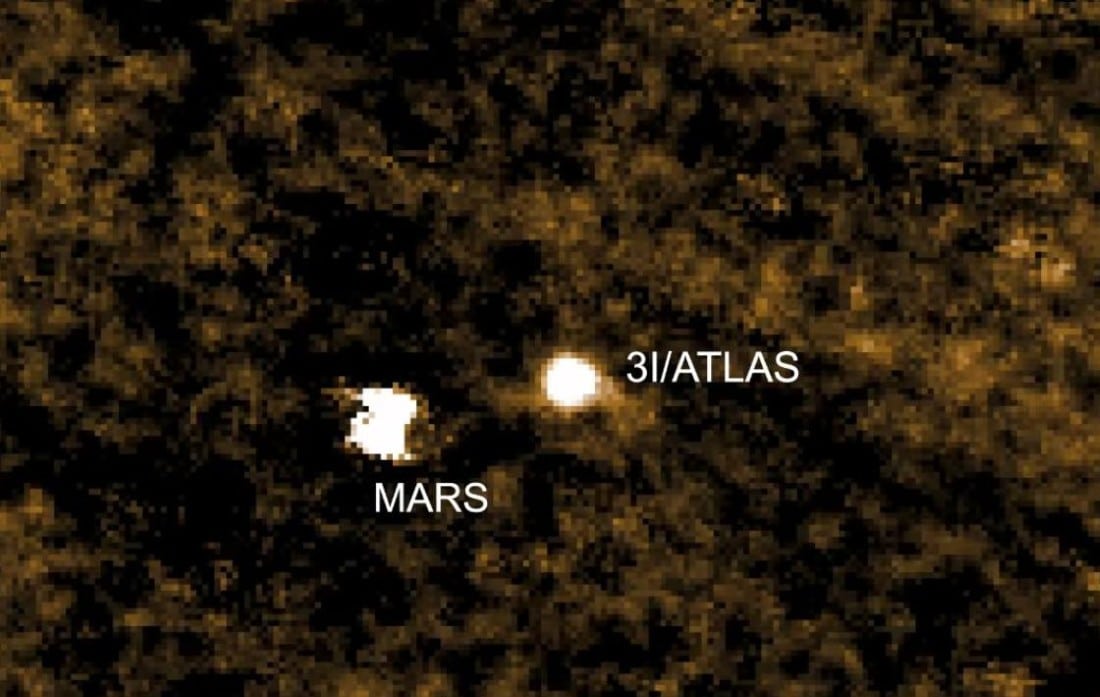
The interstellar comet 3I/ATLAS, the third confirmed object coming from outside Sistema Solar, will reach its closest proximity to Terra on December 19, 2025. Essa passage will occur at a safe distance of approximately 270 million kilometers, equivalent to 1.8 astronomical units, without any possibility of impact or threat to the planet. Descoberto in July 2025 by the ATLAS system in Chile, the celestial body follows a hyperbolic trajectory that will take it back to interstellar space after crossing the solar system.
Astronomers from several space agencies have been monitoring 3I/ATLAS since its initial detection. The comet passed through perihelion, the closest point to Sol, in October 2025, exhibiting cometary activity with a coma and tail formed by ice sublimation. Observações indicate that the object travels at high speeds, exceeding 200 thousand kilometers per hour, confirming its origin external to Sistema Solar.

The approach of December 19 represents an opportunity for detailed studies of the composition of interstellar objects. Telescópios and Hubble recorded images that reveal unique characteristics, such as a reddish coma and the absence of certain compounds typical of local comets.
Discovery of 3I/ATLAS
The ATLAS system identified the object on July 1, 2025, initially as a body of weak magnitude. Subsequent Observações confirmed cometary activity, with the presence of a diffuse coma and elongation suggesting a tail. Pré-discoveries date back to June 2025, when the comet passed through dense star fields.
International teams analyzed data from telescopes at Chile, Arizona and Havaí. The designation 3I reflects its status as the third known interstellar object, after ‘Oumuamua and Borisov.
Trajectory and speed
3I/ATLAS follows a hyperbolic orbit with an excess speed of around 58 km/s in relation to Sol. Essa characteristic indicates that the comet is not gravitationally bound to Sistema Solar and just passes through the region. The speed increased during the passage through perihelion, reaching values close to 246 thousand km/h.
After approaching Earth on December 19, the object will head towards an encounter with Júpiter in 2026. The gravity of the giant planet will slightly alter the trajectory before definitive ejection into interstellar space.
Recent observations
Space telescopes captured images of the comet in November 2025, when it was about 286 million kilometers from Terra. Registros show an increase in brightness and evolution of the coma, with a reddish color indicative of dust. Missões like Juice, from Agência Espacial Europeia, used instruments to map composition during the active period.
Observations of Hubble revealed a faint tail pointing in the opposite direction to Sol. Dados suggest a core with a diameter between 440 meters and 5.6 kilometers, based on brightness and albedo analyses.
Composition revealed
Spectroscopic analyzes indicate the presence of abundant water ice, differentiating 3I/ATLAS from typical solar comets. The coma presents high proportions of certain compounds, such as CO₂ in some records. Ausência of significant outbursts maintains stable activity since detection.
Studies indicate an estimated age of billions of years, higher than that of Sistema Solar. Composição reflects formation conditions in another star system, possibly in the thick disk of Via Láctea.
Visibility for observers
The comet reaches a magnitude that allows observation with amateur telescopes in dark skies. Melhor period occurs in the pre-auroral sky, with a favorable position until spring 2026. Aplicativos and NASA simulators assist in the precise location of the object.
- Use binoculars or telescopes with at least 20 centimeters of aperture for better viewing.
- Choose locations with low light pollution and a clear horizon.
- Consult updated sky maps for daily coordinates.
- The comet appears as a diffuse spot with a possible tail visible in long exposures.
Instruments involved
Several ground-based and space-based telescopes contributed to continuous monitoring. Hubble provided detailed images in July and November 2025. Sondas orbiting Marte recorded a close pass in October.
Collaborations between NASA, ESA and Chilean observatories accelerate data processing. Observações from TESS indicate early cometary activity, since May 2025.
Unique features
3I/ATLAS exhibits a coma with a reddish color that evolves over the months. Ausência of non-gravitational acceleration distinguishes it from ‘Oumuamua. Presença of initial antisolar tail confirms classical interaction with solar wind.
Studies estimate that the comet traveled billions of years through interstellar space. Direção origin points to the constellation of Sagitário, central region of Via Láctea.
Activity after perihelion
After its closest passage to Sol in October, the comet maintained a stable brightness. Imagens show expanded coma and elongated tail. Atividade remains without abrupt eruptions, facilitating evolution predictions.
Data from multiple instruments reveal ongoing sublimation of surface ices. Composição rich in water suggests preservation of primitive materials from another planetary system.
Interstellar comet 3I/ATLAS continues to provide valuable data to the astronomical community during its passage through Sistema Solar. Observações coordinates allow constant refinement of orbital models and compositional analyses. The safe distance of the December 19 approach ensures prolonged uninterrupted monitoring. Accumulated Registros contribute to understanding objects from other stellar systems. Trajetória hyperbolic confirmation confirms definitive ejection after gravitational interaction with outer planets. Estudos on speed and direction of origin enrich knowledge about galactic dynamics. Colaborações international companies process images and spectra for specialized publications. The event reinforces the importance of early detection systems such as ATLAS.



