
Interstellar comet 3I/ATLAS changes halo color to green in recent observations


The interstellar comet 3I/ATLAS, the third object confirmed to come from outside Sistema Solar, recorded a significant change in the color of its gaseous halo. Observações taken after its closest passage to Sol, known as perihelion, reveal a predominant green hue in the coma, the envelope of gas and dust that surrounds it. Essa change occurs as the object approaches its closest pass of Terra, scheduled for December 19, 2025, at a safe distance of about 269 million kilometers.
Experts attribute the green color to the emission of light by diatomic carbon (C2) molecules, released as the comet heats up. Imagens captured by telescopes like Gemini show this transition from red to green, indicating variations in the chemical composition of the ejected material. The phenomenon reflects natural processes of ice sublimation in the comet’s nucleus.
Discovery and trajectory
3I/ATLAS was identified on July 1, 2025 by the ATLAS telescope system, at Chile. Sua hyperbolic trajectory confirmed interstellar origin, with an excess speed of about 58 km/s in relation to Sol. Diferente of comets from Sistema Solar, it does not orbit Sol in a closed fashion and will head into deep space after passing.
The object passed perihelion on October 29, 2025, when it reached its greatest brightness and activity. Antes then approached Marte in October and Vênus in November. Após to Terra, will pass close to Júpiter in March 2026. Essas proximity has allowed detailed observations by space missions.
Observed changes in color
Pre-perihelion images displayed a reddish halo, associated with dust and irradiated organic compounds. Após the perihelion, the halo gained an intense green tone in photos composed with blue, green, orange and red filters.
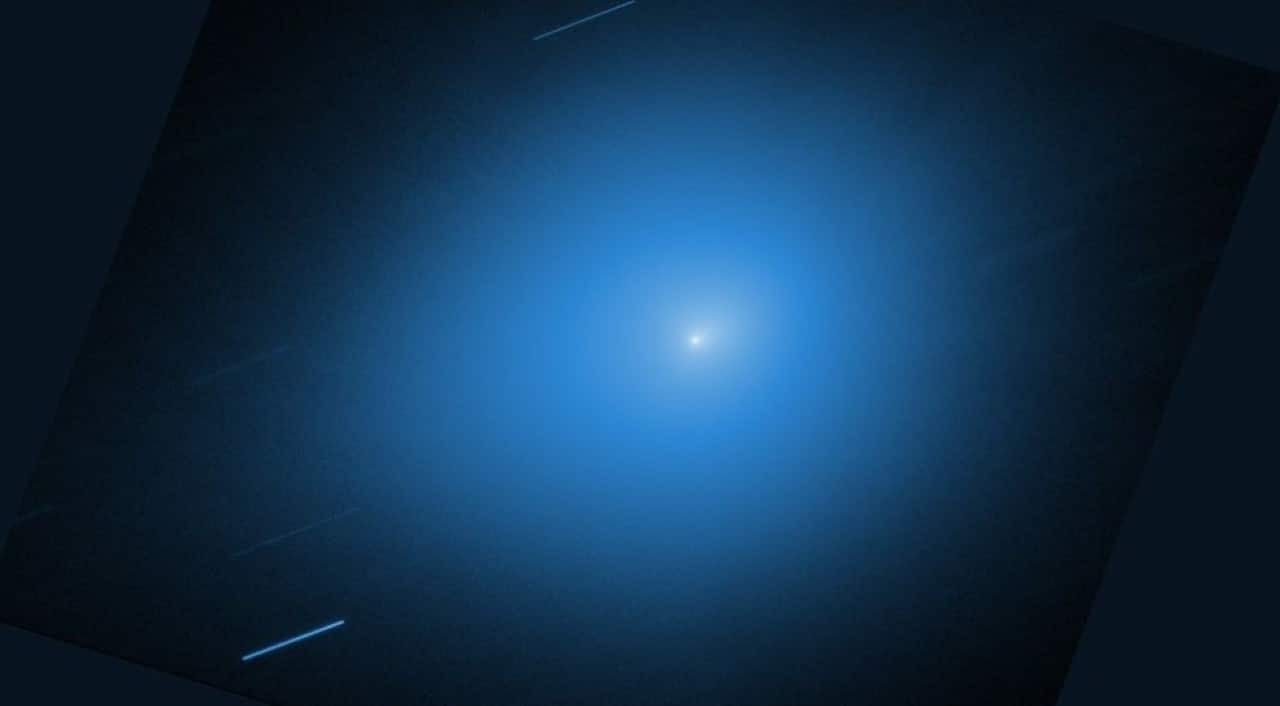
Astronomers explain that solar heating alters the release of gases, favoring molecules such as C2 that emit green light under ultraviolet radiation. Previous Observações recorded transitions to bluish tones, but the current green one stands out for its intensity. Essas variations reveal the comet’s unique composition, possibly formed in a distant star system.
- Change from red to green indicates chemical evolution in the gas plume.
- Diatomic carbon molecules account for the characteristic green emission.
- Brightness increased significantly, making it visible with amateur telescopes.
- Comparisons with previous comets show similarities in micrometer dust.
Detailed scientific observations
Telescopes like Hubble, Gemini and missions like Psyche and Lucy have captured valuable data. Hubble recorded the coma in November, 178 million miles from Terra. Imagens of Gemini South, in Chile, directly compare the pre- and post-perihelion phases.
The interstellar comet 3I/ATLAS revealed an unexpected green glowhttps://t.co/F3vi4bovwa
—Tendencias (@infobaetrends)December 13, 2025
Research indicates non-gravitational acceleration, common in comets due to ejection of material. The coma contains large dust grains and organic compounds similar to type D asteroids. Estudos spectroscopic tests confirm the presence of cyanide and nickel in unusual proportions.
These characteristics help to understand the formation of distant planetary systems. 3I/ATLAS acts as a billion-year time capsule.
Context of interstellar objects
3I/ATLAS follows ‘Oumuamua (2017) and 2I/Borisov (2019) as third confirmed visitors. Sua cometary activity, with coma and tail, differs from rocky ‘Oumuamua. The high speed and trajectory confirm ejection from another stellar system.
Observations coordinated by NASA and ESA maximize data before its final release. Não represents a risk to Terra, moving to safe distances.
Implications for astronomy
Changes like this enrich knowledge about interstellar comets. The chromatic variation reflects outgassing processes influenced by solar proximity. Dados collected support studies on the composition of extrasolar objects.
Astronomers continue monitoring with ground-based and space-based telescopes. The current brightness facilitates observations with modest equipment in dark skies.
Recent activity and brightness
The comet reached magnitude 9 after perihelion, visible with binoculars or small telescopes. Sua activity increased with production of volatile gases. Recent Imagens show short tail and diffuse coma.
These evolutions confirm typical cometary behavior, despite the external origin. Comparações with Borisov highlight similarities in initial reddish color.
- Extra acceleration due to mass ejection detected in orbital analyses.
- Composition includes exotic ices possibly preserved from interstellar space.
- X-ray and ultraviolet observations complement visible images.
- Potential for detection of larger plumes in the coming months.
Monitoring of 3I/ATLAS continues intensively as it traverses the inner Sistema Solar. Suas unique features continue to provide insights into the universe beyond solar boundaries.



