
Interstellar comet 3I/ATLAS displays an intense green glow as it approaches the sun, surprising astronomers


Interstellar comet 3I/ATLAS, the third object recognized from outside our stellar system to enter our cosmic neighborhood, has revealed a dramatic change in its color, showing a vibrant greenish glow in new observations. Esta’s remarkable transformation occurred after the object had completed its closest pass to Sol, an event that visibly altered its composition and appearance. The USA’s Laboratório Nacional of Pesquisa in Astronomia Óptica and Infravermelha of Fundação Nacional of
The observations were made recently, after the comet emerged from behind Sol, and show 3I/ATLAS on its way out of Sistema Solar, now visible near Zaniah, a triple star system in the constellation of Virgem. The comet joins ‘Oumuamua (2017) and 2I/Borisov (2019) in the select group of objects that came from outside and crossed our system, providing a rare study opportunity for the scientific community. Este reappearance with new coloration raises important questions about the physicochemical processes activated by heat and solar radiation.
Brightness of Visão Cósmica
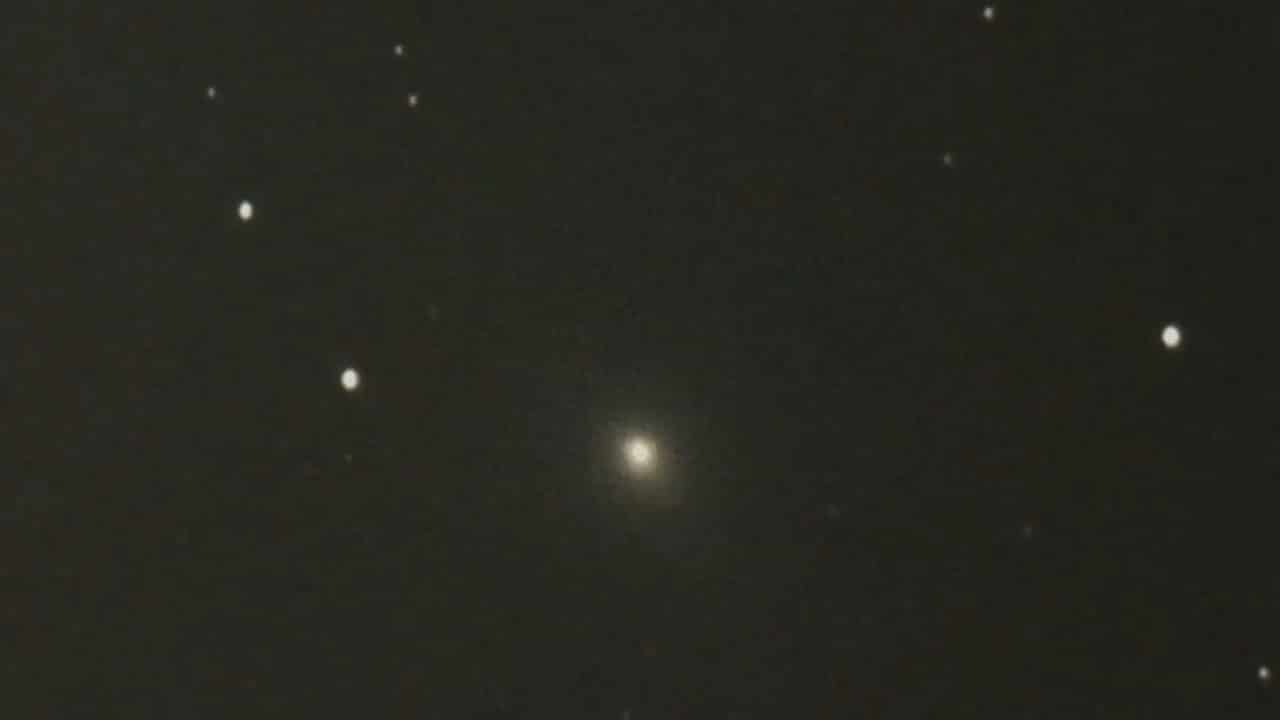
New images of comet 3I/ATLAS revealed a faint green color, in contrast to the reddish tone that predominated in photographs taken before its closest solar approach. Essa variation in light is a direct indicator of the chemical reactions that occur in the comet’s coma, the atmosphere of gas and dust that surrounds its solid core. The intriguing phenomenon is directly linked to the intense radiation and heat that the comet absorbed as it approached Sol.
Expert scientists explain that the greenish glow results from the emission of light by gases that quickly evaporate from the comet’s surface as it heats up. One of the chemical components identified in this process is diatomic carbon ($text{C}_2$), a highly reactive molecule formed by two carbon atoms. Essa specific molecule emits light at wavelengths that the human eye and instruments detect as green, a common but always spectacular phenomenon in comets. Detailed observation of these gases is vital for mapping the original composition of objects formed in other stellar systems.
To Trajetória of Saída of Visitante
The current trajectory of 3I/ATLAS takes it outside Sistema Solar, following a hyperbolic curve that confirms its interstellar origin, distinct from the elliptical orbits of native comets. The latest information shows that the comet’s journey is in full swing, with researchers closely monitoring its behavior as it moves away from the sun’s gravitational and thermal influence. Esse distancing from Sol represents a crucial phase to understand its stability and how its interior will react to gradual cooling.
Scientists highlight that uncertainty hovers over how the comet will behave as accumulated solar heat penetrates the innermost layers of its icy core and it begins its cooling phase. Este late process sometimes triggers unexpected reactions, such as the activation of sublimation of new chemical compounds that have not yet boiled or even the feared explosive fragmentation of the comet. Continuous monitoring by high-precision telescopes is essential to capture any of these events.
Details of Composição Química
Color is one of the main indicators of the chemical composition of comets, and the predominance of green in 3I/ATLAS highlights the abundant presence of $text{C}_2$ in its diffuse atmosphere. Spectral analysis of the emitted light is the fundamental tool used by astronomers to identify these volatile elements, which are released as the comet’s ice and dust heats up. Investigating these components is crucial because they represent material untouched since the formation of the comet’s home star system.
The identification of diatomic carbon is a significant finding, as this molecule is extremely unstable and only persists in vacuum conditions, being quickly destroyed by solar radiation or chemical reactions in the Terra. Its detection in an interstellar comet like 3I/ATLAS provides a glimpse into the chemical environments that prevail outside our stellar neighborhood. The observations continue to be analyzed to identify other elements and compounds that may be contributing to the comet’s color spectrum, helping to draw a complete chemical profile.
Science Compartilhada and Acesso Público
The detailed record of comet 3I/ATLAS was made possible thanks to a public dissemination initiative coordinated by NOIRLab, in partnership with the Shadow the Scientists project. Essa collaboration aims to connect the general public with the work of cutting-edge science, enabling citizens to actively participate in authentic scientific experiments, such as astronomical observations conducted by world-class telescopes. Community engagement is a growing trend that democratizes access to cutting-edge knowledge and research.
- The scientific program was led by researcher Bryce Bolin, who guided the use of cutting-edge equipment to capture the comet’s reentry in high resolution.
- The Shadow the Scientists initiative seeks to promote transparency and participation, encouraging the next generation of researchers.
- The use of the Gemini North telescope, known for its observation capabilities at multiple wavelengths, ensured accuracy in detecting the color change.
The program not only produced valuable scientific data, but also served as a powerful educational tool, exposing students and enthusiasts to real-world observations. The opportunity to track changes in an interstellar object in real time is rare and contributes immensely to global science education. The NOIRLab team continues to process the data and prepare detailed publications on the implications of the comet’s colors and activity on its receding journey.
Importance of Cometas Interestelares
Studying comets like 3I/ATLAS offers a unique window into understanding the formation of other star systems, as they carry material that has not been processed by our own star. By analyzing their composition and behavior, astronomers can infer the conditions and building blocks that existed in their source systems. The rarity of these objects makes each observation extremely valuable to contemporary astrophysics, driving the development of new tracking and analysis techniques.
The observed difference in behavior and composition between the interstellar objects already detected — ‘Oumuamua (which looked more like an asteroid) and 2I/Borisov (which behaved like a classic comet) — reinforces the diversity of celestial bodies that orbit other stars. Comet 3I/ATLAS adds another crucial data point to this set, with its greenish glow providing a distinct chemical signature that will be compared to data from the other two visitors. Esse type of research has direct implications for the theory of planetary formation and the distribution of chemical elements throughout the galaxy.



