
Interstellar comet 3I/ATLAS emits X-rays in a 400,000 km cloud detected by JAXA’s XRISM mission

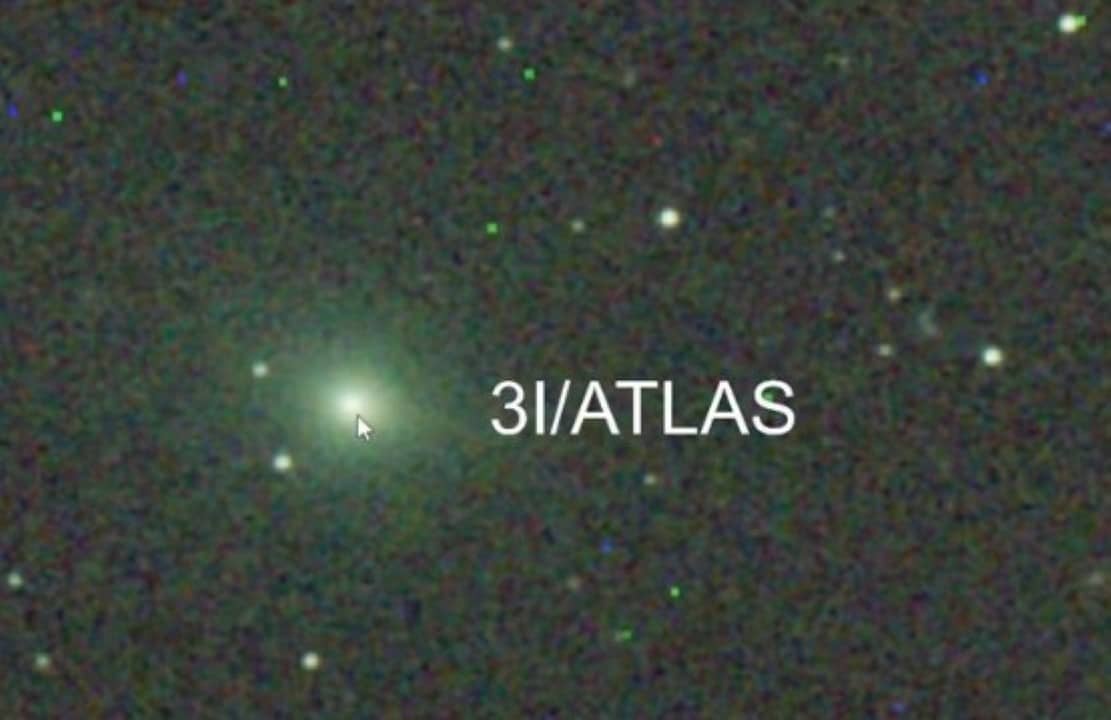
Japanese mission scientistsXRISMidentified emission ofx-rayson the interstellar comet3I/ATLAS, the third confirmed object originating from outside of Sistema Solar. The observations took place between November 26 and 28, 2025, with an effective exposure of 17 hours, revealing a faint glow that extends for around 400 thousand kilometers around the nucleus.
This detection marks the first time that an interstellar object has emitted X-rays. Preliminary analysis indicates that the phenomenon results from the interaction between gases released by the comet and the solar wind.
Comet 3I/ATLAS, discovered in July 2025 by the ATLAS telescope on Chile, follows a hyperbolic trajectory with high speed. Ele passed perihelion on October 29, 2025 and approaches Terra on December 19, at a safe distance of approximately 270 million kilometers.
- XRISM’s Xtend instrument captured the X-ray halo equivalent to 5 arcminutes.
- This extension corresponds to a diffuse cloud of gas surrounding the comet’s coma.
- The emission differs from galactic or terrestrial atmospheric backgrounds.

X-ray emission mechanism
Comets emit X-rays when the solar wind, made up of charged particles, interacts with the cloud of neutral gas that surrounds the nucleus. Esse process, known as charge exchange, occurs as the Sol heats the icy surface, vaporizing materials and forming the coma.
In the case of 3I/ATLAS, the X-rays are probably associated with carbon, nitrogen and oxygen ions. Essa interaction provides data on the comet’s chemical composition and its response to the solar environment.
The detection reinforces that interstellar comets can exhibit behavior similar to that of Sistema Solar. However, nuances in composition indicate origins in distant star systems.
XRISM mission observations
Agência of Exploração Aeroespacial of Japão (JAXA), in partnership with NASA and ESA, conducted opportunity observations with the XRISM satellite. The Xtend instrument, designed for soft X-ray imaging, repositioned itself 14 times to keep the comet in the center of the field of view.
Initial data released on December 3, 2025 alerted global observatories for follow-up. Análises further refine the processing to confirm the cometic origin of the emission.
The mission prioritizes dynamic targets like this highly active comet. The wide field of view of Xtend allowed the extent of the gas cloud to be recorded.
Comparison with previous interstellar objects
The two previous interstellar objects, 1I/’Oumuamua (2017) and 2I/Borisov (2019), did not exhibit detectable X-ray emission. ‘Oumuamua showed little cometic activity, while Borisov showed coma but no sign on X-rays.
3I/ATLAS stands out for its larger size, intense activity and high speed. Sua The extensive coma facilitated strong interaction with the solar wind, generating the observed halo.
This difference makes it possible to compare formations in protoplanetary disks from other stellar systems.
Trajectory and characteristics of 3I/ATLAS
The comet entered Sistema Solar with a relative speed of about 58 km/s. Sua hyperbolic orbit, with extreme eccentricity, confirms external origin.
After perihelion at 1.4 astronomical units from Sol, the object emerges visible again. Complementary Observações include optical images and images at other wavelengths.
- Maximum speed reached close to Sol.
- Minimum distance from Terra in December 2025.
- No risk of impact.
Implications for future studies
The X-ray emission serves as a probe of the solar wind in distant regions, about 2 astronomical units away. Dados from XRISM contribute to a comparative catalog of interstellar comets, rare each decade.
Multiwavelength observations, including telescopes such as James Webb, complement the findings. Continued analysis reveals more about interactions between interstellar material and the heliospheric medium.
This detection expands the use of missions like XRISM to transient objects.
XRISM mission context
Launched in 2023, XRISM is the result of international collaboration between JAXA, NASA and ESA. The satellite focuses on high-resolution X-ray imaging and spectroscopy.
Instruments like Xtend cover broad regions, ideal for extensive phenomena like cometic halos. Monitoramento with MAXI in Estação Espacial Internacional contextualizes the trajectory.
The mission prioritizes unique opportunities, such as the passage of 3I/ATLAS.
The detection of X-rays in 3I/ATLAS represents an advance in the understanding of interstellar visitors. Observações continue as long as the comet remains accessible, enriching knowledge about extrasolar compositions.



