
Approach of interstellar comet 3I/ATLAS on December 19, 2025 intrigues astronomers

The interstellar comet 3I/ATLAS, the third confirmed object of its category, will make its closest approach to Terra on December 19, 2025. Este astronomical event represents a unique opportunity for the scientific community to study a celestial body originating outside our solar system.
The passage will take place at a safe distance of approximately 270 million kilometers, equivalent to 1.8 astronomical units, eliminating any risk of collision or threat to the planet. The object was discovered in July 2025 by the ATLAS system (Asteroid Terrestrial-impact Last Alert System), located at Chile.

Since its identification, 3I/ATLAS has been observed following a hyperbolic trajectory, a characteristic that confirms its extrasolar origin. Após crosses the inner solar system, it is expected to return to interstellar space, offering precious data about formation conditions elsewhere in the galaxy.
Discovery and classification of 3I/ATLAS
The ATLAS system initially identified the object on July 1, 2025, classifying it as a celestial body of weak magnitude. Subsequent Observações, however, revealed the presence of a diffuse coma and an elongation, indicating the formation of a tail, typical characteristics of a comet.
Preliminary research, which goes back to data from June 2025, already showed the comet crossing dense star fields. Equipes of international astronomers, using telescopes at Chile, Arizona and Havaí, analyzed this data to confirm the nature and trajectory of 3I/ATLAS, which now joins Oumuamua and
The hyperbolic journey through space
Comet 3I/ATLAS moves in a hyperbolic orbit with an excess speed of about 58 kilometers per second relative to Sol. Essa high speed is a clear indication that the object is not gravitationally bound to our solar system, just crossing it on its galactic journey.
Its speed increased considerably as it passed perihelion, the closest point to Sol, in October 2025, reaching approximately 246,000 kilometers per hour. Após approaches Terra in December, the comet will head towards a rendezvous with Júpiter in 2026.
The gravity of the gas giant Júpiter will exert a slight change in its trajectory, but not enough to hold it back. The comet will then be definitively ejected into interstellar space, where it came from, continuing its cosmic journey.
Recent observations and unique features
Space telescopes captured images of the comet in November 2025, when it was approximately 286 million kilometers from Terra. The records show a notable increase in brightness and the development of a reddish coma, suggesting the presence of dust and other materials in its composition.
Missions such as Juice, from Agência Espacial Europeia (ESA), used their instruments to map the composition of the comet during its period of greatest activity. Telescópio Espacial Hubble, in turn, provided detailed images that reveal a faint tail pointing away from Sol, a common phenomenon when the comet approaches the star.
Brightness and albedo analyzes (capacity to reflect light) indicate that the 3I/ATLAS core has an estimated diameter of between 440 meters and 5.6 kilometers. Essas characteristics distinguish it from comets typical of our solar system, which generally have more homogeneous compositions and more predictable brightness patterns. The absence of certain specific compounds, common in internal comets, reinforces the idea of their distant origin.
Spectroscopic analysis and unique composition
Spectroscopic analysis of 3I/ATLAS reveals an abundance of water ice in its composition, a characteristic that differentiates it from many comets in the inner solar system. Além Additionally, significant amounts of carbon dioxide (CO2) were detected in its coma, suggesting a distinct formation environment.
The comet has maintained stable activity since its discovery, without large explosions or sudden variations in brightness, which makes it easier to predict its evolution. Estudos indicate that 3I/ATLAS may be billions of years old, therefore older than our own solar system. Sua composition reflects formation conditions in another stellar system, possibly in a dense region of Via Láctea. Essa stability and unique composition offer valuable insights into the diversity of materials present in interstellar space.
Visibility for amateur astronomers
Comet 3I/ATLAS will reach a magnitude that will allow it to be observed by amateur astronomers equipped with telescopes in dark skies. The ideal period for observation extends from dawn to spring 2026, offering several weeks to follow its trajectory. Aplicativos and NASA simulators can assist in accurately locating the object in the night sky.
For an optimized experience, it is recommended to use binoculars or a telescope with an aperture of at least 20 centimeters. Choosing a location with low light pollution and an unobstructed horizon is crucial. Consultar daily updated sky maps will guarantee the latest coordinates. The comet will appear as a fuzzy blur, with a possible tail visible in longer exposures.
Instruments and scientific collaborations
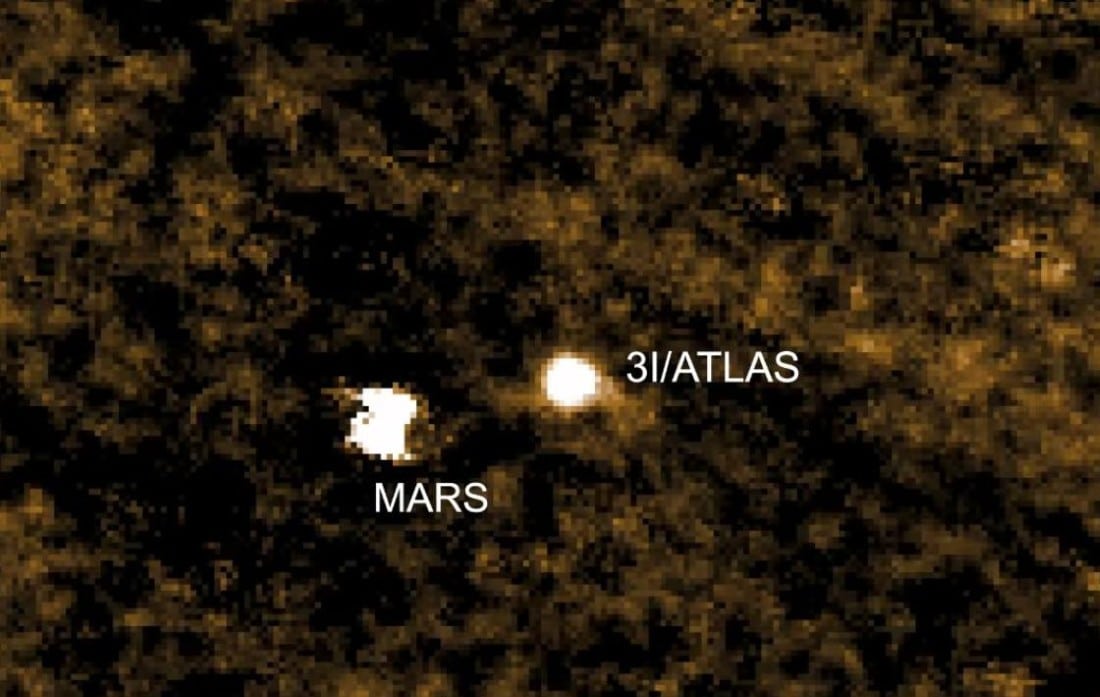
Several ground-based and space-based telescopes contributed to the continuous monitoring of 3I/ATLAS. Telescópio Espacial Hubble, in particular, provided detailed images in July and November 2025, essential for understanding its morphological characteristics. Sondas in orbit around Marte also recorded the comet’s close passage in October.
Collaboration between NASA, ESA and Chilean observatories accelerated the processing and analysis of the collected data. Observações from the TESS satellite (Transiting Exoplanet Survey Satellite) indicated signs of cometary activity as early as May 2025, allowing early monitoring of the object.
Unprecedented research opportunities
3I/ATLAS displays a reddish coma that has developed over several months, a fascinating sight for scientists. The absence of non-gravitational acceleration, which was observed in Oumuamua, distinguishes 3I/ATLAS and allows a more focused study of its purely gravitational interaction and with the solar wind. The presence of an initial tail that moves away from Sol confirms the classical interaction with the solar wind, providing important data for modeling the behavior of interstellar comets.
Studies of its trajectory and origin speed contribute significantly to the knowledge of galactic dynamics. International cooperation has been fundamental for the processing of images and spectra, resulting in specialized publications that enrich the understanding of celestial phenomena.
Continued activity after perihelion
After its closest pass to Sol in October, the comet maintained a stable luminosity. The images captured show an expanded coma and an elongated tail, highlighting the continuous sublimation of surface ices. Essa persistent activity, without abrupt eruptions, facilitates the prediction of its evolution and the study of its volatile components.
The rich water composition of 3I/ATLAS suggests the preservation of primitive materials, possibly from another planetary system. Este scenario offers a window into the conditions for the formation of planets and smaller bodies in cosmic environments different from our own.



