
Intense green halo marks interstellar comet 3I/ATLAS as it approaches Earth


A rare celestial phenomenon is captivating astronomers and enthusiasts: the interstellar comet 3I/ATLAS has revealed a surprising change in the color of its gaseous halo. Após its closest passage to Sol, known as perihelion, the object now displays a predominant green hue in its coma, the cloud of gas and dust that surrounds it.
This chromatic change is attributed to the emission of light by diatomic carbon (C2) molecules, which are released and excited as the comet heats up under solar radiation. The event occurs at a crucial time, as 3I/ATLAS prepares for its closest approach to Terra, scheduled for December 19, 2025, maintaining a safe distance of approximately 269 million kilometers.
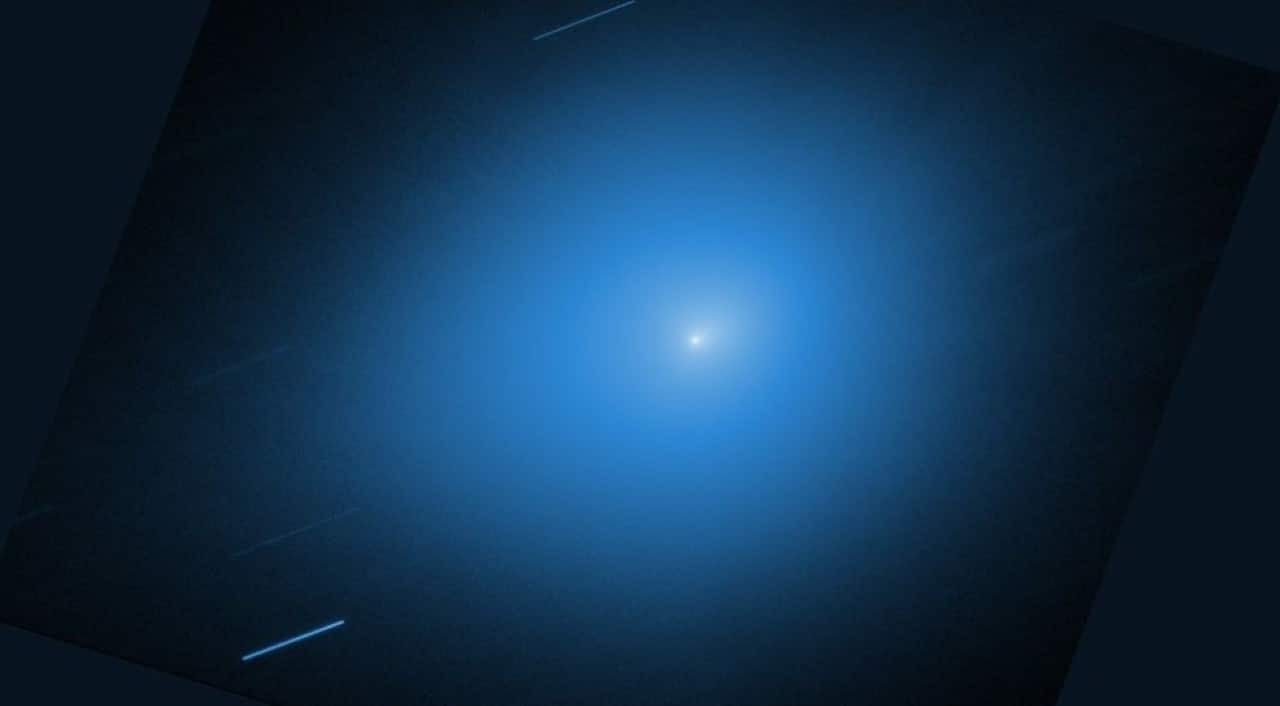
The detailed observations, carried out by several telescopes, provide valuable data about the chemical composition and physical processes that govern these visitors from outside our star system. The intense green coloration serves as a direct indicator of variations in the material ejected from the comet’s nucleus, offering clues about its origin and evolution.
Comet trajectory and identification
Comet 3I/ATLAS was first detected on July 1, 2025, using the ATLAS telescope system, located at Chile. Sua trajectory, classified as hyperbolic, confirmed its interstellar origin, revealing an excessive speed of about 58 kilometers per second in relation to Sol. Diferente of the native Sistema Solar comets, it does not follow a closed orbit around our star and will continue its journey through deep space after its passage.
This peculiar object reached its perihelion on October 29, 2025, when it showed its greatest brightness and activity. Antes from approaching Terra, 3I/ATLAS had already had close encounters with other planets, passing through Marte in October and Vênus in November. Essas approaches have allowed a series of detailed observations by space missions and ground-based observatories, collecting crucial data about their nature.
The evolution of halo coloration
Images captured before 3I/ATLAS perihelion showed a predominantly reddish halo, a color generally associated with the presence of dust and irradiated organic compounds. However, after its closest approach to Sol, the color of the coma changed drastically, displaying an intense green tone, especially in photographs composed with filters that enhance this spectrum band.
[[_1]
Astronomers explain that intense solar heating causes the sublimation of ice in the comet’s nucleus, releasing gases that include diatomic carbon molecules (C2). Essas molecules, when exposed to ultraviolet radiation from Sol, emit light in the green range, creating the visual spectacle observed. Although transitions to bluish tones have been recorded in other comets, the intensity of the current green in 3I/ATLAS is remarkable and suggests a unique composition, possibly shaped by a distant star system.
Scientific analyzes and discoveries
Cutting-edge telescopes such as the Hubble and Gemini, along with data from space missions such as the Psyche and Lucy, have been instrumental in capturing information about 3I/ATLAS. The Hubble space telescope, for example, recorded the comet’s coma in November, when it was about 178 million miles from Terra, providing high-resolution images.
Research indicates that the comet exhibits non-gravitational acceleration, a phenomenon common in comets and attributed to the ejection of volatile material that acts as a propellant. The 3I/ATLAS coma contains sizable dust grains and organic compounds that resemble those found in D-type asteroids, suggesting a specific origin or formation.
Additional spectroscopic studies confirmed the presence of cyanide and nickel in proportions that appear unusual compared to comets originating from our Sistema Solar. Essa atypical chemical composition is of great scientific interest, as it can offer new insights into the conditions for the formation of extrasolar planetary systems.
3I/ATLAS, therefore, acts as a time capsule, bringing information from billions of years ago and from distant regions of the universe, allowing scientists to uncover secrets of astrochemistry and cosmic evolution.
The 3I/ATLAS in the interstellar scenario
Comet 3I/ATLAS cements its position as the third confirmed interstellar object to visit our Sistema Solar, following in the footsteps of ‘Oumuamua, detected in 2017, and 2I/Borisov, observed in 2019. significant gases. 3I/ATLAS’s high speed and hyperbolic trajectory are irrefutable evidence that it was ejected from another star system, traveling vast distances in interstellar space before its arrival. Observações coordinated by agencies such as NASA and ESA are maximizing data collection before the comet continues its journey out of Sistema Solar. It is important to highlight that 3I/ATLAS does not pose any risk to Terra, as its passage will occur at a safe and predictable distance.
Monitoring and visibility
The comet reached a magnitude of 9 after passing through perihelion, which makes it visible with the aid of binoculars or small telescopes in dark sky conditions. Sua activity has increased considerably, driven by the production of volatile gases that fuel the formation of its coma and tail.
[[_0]
These evolutions confirm very typical cometary behavior, even considering its origin external to our system. Comparações with 2I/Borisov, another interstellar comet, highlight similarities in the initial reddish color, which suggests similar chemical and physical processes in comets of different stellar origins.
Composition and activity details
3I/ATLAS orbital analyzes detected an extra acceleration, which is attributed to mass ejection, a mechanism by which comets propel themselves into space. The comet’s composition includes exotic ices, which were likely preserved during its long journey through interstellar space.
X-ray and ultraviolet observations complement the visible images, providing a more complete picture of the comet’s structure and activity. Há has significant potential for detecting larger plumes of material in the coming months as the comet continues its interaction with solar radiation.
Monitoring of 3I/ATLAS continues intensively as it traverses the inner Sistema Solar. Suas unique features continue to provide valuable and unprecedented insights into the universe beyond solar boundaries, enriching our understanding of the formation and diversity of celestial objects.



