
Interstellar comet 3I/ATLAS reaches closest proximity to Earth on December 19 at 270 million km


The interstellar comet3I/ATLAS, the third confirmed object coming from outside Sistema Solar, reaches its closest approach to Terra on December 19, 2025. Essa minimum distance is around 270 million kilometers, or 1.8 astronomical units, without posing any risk to the planet.
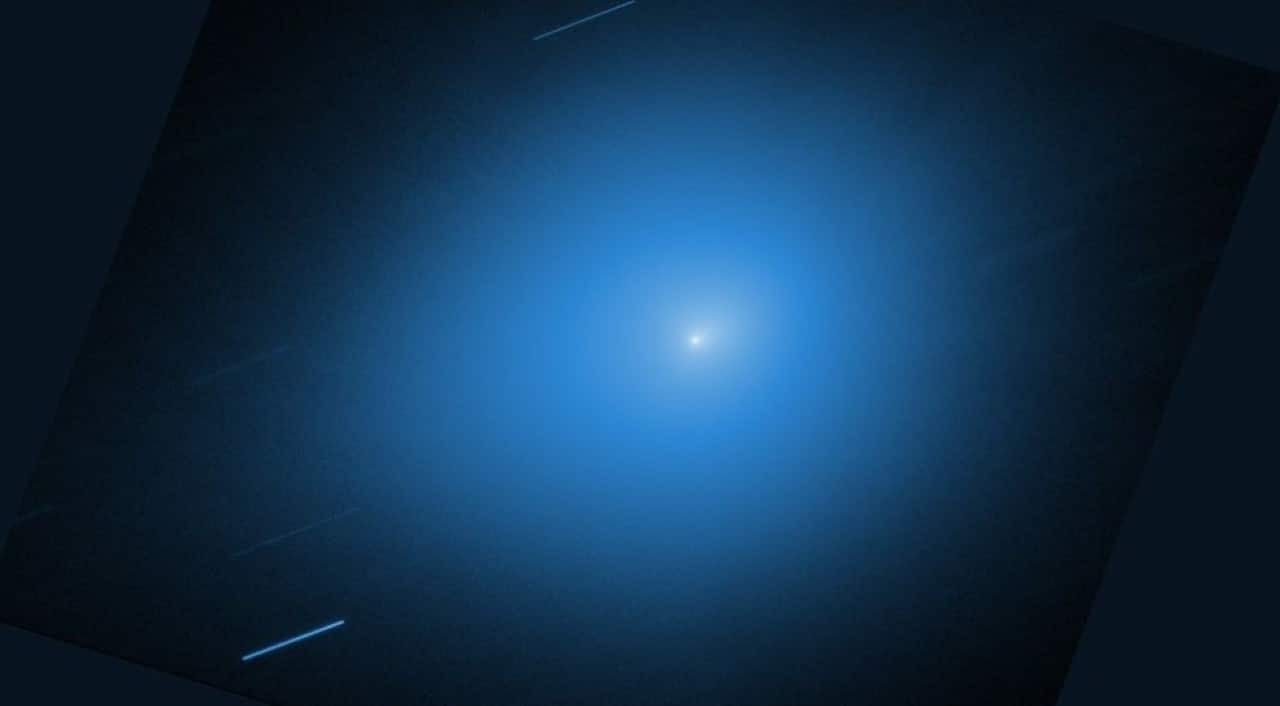
Discovered on July 1, 2025 by the ATLAS telescope system at Chile, the celestial body follows a hyperbolic trajectory that confirms its extrasolar origin. Observações’s recent Telescópio Espacial Hubble, taken on November 30, captured details of the comet’s coma and activity when it was 286 million kilometers from Terra.
Astronomers around the world are intensely monitoring this passage, which offers a unique opportunity to study material formed in another star system.
- The comet passed perihelion, the closest point to Sol, on October 29, 2025, at 1.4 AU.
- Its high speed, exceeding 200,000 km/h in some sections, reflects its interstellar nature.
- After approaching Earth, the object heads towards deep space, without returning.
Discovery and trajectory of 3I/ATLAS
The ATLAS system, funded by NASA for asteroid monitoring, detected the3I/ATLASinitially as a fast-moving object. Subsequent Observações revealed a coma and tail, classifying it as an active comet.
Its hyperbolic orbit, with an eccentricity greater than 6, indicates that the comet is not gravitationally bound to Sol. Ele joined Sistema Solar from the direction of the constellation Sagitário, traveling billions of years ago through the interstellar medium.
The core is estimated to have a diameter between 440 meters and 5.6 kilometers. Dados from Hubble and other missions helped refine these measurements over the months.
Composition revealed by observations
Observations with Telescópio Espacial James Webb, carried out shortly after its discovery, indicated enrichment in carbon dioxide. Isso suggests formation in more distant regions of the original star system, compared to comets from Sistema Solar.
O 3I/ATLASIt has a greater amount of carbon monoxide and carbon dioxide compared to water. Essas characteristics differ from local comets, which generally have water as their main ice.
Recent images show a greenish coma and distinct tails of dust and plasma. Missões and ESA’s Juice captured data in November, revealing intense post-perihelion activity.
Some observations detected X-ray emission, a phenomenon caused by the interaction of the solar wind with the coma. Esse record represents the first confirmed interstellar object.
Opportunities for Earth Observation
The December 19th approach coincides with a new moon, favoring nighttime visibility without lunar contamination. The comet is positioned in the constellation Leão, visible in the pre-dawn sky with small amateur telescopes.
Its expected magnitude allows detection with powerful binoculars or moderate aperture telescopes. Aplicativos sky map makes it easy to pinpoint your location throughout the month.
Professionals use ground-based and space-based instruments to collect spectra and detailed images. Essa window observes features that become more evident as the distance decreases.
Comparison with previous interstellar objects
O 3I/ATLAShe follows1I/’Oumuamua, discovered in 2017, and2I/Borisov, in 2019, as the third confirmed visitor. Diferencia is characterized by clear cometary activity from greater distances, activating about 6.4 AU from Sol.
‘Oumuamuaexhibited non-gravitational behavior with no visible coma, while Borisov showed a prominent tail with a composition rich in carbon monoxide. THE3I/ATLAScombines traces of both, with enrichment in CO2 and early activity.
These objects provide direct samples of planetary formation in distant systems. Simulações indicate that stellar systems eject large amounts of similar material during planetary migrations.
Contributions from space missions
Several probes captured data from the3I/ATLASduring its passage. The Psyche mission recorded images in September, refining its trajectory when the comet was 53 million kilometers away.
Orbiters on Marte, such as ExoMars TGO and Mars Reconnaissance Orbiter, observed during Martian approach in October. Esses records improved orbital accuracy by a factor of 10.
The Juice probe, heading to Júpiter, used multiple instruments in November to analyze coma and tails. Missões as well as Parker Solar Probe and PUNCH captured solar wind interactions incidentally.
Scientific significance of the passage
The visit of3I/ATLASallows us to contextualize Sistema Solar in the galaxy. Distinct Composições suggest variation in planetary formation processes, with outer regions richer in cold volatiles.
Studies estimate the comet’s age between 3 and 14 billion years, based on its origin in the thick disk of Via Láctea. Essa antiquity offers insight into early conditions of the universe.
Data collected assists models of material ejection by gas giants. Nossa system has likely released similar amounts of interstellar comets in the past.
Observations continue until mid-2026, when the comet becomes very faint. Essa multi-instrumental campaign represents unprecedented coordinated effort for interstellar object.



