
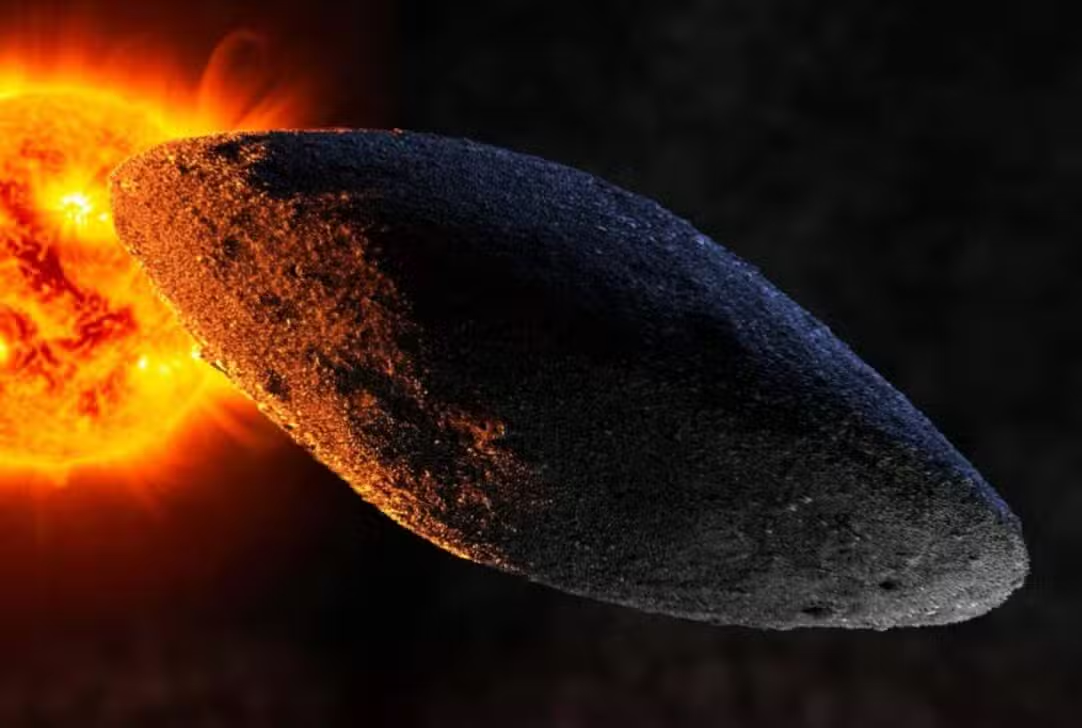
The passage of comet 3I/Atlas through the solar system has captured the attention of the global scientific community, driven by its impressive speed of 57 kilometers per second. Esta remarkable speed, combined with a trajectory confirmed to be hyperbolic, unequivocally establishes that the object is not originally from our star system, but rather a visitor from a distant solar system. The detection and monitoring of this celestial body offers a unique opportunity to study matter originating from other regions of the galaxy, providing valuable insights into the diversity of cosmic composition. Sua route prevents it from being permanently captured by solar gravity, ensuring that it continues its journey through interstellar space after its brief run near Sol.
The discovery of 3I/Atlas marks a significant achievement for astronomy, being only the third interstellar object confirmed to be observed in our cosmic environment. Antes of it, we had the enigmatic Oumuamua and the comet Borisov, but 3I/Atlas surpasses its predecessors in speed.
This exceptional speed provides crucial data for comparative studies on the dynamics of objects that transit between stars, deepening our understanding of the formation and evolution of planetary systems beyond our own.
The cosmic route of comet 3I/Atlas
Celestial bodies like 3I/Atlas begin their trajectories orbiting distant stars before being ejected into the interstellar vacuum. Essas ejections can be the result of complex gravitational interactions or violent stellar events, such as supernova explosions in their home systems.
After millions of years of traveling through the deep cosmos, these cosmic visitors may eventually cross into star systems like ours. The identification of their trajectories, which are not gravitationally linked to our Sol, is essential to confirm their extrasolar nature. Detailed observation of its orbit and speed allows astronomers to trace its ingress and egress path, providing clues about the forces that propelled it out of its home system and across the galaxy.
Each new detection contributes to improving existing models about the spread of planetary material and the frequency of interstellar visitors in our cosmic neighborhood.
Observed acceleration and forces at work
Oumuamua, the first interstellar object detected in 2017, demonstrated an unexpected acceleration as it passed close to Sol. Este phenomenon was later attributed to the emission of trapped water vapor, a natural behavior of comets when heated by stellar radiation.
Solar heat causes the release of volatile gases from the surface and interior of the object, generating a small impulse that subtly alters its trajectory. Outras hypotheses for this acceleration did not find concrete confirmation through observations or models, consolidating the explanation for degassing.
The hyperbolic path of no return
A hyperbolic trajectory is characterized by a velocity that exceeds the local escape velocity at any point along its path. Isso means that upon entering the solar system, 3I/Atlas is deflected by solar gravity, but is not slowed down enough to be captured in an elliptical or parabolic orbit.
The gravitational influence of Sol changes the comet’s direction, but not its kinetic energy to the point of trapping it. Observatórios around the world constantly track its route, recording every movement on its return to deep space.
Precise calculations have already been performed to predict its closest point to Sol. Embora the interaction lasts just a few weeks, computer models simulate the “gravitational slingshot” effect that propels the comet away, back into the vast unknown.
Distinctions between solar comets and stellar visitors
Comets that are born and orbit within our solar system reach their maximum speed at perihelion, the closest point to Sol, often reaching tens of kilometers per second. However, these objects are gravitationally bound to the Sol, returning periodically or following closed orbits. The main distinction lies in their origin and orbital energy, as objects such as 3I/Atlas maintain velocities inherited from the galactic environment from which they originated, which exceed the escape velocity of the solar system. Esta fundamental difference in orbital dynamics serves as the main indicator of its external provenance, complemented by spectroscopic analyzes that can reveal unique chemical compositions distinct from those found in our native comets. Understanding these differences is vital to correctly classifying these celestial travelers.
Chemical composition: clues from a distant birth
Preliminary studies and spectroscopic comparisons indicate that 3I/Atlas has common chemical elements, but in proportions that differ from those found in comets originating in our solar system. Esta analysis serves as one of the pillars to confirm its classification as an interstellar object. The unique chemical signature could provide crucial clues about formation conditions in another star system, offering a window into the chemical diversity of the universe.
Continued research into its tail and coma may reveal more details about these components, including the presence of rare elements or complex molecules that are not typical in comets formed within our system. The detection of specific isotopes or unique organic compounds, for example, would reinforce the thesis of their extrasolar origin, opening new paths for astrophysics and the understanding of intergalactic chemistry.
Challenges in detecting cosmic travelers
The discovery of interstellar objects presents a serious challenge due to their unpredictable nature and the high speeds they reach. Eles emerge from unexpected directions and remain visible for a relatively short period of time, requiring advanced sky scanning systems and global cooperation between observatories to be identified in time.
The future of interstellar object astronomy
The ability to identify these cosmic travelers has improved significantly with the advancement of telescopic technologies and data processing algorithms. Telescópios like Pan-STARRS, which played a vital role in the discovery of Oumuamua, are designed to monitor large areas of the sky for moving objects.
Each new discovery, like that of 3I/Atlas, offers scientists a unique opportunity to investigate the composition and conditions of other star systems without the need to send expensive and complex space missions. It is, in a way, a free “taste” of the outside universe.
Understanding the frequency and characteristics of these objects could provide crucial information about planetary formation and evolution elsewhere in the galaxy. The presence of different types of material can indicate variations in the birth conditions of stars and planets, influencing our perception of cosmic diversity.
It is hoped that as new generations of telescopes emerge in the coming years, more interstellar objects will be discovered, expanding our knowledge of the vast cosmic tapestry and revealing secrets of distant worlds.