
Images reveal unusual behavior of comet 3I/ATLAS as it approaches Earth

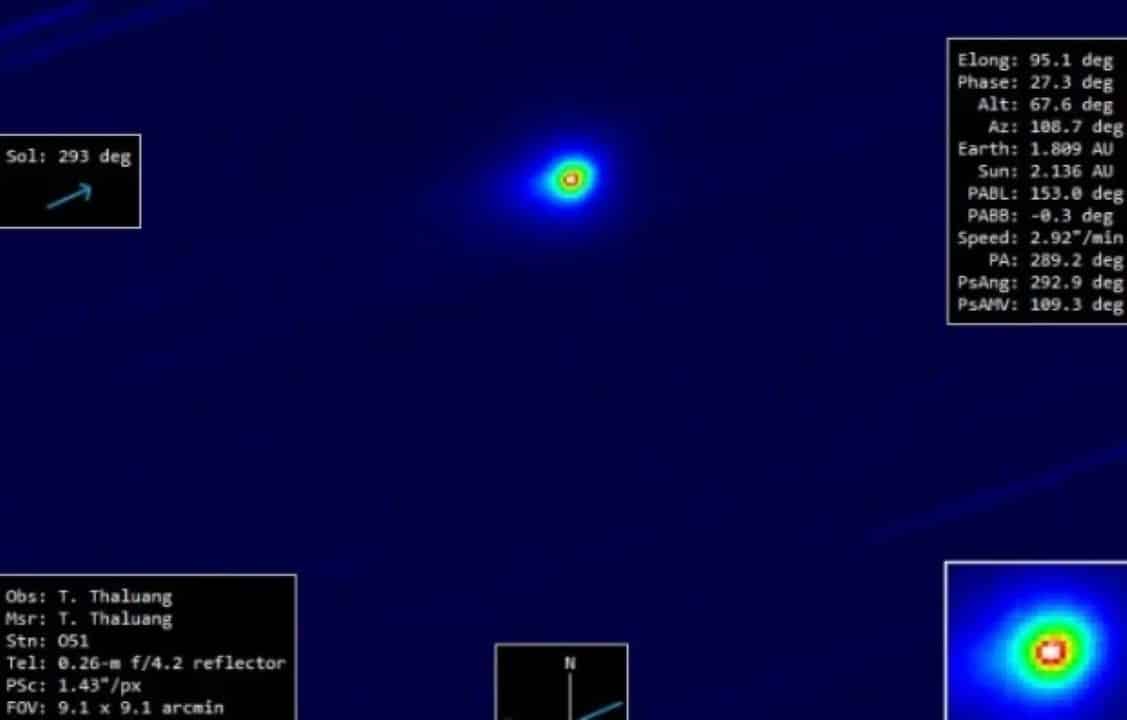
The interstellar comet3I/ATLAS, the third confirmed object from another star system, continues to show unusual characteristics in recent observations. An image captured on December 13, 2025 by a telescope at Tailândia shows a compact core and an emission structure directed at Sol, known as the anti-tail. Esse feature persists even after perihelion, which occurred in October, and defies traditional expectations of cometary behavior.
Astronomers have been recording these anomalies since July, when the object was discovered by the ATLAS system. The comet will reach its closest approach to Terra on December 19, at around 270 million kilometers, without posing a risk.
Data from Telescópio Espacial Hubble and ground-based observatories confirm the consistent presence of the anti-tail from the initial approach to the current withdrawal phase.
Recent image highlights anomalies
A photograph taken on December 13 by Teerasak Thaluang, with a 0.26 meter telescope at Rayong, at Tailândia, results from the composition of 271 individual exposures, totaling more than two hours of observation.
The false color image reveals a punctual and compact nucleus, with concentrated brightness and little dust release.
A sunward structure extends from the core, characterized as persistent anti-tail.
This configuration differs from typical comets, which release material in all directions as they heat up near Sol.
3I/ATLAS surprises again…
— UNCLE OVNI CHILE (@OvniChile1)November 30, 2025
From Rayong, Tailandia, the astronomer Teerasak Thaluang captured this impressive image of the interstellar visitor 3I/ATLAS this November 29, 2025.
A star-studded journey… we follow every movement.
Credits: Teerasak Thaluangpic.twitter.com/eTWYd4eHMo
Expected behavior in comets
Common comets sublimate ice as they approach Sol, forming a wide and diffuse coma.
Solar radiation pressure and solar wind push gas and dust away, creating tails that always point in the opposite direction to Sol.
Anti-tails in Sistema Solar comets occur rarely, as temporary optical effects when Terra crosses the orbital plane.
In the case of 3I/ATLAS, the sunward feature appears in images since July 2025, at varying distances, and remains visible after perihelion.
Proposed scientific explanations
Astrophysicist Avi Loeb has published articles analyzing the phenomenon.
One hypothesis suggests the release of tiny fragments of ice on the side facing Sol, which evaporate quickly without being pushed back.
Another associates the anti-tail with the non-gravitational acceleration of the object, causing released material to fall behind and align itself sunward.
- Observations of Hubble in July and November confirm persistence.
- Thousands of terrestrial images reinforce consistency.
- Telescopes like Gemini and XMM-Newton record similar activity.
These explanations remain under investigation and do not require extraordinary hypotheses.
Observations from Hubble
Telescópio Espacial Hubble captured images on July 21, 2025, when the comet was about three astronomical units from Sol, showing the initial anti-tail.
A second observation on November 30, after perihelion, confirmed the feature.
These records, combined with terrestrial data, indicate that the emission is not the result of a perspective illusion.
The object exhibits non-gravitational acceleration moving away from Sol, a measurement consistent across trajectories.
Approach to Terra
On December 14, 2025, 3I/ATLAS was approximately 270 million kilometers from Terra.
The light takes about 15 minutes to arrive, delaying the observed images.
The minimum approach will occur on December 19, at a safe distance of around 269 million kilometers.
Astronomers plan intense observations to resolve questions about composition and dynamics.
The comet follows a hyperbolic trajectory, with an excessive speed of around 58 km/s, confirming an interstellar origin.
General characteristics of the object
3I/ATLAS was discovered in July 2025 by the ATLAS system on Chile.
This is the third confirmed interstellar object, after 1I/’Oumuamua and 2I/Borisov.
It presents coma and cometary activity, with a composition rich in carbon dioxide and other gases.
X-ray and ultraviolet observations by missions such as XMM-Newton and MAVEN reveal a gas halo.
The high speed and extreme eccentricity distinguish it from Sistema Solar comets.
Studies estimate a possible age of billions of years, coming from the thick disk of Via Láctea.
Trajectory and future
The comet passed perihelion on October 29, 2025, at 1.36 astronomical units from Sol.
Now it moves away, heading towards the constellation of Gêmeos.
Will leave Sistema Solar permanently in the coming years.
Observations continue with ground- and space-based telescopes to refine formation models in other star systems.



