
NASA records non-gravitational acceleration on interstellar comet 3I/ATLAS on exit trajectory


Nasa continues intense monitoring of the interstellar comet 3I/ATLAS, the third object confirmed to come from outside Sistema Solar. Recent Dados indicate that the comet presents non-gravitational acceleration after its passage through perihelion in October 2025. Essa acceleration results from the ejection of gases and dust, a common phenomenon in active comets.
The object, discovered in July 2025 by the ATLAS system in Chile, follows a hyperbolic trajectory that will take it back to interstellar space. Observações combined ground- and space-based telescopes, including Hubble and James Webb, confirm cometary activity with visible coma and tail. The current speed exceeds 200 thousand kilometers per hour.
Space agency experts analyze these variations to better understand the composition of bodies originating from other stellar systems. The comet will pass about 270 million kilometers from Terra on December 19, 2025, a safe distance that allows detailed observations.
Discovery and initial trajectory
Comet 3I/ATLAS was identified on July 1, 2025 by telescopes from the ATLAS project, funded by Nasa. Hyperbolic Trajetória immediately confirmed its interstellar origin, unlike comets orbiting Sol.
Initial observations revealed diffuse coma and signs of activity, with material ejected even at greater distances from the Sol. The object approached Marte in October, allowing capture by orbital probes.
Observed cometary activity
3I/ATLAS exhibited a coma and tail from early detection, with composition including carbon dioxide, carbon monoxide and water vapor. Telescópios as well as Hubble recorded teardrop-shaped dust envelope around the nucleus.
Activity increased near perihelion, on October 30, 2025, to 1.4 astronomical units of Sol. Brilho rose significantly, facilitating monitoring by various instruments.
- Detection of water vapor and hydroxyl by ultraviolet observatories.
- Presence of cyanide and atomic nickel in spectroscopic analyses.
- Reddish color indicative of organic dust.
These elements aligned with Sistema Solar comets, but with unique proportions, suggest formation in a distant stellar environment.
Non-gravitational acceleration explained
Tracking data reveals additional acceleration beyond gravitational, attributed to the asymmetric sublimation of ices in the core. Ejeção of gases generates recoil impulse, slightly altering trajectory and speed.
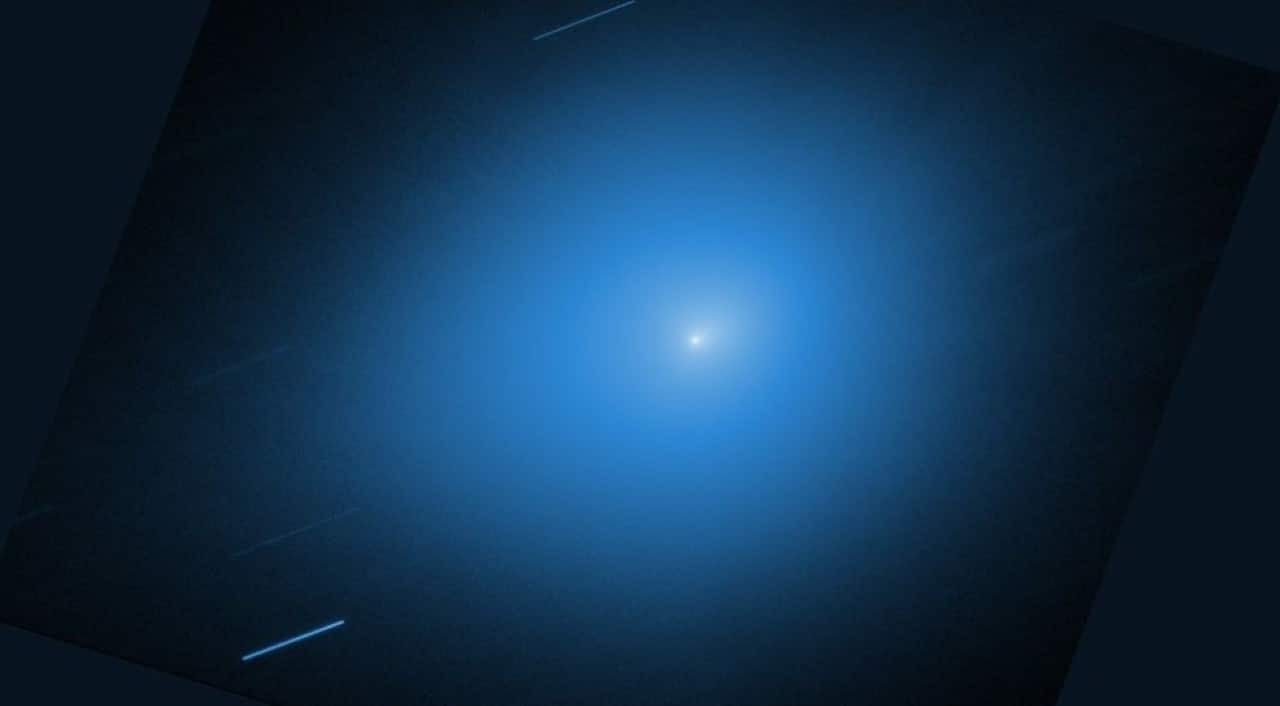
Precise measurements, combining observations from Hubble, Psyche, and Martian orbiters, have quantified this effect. Valores compatible with outgassing models in active comets.
Phenomenon differs from accelerations observed in previous interstellar objects, such as ‘Oumuamua, which did not exhibit visible activity. In the case of 3I/ATLAS, the coma and tail confirm the natural origin of the impulse.
Monitoring for multiple missions
Nasa coordinated an observational campaign involving several space missions. Hubble took images in July, November and December 2025, refining estimates of the core between 440 meters and 5.6 kilometers in diameter.
Missions such as Psyche, Lucy and MAVEN captured the comet from unique angles during its passage. Observatório SOHO and STEREO recorded the object in heliocentric regions.
- Composite images show ionic tail deflected by the solar wind.
- Ultraviolet spectroscopy detected a hydrogen halo.
- Data from rovers and orbiters in Marte complement three-dimensional vision.
This unprecedented collaboration maximizes information about a rare visitor before his final departure.
Composition and scientific implications
Analysis indicates enrichment in volatile elements such as CO2 and CO, suggesting origin in a cold region of an ancient stellar system. Presença of nickel and iron indicates prolonged exposure to cosmic radiation during interstellar travel.
The comet serves as a time capsule, offering clues about planetary formation in other corners of Via Láctea. Comparações with 2I/Borisov reveal similarities and differences in gas proportions.
Studies continue to focus on variations in brightness and possible flares, common in comets heated by Sol. Atividade stable so far facilitates accurate modeling.
Recent Earth Observations
Ground-based telescopes resumed tracking after solar conjunction in October. Imagens of December show an extensive conventional tail, exceeding 50 thousand kilometers by some estimates.
Comet visible in pre-dawn sky with amateur telescopes, positioned in the constellation Leão. Brilho moderate allows follow-up until spring 2026.
International astrometric campaigns refine the orbit, confirming the absence of risk to Terra. Distância minimum on December 19 facilitates detailed spectroscopy.
Future trajectory of the object
After terrestrial approach, 3I/ATLAS will head for a distant rendezvous with Júpiter in March 2026. Gravidade planetary will alter course slightly, but will not trap it in Sistema Solar.
Object will reach deep interstellar space in the 2030s, traveling at hyperbolic speeds. Monitoramento will proceed while visible, extracting maximum data.
This rare visitor reinforces understanding of the frequency of interstellar objects and galactic chemical diversity.



