
Comet 3I/Atlas approaches Earth and studies point to its origin as a primordial interstellar planetesimal

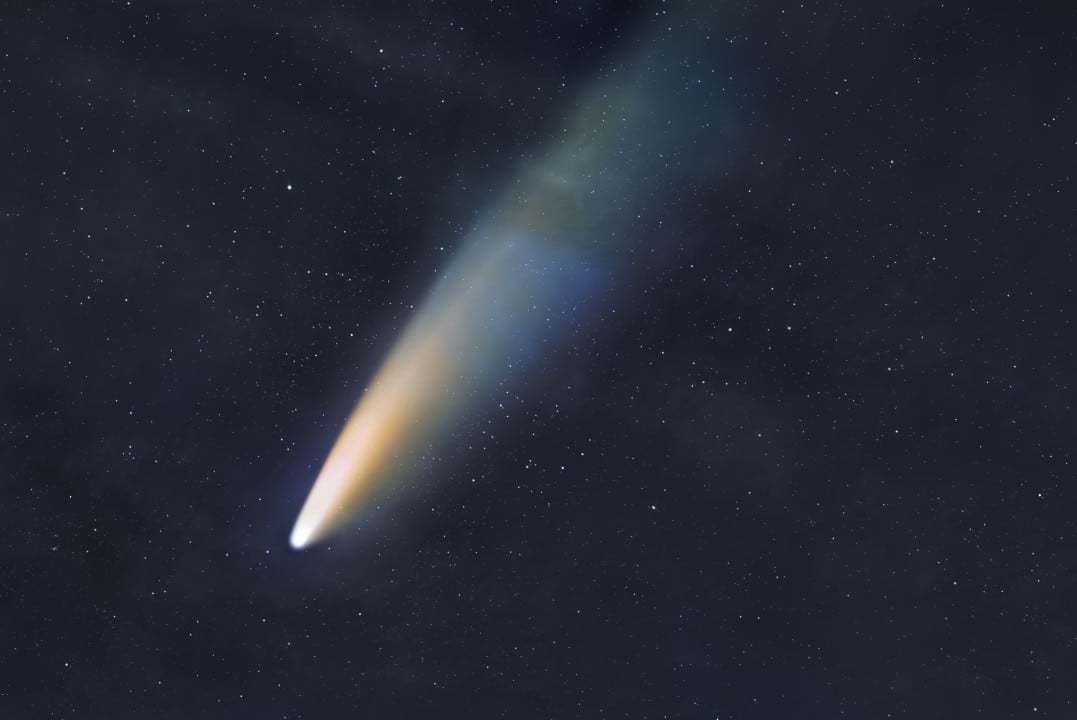
The interstellar comet 3I/Atlas will reach its closest proximity to Terra this Friday, December 19, at a safe distance of approximately 270 million kilometers. Descoberto in July 2025 by the ATLAS system in Chile, the object is the third confirmed as coming from outside Sistema Solar, following a hyperbolic trajectory that confirms its external origin.
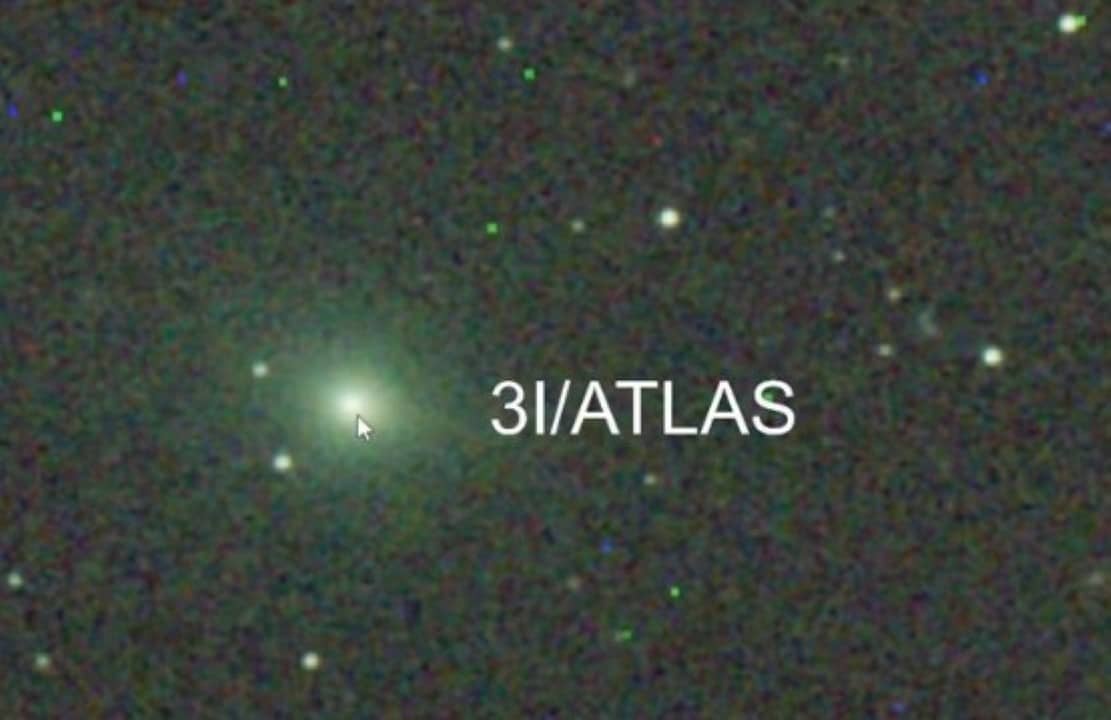
Recent observations with telescopes such as Hubble reveal that 3I/Atlas exhibits typical cometary activity, with a coma and tail, but has characteristics that distinguish it from common comets. Pesquisas indicate that it may be a primitive body, similar to planetesimals formed in the protoplanetary disks of other stellar systems.
- The object’s core measures at least five kilometers in diameter.
- Its composition includes water ice that sublimes as expected as it approaches Sol.
- The high speed, exceeding 200 thousand kilometers per hour, reinforces the gravitational ejection of its original system.
These data allow astronomers to compare planetary formation processes in different regions of Via Láctea.
Trajectory and discovery of the cosmic visitor
3I/Atlas was initially detected in images from July 2025, when it was close to the orbit of Júpiter. Sua hyperbolic orbit, with excessive speed compared to Sol, quickly confirmed its interstellar nature.
The object passed perihelion in October 2025, about 1.4 astronomical units from Sol. Desde then heads towards outer space, with the approach to Terra marking the closest point before definitively abandoning Sistema Solar.
Terrestrial and space observatories recorded early activity, with signs of coma detected even at high distances from Sol. Essa characteristic suggests preservation of volatile materials since their formation.
Composition and primitive characteristics
Studies indicate that 3I/Atlas has traces of a primordial body, ejected during turbulent phases of planetary formation in another system. Sua composition reveals similarities to early asteroids and carbonaceous chondrites known in Sistema Solar.
The core presents a high brightness and release of gases that indicate the presence of water ice and other volatiles. Observações in X-rays detected diffuse glow around the nucleus, confirming sublimatory activity.
Researchers highlight that the object awakens at typical distances for water sublimation, behaving in a manner consistent with cometary models. Essa normality, despite external origin, provides clues about the universality of accretion processes in protoplanetary disks.
Observations carried out by space missions
Several NASA missions have captured images of 3I/Atlas at different points in its trajectory. The Hubble telescope recorded details of the coma and tail in July and November 2025.
Probes on Marte, such as MAVEN and Mars Express, obtained close views during a pass by the red planet in October. Instrumentos ultraviolet light revealed a hydrogen halo around the nucleus.
Missions like Psyche and Lucy also contributed data during their outbound routes. Essas multiple observations allow refining the trajectory and analyzing brightness variations.
Implications for the formation of planetary systems
Analysis of 3I/Atlas suggests that it represents a lost slab, preserving primitive conditions of distant protoplanetary disks. Sua likely ejection occurred by gravitational interactions with giant planets in its home system.
Comparisons with solar comets indicate chemical similarities, but with variations that point to differences in formation environments. The object enriches the understanding of the distribution of volatile materials in the galaxy.
Astronomers hope that future observatories like Vera C. Rubin will detect more interstellar visitors annually. Cada new case would expand knowledge about the diversity of exoplanetary systems.
Details about the core and activity
The nucleus of 3I/Atlas rotates in approximately 16 hours, according to light curve measurements. Sua estimated mass is significantly greater than that of previous interstellar objects such as Oumuamua and Borisov.
Cryogenic activity begins at distances expected for water ice, with no explosive outbreaks detected to date. The antisolar tail has grown to tens of thousands of kilometers in recent observations.
These parameters indicate relative stability, allowing for extended observations over the coming months.
Visibility and current tracking
Although not visible to the naked eye due to its distance, 3I/Atlas can be observed with medium-sized amateur telescopes in dark skies. Sua apparent magnitude varies between 11 and 13 in current weeks.
Online platforms offer real-time tracking with data from JPL and Minor Planet Center. Observações will continue until the object moves too far away.
Safe passage reinforces the rarity of such events, with estimates of a similar object every five to ten years in the inner Sistema Solar.
Comparison with previous interstellar objects
Unlike Oumuamua, which did not exhibit cometary activity, 3I/Atlas has a clear coma and tail. In relation to Borisov, it has a larger nucleus and greater mass.
Its hyperbolic speed exceeds that of its predecessors, suggesting origin in a different dynamic region. Essas variations highlight diversity among interstellar visitors.
The joint study reinforces common patterns in the formation of icy bodies in distant systems.
3I/Atlas continues to provide valuable data as it moves away, contributing to models of galactic evolution. Observações integration of multiple space agencies guarantees comprehensive coverage of the phenomenon.



