
Unpublished image of comet 3I/ATLAS with straight tail and symmetrical coma is recorded by astronomer

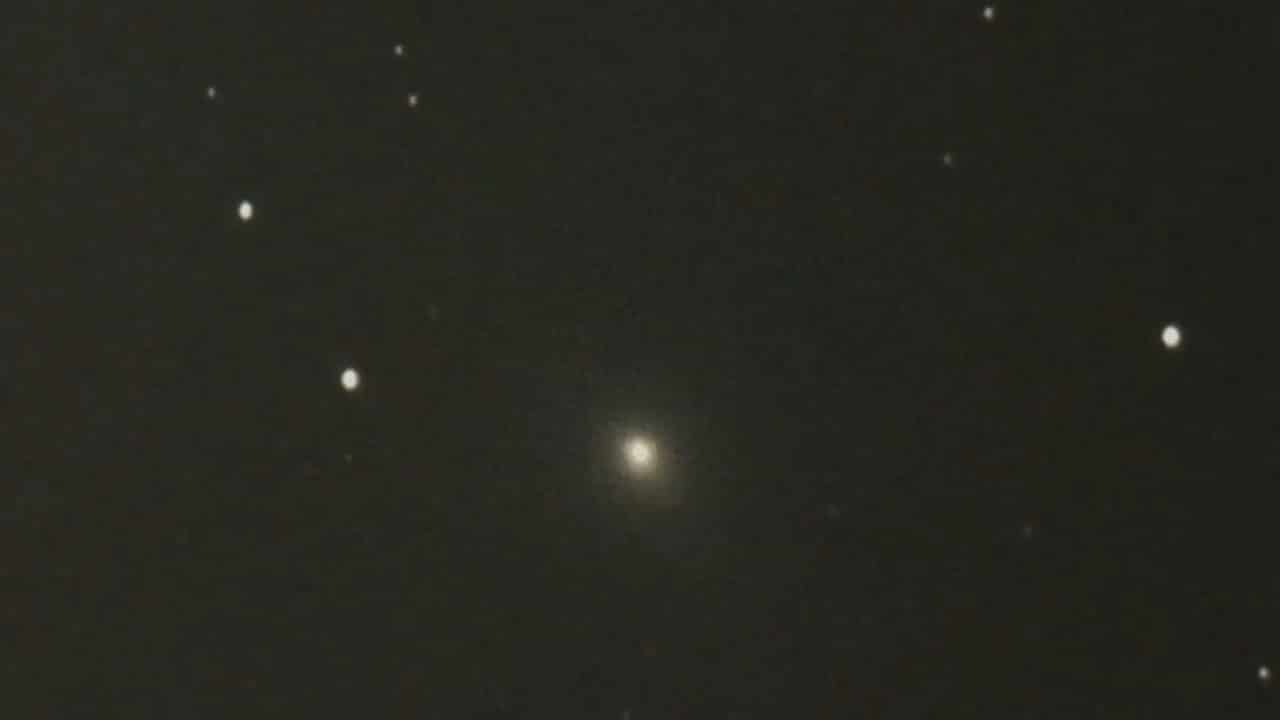
An unprecedented photographic record of the interstellar comet 3I/ATLAS was captured on November 22, 2025 by Japanese astronomer Mitsunori Tsumura, using a 0.5-meter telescope. The recently released image reveals distinctive features that differentiate it from typical Sistema Solar comets, including an ionic tail and fine, collimated dust.
Astrophysics experts examine the material to understand possible differences in the object’s composition, given its origin outside our stellar system. Esta critical observation occurs amid a series of global monitoring, initiated after the discovery of the comet by the ATLAS system in July 2025.
The initial analysis points to unusual behavior, which challenges existing models about the interaction of celestial objects with the space environment. The 3I/ATLAS singularity adds a layer of complexity to the study of interstellar bodies.
Unique characteristics of 3I/ATLAS intrigue scientists
The image obtained by Tsumura details aspects that immediately caught the attention of the scientific community. The comet’s tail, for example, exhibits remarkable uniformity, without the texture of visible debris that often accompanies these celestial bodies.
The central core of 3I/ATLAS manifests itself as a compact point source, reinforcing the idea of an atypical structure. Além In addition, a tenuous secondary filament was identified, running parallel to the main filament, a configuration that raises questions about the material emission processes.
These particularities fuel the debate about the formation and evolution of interstellar comets, offering a rare opportunity to study matter from other stellar systems.
Straight tail challenges conventional models
The tail of 3I/ATLAS maintains a consistent narrowness throughout its entire length, which contrasts sharply with the dispersion usually caused by the solar wind. Esse behavior suggests the presence of materials with high resistance to external pressure.
The observed collimation is similar to that of other interstellar objects, such as 2I/Borisov, but 3I/ATLAS demonstrates an even more pronounced linearity. Tal characteristic may indicate a distinct chemical or physical composition, adapted to conditions in a different stellar environment.
Absence of orbital curvature
There is no evidence of curvature in the comet’s tail, even considering its hyperbolic trajectory. The solar wind normally imposes arcs on the tails of solar comets due to relative velocity, but in 3I/ATLAS, complete straightness prevails.
NASA data points to non-gravitational accelerations that regulate the comet’s orbit, with a precision that approaches the radius of Hill of Júpiter, estimated at 53.5 million kilometers. The predicted distance for 2026, of 53.445 million kilometers, corroborates recent orbital analyses.
The lack of curvature in the tail, together with non-gravitational accelerations, suggests that 3I/ATLAS may be subject to forces and interactions that are not commonly observed in comets originating from our own planetary system.
Central coma: symmetry and stability
The 3I/ATLAS coma has a uniform luminosity and an almost spherical shape, without the anisotropic jets that are common in irregular comet nuclei. Chaotic sublimation in natural comets generally generates asymmetries, but the uniformity of this comet indicates more stable and controlled gas and dust emission processes.
Observations from the Hubble space telescope estimated the core’s diameter at up to 5.6 kilometers, although data from August 2025 suggests a smaller size, perhaps below 440 meters. Imagens from missions like PUNCH confirm a brief elongation of the tail, aligning with atypical patterns detected in September. The discrepancy in the luminosity decay indicates a controlled emission, although analyzes suggest the presence of ancient interstellar ice, formed under conditions in another stellar system.
[[_0]
Secondary filament: a parallel enigma
A weak, linear structure appears parallel to the main tail, maintaining minimal angular separation. Diferentemente of the usual division between ionic and dust tails, this filamentation remains in close proximity, which may suggest multiple flows of material without the divergence of patterns.
Ground-based telescopes recorded an extension greater than would be expected for natural objects, comparable to emissions observed in October records, close to Marte. Este phenomenon reinforces the enigmatic nature of 3I/ATLAS, challenging current understandings of cometary dynamics.
Compact, diffusionless core
The nucleus of 3I/ATLAS appears as a stellar condensation, devoid of the dust diffusion that typically characterizes comets. In common structures, the nuclei emit diffuse halos with clusters and streaks, but in this case, the central concentration is high and there are no luminous nodes.
The absence of diffuse texture corroborates the uniformity of the tail, which has been observed in multiple spectral bands since passing through perihelion, 1.4 astronomical units from Sol, in October 2025. The proximity to Marte has allowed data from missions such as Lucy and non-gravitational accelerations to continue to fine-tune the orbit, monitored by international astronomers.
Hyperbolic trajectory and continuous monitoring
Comet 3I/ATLAS follows a hyperbolic path, having originated in the direction of the constellation Sagitário, opposite the solar apex. Observations carried out by the Gemini Sul and Nordic Optical Telescope telescopes confirm the comet’s activity since May 2025, when it was 6.4 astronomical units from Sol.
The reddish composition of the coma is constantly evolving, indicating a changing surface, with nickel and iron emissions detected in the August analyses. Missões like MAVEN record ultraviolet hydrogen, but without a predicted visible match, broadening the debate about interstellar volatility and the uniqueness of this cosmic visitor.



