
Interstellar comet 3I/ATLAS reaches closest approach to Earth at 270 million km this Friday

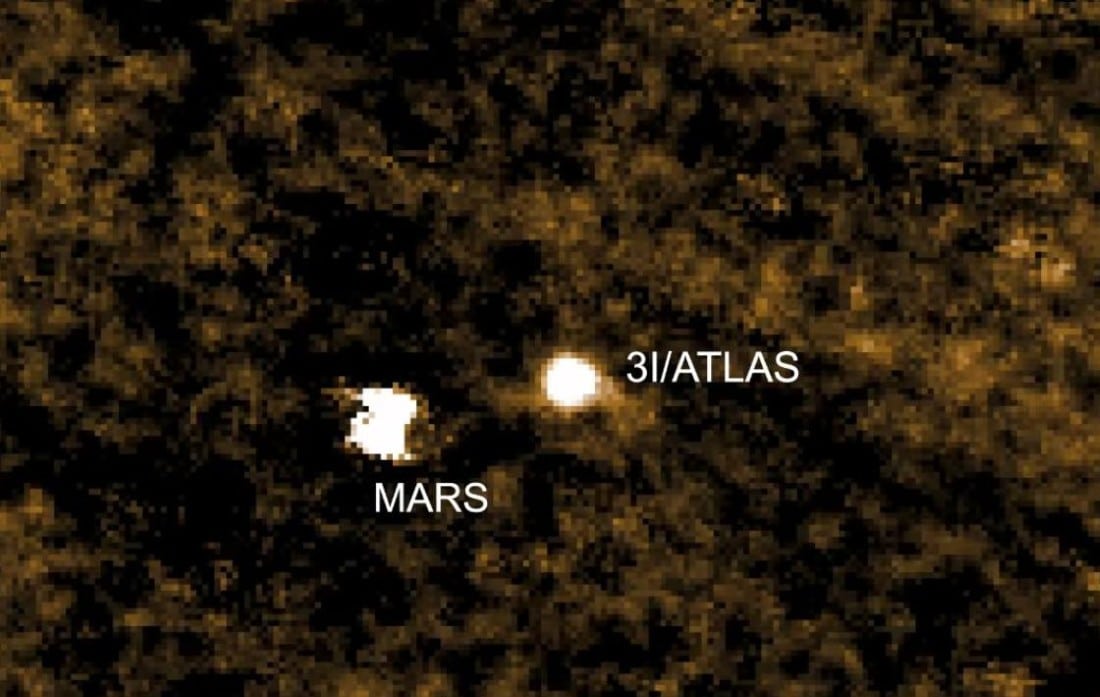
The interstellar comet 3I/ATLAS reached its closest approach to Terra this Friday, December 19, 2025, passing at a safe distance of approximately 270 million kilometers. Esse event marks the closest passage of the third confirmed object coming from outside Sistema Solar, without any risk of collision with the planet.
Discovered on July 1, 2025 by the ATLAS telescope system at Chile, 3I/ATLAS follows a hyperbolic trajectory that confirms its external origin. Após reached perihelion on October 29, the comet began to move away from Sol and Terra, heading towards the outer regions of Sistema Solar.
Observations carried out by ground-based and space telescopes have recorded typical cometary activity, including the formation of coma and tail. Esses data allows comparisons with objects native to Sistema Solar and reveals unique characteristics of the interstellar visitor.

- The comet has a speed greater than 60 km/s relative to Sol.
- Its composition includes water ice, carbon dioxide and carbon monoxide.
- Estimates indicate a core with a diameter between 1 and 5 kilometers.
- Calculated age suggests formation billions of years ago in another star system.
Interstellar discovery and confirmation
Astronomers initially identified 3I/ATLAS as a fast-moving object within the orbit of Júpiter. Fast Análises of the trajectory revealed eccentricity greater than 1, characteristic of orbits not bound to solar gravity.
Subsequent observations confirmed the presence of a coma and tail, classifying it as an active comet. Diferentemente of ‘Oumuamua and 2I/Borisov, 3I/ATLAS exhibited intense brightness and color changes during solar approach.
Observed characteristics
The comet developed a greenish coma after perihelion, the result of chemical processes activated by solar heat. Imagens from telescopes like Gemini Norte and Hubble have captured tails of dust and ions stretching hundreds of thousands of kilometers.
X-ray emissions detected by space observatories represent the first record of their kind from an interstellar object. Essas emissions indicate interaction between solar wind and gases released by the core.
Spectroscopic research identified an abundance of certain elements, suggesting formation in a stellar environment other than the solar one. Comparações with local comets highlights variations in the proportion of volatiles.
Current trajectory
3I/ATLAS passed Marte in October, Vênus in November and Terra in December. Sua hyperbolic speed guarantees permanent exit from Sistema Solar in the next decade.
Simulations indicate that non-gravitational forces, such as gas jets, slightly influence the path. Continuous Observações refine predictions about the future path.
Future meeting with Júpiter
In March 2026, the comet will pass close to the Hill radius of Júpiter, about 53 million kilometers from the planet. Essa approach may subtly alter the final trajectory due to Jovian gravity.
The Juno probe, in orbit around Júpiter, will position itself to record the event between March 9th and 22nd. Dados collected will help understand gravitational effects on interstellar objects.
Other missions, such as ESA’s Juice, have already captured images during the passage. Essas observations complement studies on orbital dynamics.
Observations made
Ground-based telescopes at Havaí, Chile and Arizona have followed the comet since its discovery. Instrumentos spaces such as Hubble, James Webb and Parker Solar Probe recorded details of the coma and tail.
Missions to Marte, including MAVEN and Mars Reconnaissance Orbiter, have obtained unique views during the Martian approach. Europa Clipper and Psyche also contributed images during their trajectories.
Scientific importance
3I/ATLAS functions as a time capsule for another star system. Sua composition reveals conditions for planetary formation in environments far from Via Láctea.
Trajectory studies indicate its origin in the thick galactic disk, a region with old stars. Essa information enriches models of stellar evolution and migration of interstellar objects.
Comparisons with ‘Oumuamua and Borisov highlight diversity among extrasolar visitors. Dados accumulated expand knowledge about primordial cosmic chemistry.
Visibility and monitoring
The comet was not visible to the naked eye, requiring medium-sized telescopes for observation. Posicionado initially in the morning sky, changed to nighttime visibility after opposition in January 2026.
Projects such as Virtual Telescope have offered live broadcasts during the land approach. Astrônomos amateurs contributed images in places with low light pollution.
Monitoring continued until the comet became very faint, expected in mid-2026. Redes international teams coordinated efforts to maximize data collection.
Composition revealed
Analysis indicates a predominance of carbon dioxide in the coma, differing from solar comets rich in water. Presença of carbon monoxide and other volatiles suggests formation at low temperatures.
Detections of nickel and other metallic elements in high proportions point to a unique environment of origin. Esses chemical traits distinguish 3I/ATLAS from native objects.
Ultraviolet and X-ray observations revealed hydrogen envelope and interactions with solar wind. Esses phenomena provide clues about sublimation of deep ice.
Legacy of the passage
The visit by 3I/ATLAS reinforces the rarity of interstellar objects detected. Melhorias in search systems increases the chances of future discoveries.
Data collected will influence studies of exoplanets and protoplanetary disks. Modelos of comet ejections from stellar systems will gain precision from these observations.
The incident-free passage demonstrates the effectiveness of planetary monitoring networks. Experiências acquired prepares astronomers for upcoming cosmic visitors.



