
Interstellar comet 3I/ATLAS reaches closest approach to Earth on December 19 and requires telescope for detailed observation

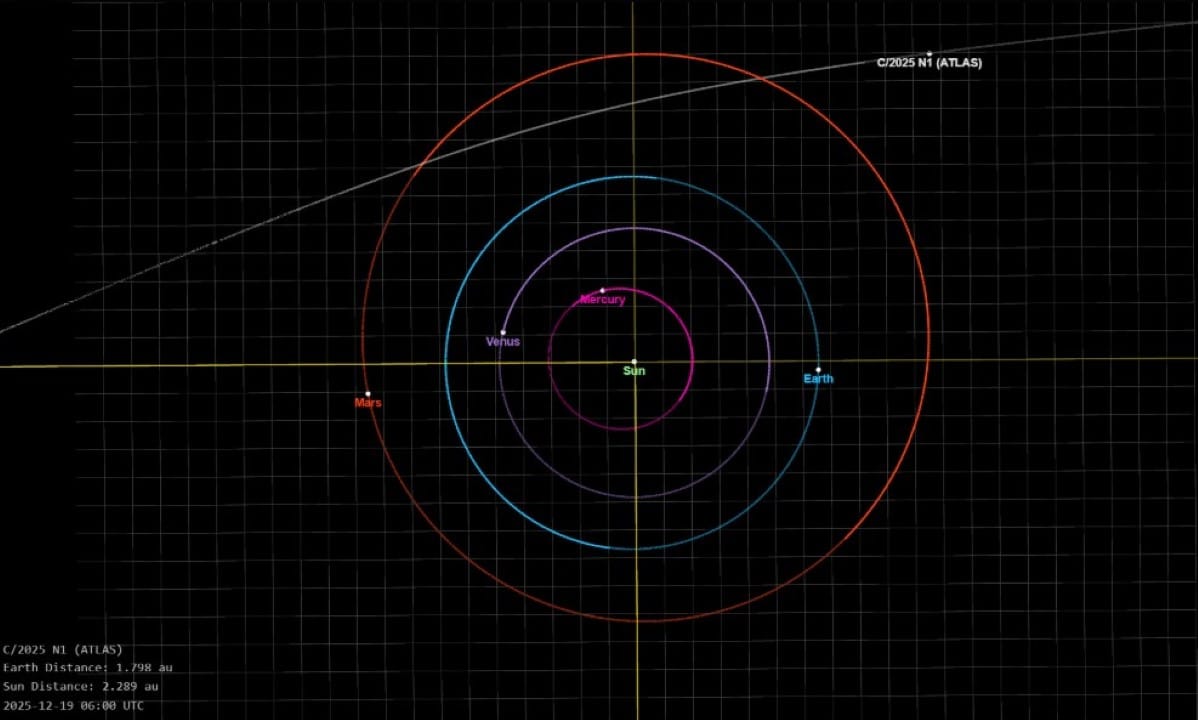
The interstellar comet3I/ATLAS, the third confirmed object coming from outside Sistema Solar, reaches this Friday, December 19, 2025, the point of closest approach to Terra.
The minimum distance will be approximately 270 million kilometers, equivalent to around 1.8 astronomical units, without any risk of collision.
Astronomers highlight that the phenomenon will not be visible to the naked eye or with ordinary binoculars, due to the object’s weak brightness.
Observations require medium to large amateur telescopes to detect just a fuzzy point in the sky.
- Locate the comet in the early morning hours, before Sol rises, heading east.
- Prefer regions with low light pollution to improve the chances of detection.
- Equipment with an opening greater than 150 mm facilitates object registration.
Origin and discovery of 3I/ATLAS
The comet3I/ATLASit was discovered in July 2025 by the ATLAS telescope system, at Chile.
Its hyperbolic trajectory confirms its interstellar origin, formed around another star billions of years ago.
Experts estimate that the object could be up to 3 billion years older than Sol.
It follows in the footsteps of ‘Oumuamua, detected in 2017, and 2I/Borisov in 2019, as rare visitors from deep space.
Interstellar comet 3I/ATLAS just had its closest approach to Earth!
— 🚀conspiracy_slayer🌕 (@conspiracyslyr)December 19, 2025
Time: 2025-12-19 06:01 UTC
Distance: 1.79756 AU (268.91 million km / 167.09 mi)pic.twitter.com/AuQegEmTdh
Observation conditions in the southern hemisphere
In Brasil and other countries in the Southern Hemisphere, visibility remains limited by position in the sky and morning time.
Locations far from urban centers offer the best conditions for attempts with telescopes.
The comet reappeared in the sky in early December, after a period hidden by sunlight.
Recent images show increasing activity, with diffuse coma and faint brightness.
Scientific importance of the passage
The December 19 approach facilitates accurate data collections by professional telescopes and space instruments.
Research focuses on the chemical composition, including unusual proportions of nickel and iron.
Observations analyze mass loss after perihelion and changes in the object’s speed.
Telescopes such as Hubble and James Webb record details about released gases and dust.
Recently observed features
The comet displayed an initial reddish color, evolving to a faint green tone after solar heating.
Cometary activity includes elongated coma and possible weak tail.
Current magnitude varies between 11 and 13, insufficient for vision without optical aid.
Studies confirm similar behavior to natural comets, with no evidence of artificial origin.
Practical tips for amateur astronomers
Choose nights with clear skies and an unobstructed eastern horizon.
Use astronomy apps to locate the exact position of the3I/ATLASin the constellations of Virgem and Leão.
Larger aperture telescopes better capture the diffuse point representing the comet.
Shoot long exposures to highlight coma details in photographs.
Future trajectory of the object
After approaching land, the3I/ATLASwill continue its hyperbolic orbit, leaving Sistema Solar permanently.
There is no expected return date, making this trip a unique opportunity for studies.
Observations continue until early 2026, when the brightness progressively decreases.
Data collected contributes to understanding planetary formations in other star systems.



