
Interstellar comet 3I/ATLAS shows uniform structure in new deep-red filtered image

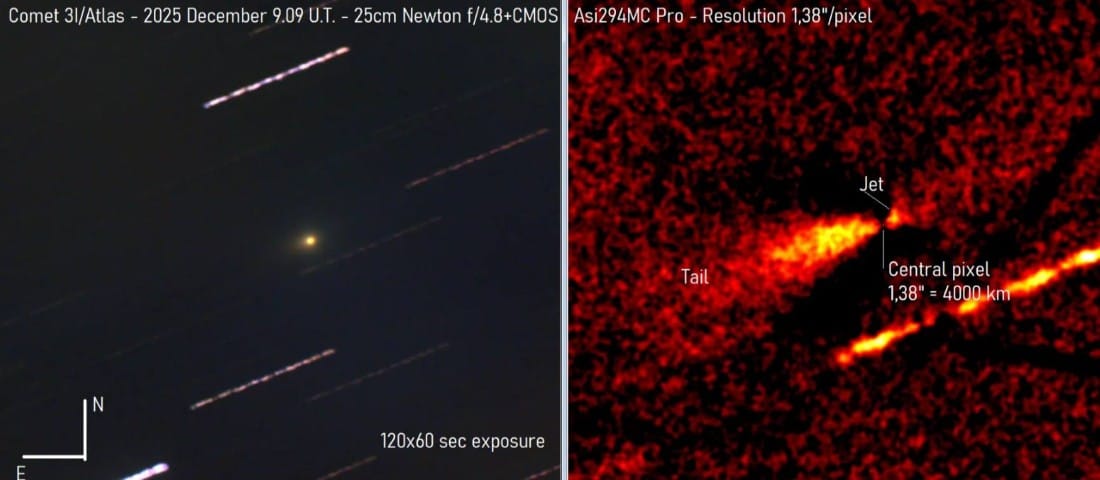
The interstellar comet 3I/ATLAS, the third object confirmed to come from outside Sistema Solar, recorded a deep red filter image that reveals a compact luminous core surrounded by a smooth, uniform halo. Essa capture, taken recently, shows the object in sharp definition against a background of elongated stars due to relative motion during exposure. Astrônomos analyze these details to better understand the behavior of the interstellar visitor, who passes through Sistema Solar on a hyperbolic trajectory.

The image shows an intense concentration of light in the center, without evident signs of asymmetric jets or a pronounced tail, common characteristics in comets during solar approach. The halo presents a gradual and symmetrical gradient, suggesting uniform dispersion of fine dust or specific emission at red wavelengths. Complementary Observações indicate transition to a dust-dominated phase, with suppression of green emissions typical of diatomic carbon.
Experts highlight the absence of fragmentation or elongation in the core, even under solar heating. Essa stability contrasts with expectations for interstellar objects exposed to radiation in strange systems.
Features of the image in red
Deep red filter capture highlights heavy or ionized particulate components while suppressing classic volatile emissions. The core appears saturated and rounded, with soft luminosity rather than irregular shapes.
- The uniform halo fades gradually, without feathers or broken streaks.
- This points to the dominance of fine dust scattering light in a balanced way.
- Can mask underlying chaotic activity by specific emission profile.
The stellar background with uniform lines confirms camera movement, reinforcing that the central structure is intrinsic to the object, not a tracking artifact.
Absence of expected structures
Typical observations of comets approaching the Sun expect irregular outgassing, asymmetry in jets or development of a tail away from the Sol. Nenhum of these elements appears clearly in the image.
The object remains compact and self-contained, with no pronounced tail or visible fragmentation. Essa containment aligns with recent patterns, where 3I/ATLAS exhibits restricted activity despite interstellar origin.
Unknown materials react to thermal stress and radiation without apparent disruption. The observed calm suggests resilient composition.
Context of recent observations
Comet 3I/ATLAS, discovered in July 2025 by the ATLAS system at Chile, passed through perihelion in October and approaches Terra in December, at around 270 million kilometers. Imagens from telescopes such as Hubble and Gemini reveal greenish coma and increasing post-perihelion activity.
- Hyperbolic trajectory confirms external origin, with excessive speed of around 58 km/s.
- Composition includes gases such as cyanide and atomic nickel vapor, similar to solar comets.
- Core size estimated between 440 meters and 5.6 kilometers.
Multi-agency observations, including NASA and ESA, track the object before its definitive exit from Sistema Solar.
Brightness distribution and symmetry
Pixel analysis reveals remarkable symmetry in the brightness distribution, with a gradual drop off from the saturated core. Essa regularity suggests control in the release of material, unlike dramatic outbursts.
The smooth, rounded light profile reinforces the absence of visible instability. Comparações with comet models highlight partial compliance, but with deviations in halo uniformity.
Implications for interstellar studies
Images like this contribute to the body of evidence about 3I/ATLAS, which does not fit neatly into traditional comet models. Cada capture answers specific questions while expanding uncertainties about composition and dynamics.
- The subject remains calm and compact, with a soft light profile.
- Surrounding environment shows movement, but the core appears composed.
- This composure is unusual for an interstellar visitor to a foreign system.
Data accumulated from multiple sources refines understanding of external objects.
Dust-Dominated Activity
Observed transition indicates dust-dominated phase, with calmer glow after initial volatility. Filtro red emphasizes particulate reflection, aligning with recent changes.
Absence of an extensive tail or nuclear elongation suggests containment activity. Comparações with 2I/Borisov and 1I/’Oumuamua highlight differences in stability.
Star field and technical validation
Uniform stellar traces validate imaging conditions, confirming sharpness of the core relative to the background. Isso excludes tracking errors as the cause of the observed structure.
The sharp setting reinforces intrinsic characteristics, such as a controlled halo and intact core. Análises forensics continue to examine pixel by pixel for additional patterns.
Closing observational window
With Earth approach in December 2025, the window for detailed observations is closing. Dados of Hubble, JWST and space missions such as Juice and Psyche complement terrestrial images.
The comet heads towards the exit of Sistema Solar, carrying information about formation in another star system. Estudos spectroscopic scans reveal organic molecules and traces of water.
Capture details in red
The deep red palette, enhanced by processing, highlights ionized components. Isso masks green emissions while highlighting heavy dust.
The result is composite object image, with halo fading evenly. Especialistas notice transition to a calmer state.



