
James Webb Telescope reveals lemon-shaped exoplanet orbiting pulsar with carbon-rich atmosphere

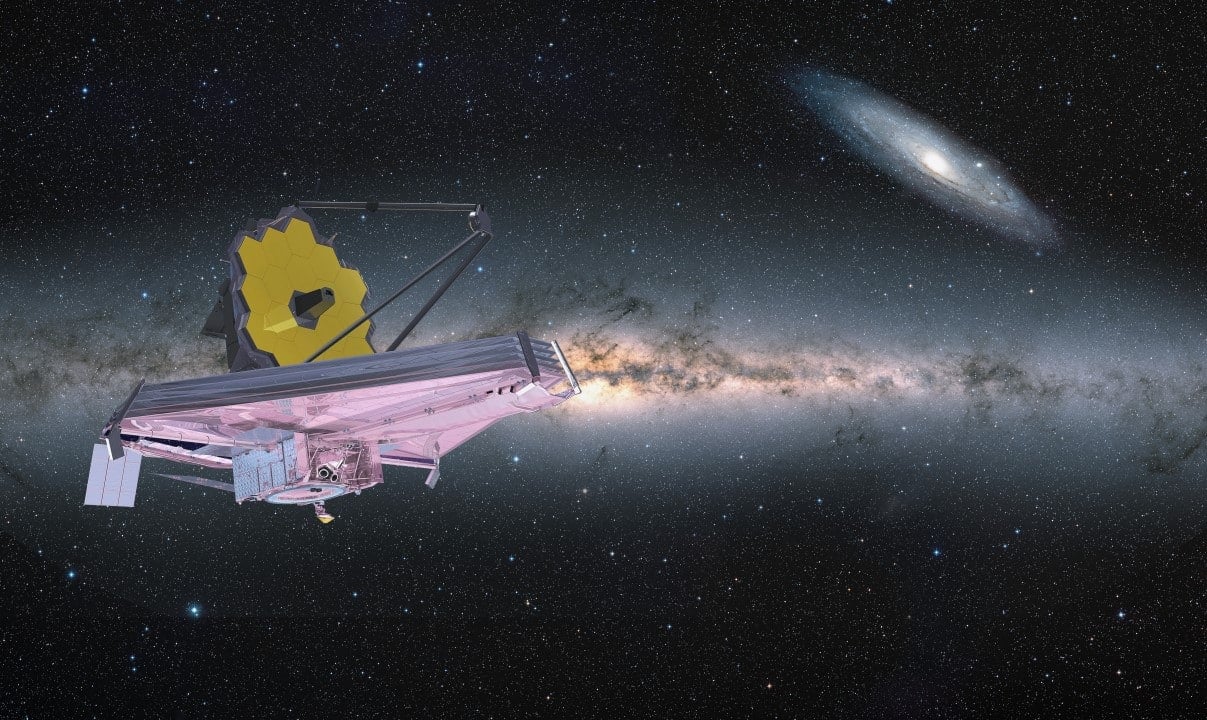
Space telescope James Webb identifies exoplanet with an elongated shape similar to a lemon.
The object, named PSR J2322-2650b, has a mass equivalent to that of Júpiter and orbits a pulsar at an extremely close distance.
This proximity causes intense gravitational deformation, resulting in the observed ellipsoidal shape.
The discovery occurred through infrared observations carried out recently.
- The planet completes an orbit in about 7.8 hours.
- It is located more than 2 thousand light years from Terra.
- It is the only known gas giant orbiting a pulsar.
Exoplanet characteristics
The PSR J2322-2650b has an equatorial diameter 38% larger than the polar one.
This distortion occurs due to tidal forces from the host pulsar.
Material from the planet is funneled toward the star, forming an ejection point.
The temperature varies significantly between the lit and dark hemispheres.
Webb reveals exotic planet around a pulsar and challenges planetary formation theories
— JAMES WEBB (@jameswebb_nasa)December 16, 2025
Astronomers using Telescópio Espacial James Webb (#JWST) made a discovery that is intriguing the scientific community: a planet outside of Sistema Solar with a composition…pic.twitter.com/Or5NgEkdoZ
Atmospheric composition
Observations reveal a predominance of helium and molecular carbon.
There is no detection of hydrogen, oxygen or nitrogen in significant quantities.
This configuration differs from all previously studied atmospheric exoplanets.
Possibly indicates formation in an extreme post-supernova environment.
Observations with James Webb
The telescope captured variations in brightness throughout the orbit.
This allowed us to model the shape and analyze the atmospheric spectrum.
The pulsar’s emission in gamma rays does not interfere with infrared readings.
This is the first detailed analysis of the atmosphere on a planet around a pulsar.
Context of the discovery
The object was initially detected in 2011 by radio telescope.
Recent studies confirm its unique properties among more than 6 thousand known exoplanets.
The extreme proximity exposes the planet to intense radiation.
Orbital details
The orbit occurs about 1.6 million kilometers from the pulsar.
This is equivalent to a fraction of the distance Terra-Sol.
The short orbital period results in extreme thermal conditions.
Temperature differences between sides of the planet reach thousands of degrees.
Scientific implications
The composition suggests rare chemical processes at high pressures.
There is possibly the formation of carbon crystals inside.
The system is classified as a potential “black widow” in evolution.
Future research may clarify origins of worlds in hostile environments.
Unusual formation
Theories indicate that the planet survived or was formed after a stellar explosion.
Environments around pulsars are considered inhospitable for gaseous planets.
This detection expands understanding of the diversity of planetary systems.
The study was published in a specialized scientific journal.
Single observation
The absence of strong infrared light from the pulsar made measurements easier.
This allowed complete monitoring of the orbit without interference.
Data collected highlights instrument capabilities on distant exoplanets.



