
NASA: Interstellar comet 3I/ATLAS reaches closest approach to Earth on December 19 at 270 million km

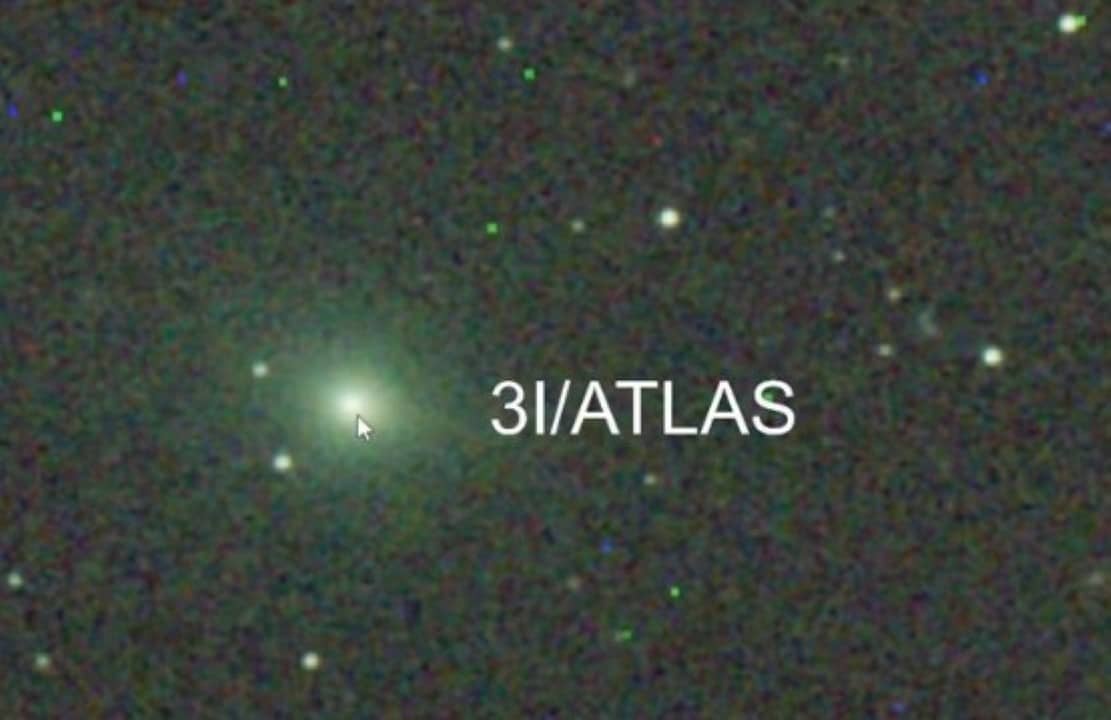
The interstellar comet 3I/ATLAS, the third confirmed object coming from outside Sistema Solar, reaches its closest point to Terra this Friday, December 19, 2025. The minimum distance will be approximately 270 million kilometers, equivalent to around 1.8 astronomical units, without any risk of impact on the planet. Descoberto in July 2025 by the ATLAS system in Chile, the object follows a hyperbolic trajectory that will take it back to interstellar space after this passage.
Recent observations indicate intense cometary activity, with the formation of a coma and tail visible in professional telescopes. Astrônomos from several space agencies monitor the comet to collect data on its composition and origin in another star system.
- 3I/ATLAS passed perihelion on October 29, 2025, about 210 million kilometers from Sol.
- Its hyperbolic velocity confirms its extrasolar origin, unlike orbital comets.
- Images from Telescópio Espacial Hubble reveal details of the coma and variations in brightness.
Discovery and trajectory
Comet 3I/ATLAS was identified on July 1, 2025 by the ATLAS telescope at Río Hurtado, at Chile. Initial and pre-discovery Observações dates back to June, when the object crossed dense star fields near the center of Via Láctea. Sua hyperbolic trajectory, with an eccentricity greater than 1, was quickly confirmed, classifying it as the third known interstellar object, after ‘Oumuamua in 2017 and 2I/Borisov in 2019.
After perihelion in October, the comet exhibited non-gravitational acceleration due to the sublimation of ices, behavior typical of active comets. Ele will continue its journey, passing close to Júpiter in March 2026 before definitively leaving Sistema Solar in the 2030s.
Observed characteristics
Images captured by Hubble in November 2025 show a bright, active coma, with intensified sublimation of ices such as carbon dioxide and water. The estimated core varies between 440 meters and 5.6 kilometers in diameter, surrounded by a cloud of gas and dust. Observações spectroscopic measurements indicate the presence of carbon monoxide, nickel vapor and other compounds similar to those of solar comets, but with variations that suggest formation in a different cosmic environment.
Recently, the comet developed a greenish glow due to chemical processes activated by solar heating. Algumas images reveal anti-tail, a visual phenomenon formed by material ejected towards the Sol.
Scientific observations
Ground-based and space telescopes, including Gemini North in Havaí and James Webb, recorded the evolution of 3I/ATLAS’s coma and tail. NASA’s Missões as well as Psyche and ESA orbiters at Marte contributed trajectory and activity data. Essas coordinated observations allow us to refine orbital models and analyze chemical composition, providing clues about the formation of planets in other stellar systems.
The apparent magnitude of around 13 during approach requires professional viewing equipment. Eventos live streaming facilitates remote monitoring by amateur and professional astronomers.
Composition and origin
Analysis indicates that 3I/ATLAS is rich in carbon dioxide, with water ice and traces of carbon monoxide. Sua composition suggests an age greater than billions of years, possibly older than Sistema Solar. Estudos points to their origin in the thin or thick disk of Via Láctea, transporting primordial material from another planetary system.
Comparisons with solar comets reveal enrichment in certain elements, such as nickel, due to prolonged exposure to interstellar cosmic radiation. Essa characteristic reinforces the scientific value of the object as a relic of distant environments.
Speculations and confirmations
Initially, unusual trajectories and high brightness generated hypotheses about artificial origin, discussed by astronomers as Avi Loeb. Dados, including acceleration due to outgassing and emissions typical of comets, confirm natural nature. Agências as NASA and ESA classify 3I/ATLAS as an active interstellar comet, ruling out artificial possibilities based on observational evidence.
Research published in specialized journals reinforces that the behavior is in line with known comets, with variations explained by extrasolar origin.
Study opportunities
The December 19 approach represents the best window for detailed observations before the comet’s permanent exit. Telescópios on land and space capture subtle features such as jets of material and coma evolution. Esses data contributes to understanding interstellar objects and ubiquity of planetary formation in the galaxy.
After December, monitoring continues until the comet becomes invisible towards deep space.
- Presence of gases such as CO₂ and H₂O indicates typical sublimation.
- Anti-tail extends hundreds of thousands of kilometers.
- Stable activity facilitates long-term predictions and analysis.
- Data helps model interactions with solar wind.
Astronomical legacy
3I/ATLAS enriches knowledge about interstellar visitors, expanding studies started with ‘Oumuamua and Borisov. Sua safe and observable passage reinforces advances in detection and characterization of extrasolar bodies. Informações collected serve as a basis for future discoveries, improving astronomical monitoring technologies.
The international collaboration involves dozens of observatories, highlighting the importance of global networks for rare events like this.



