
Reduction in the activity of comet 3I/ATLAS allows us to see internal structures more clearly


The interstellar comet3I/ATLAS, the third confirmed object from another star system, shows significant changes in its recent appearance. A photograph captured by Italian astronomer Toni Scarmato shows a remarkable transition in color, going from green to gold tones. Essa change suggests a substantial slowdown in the object’s outgassing activity.
The comet’s outer coma has also weakened considerably, making it easier to observe the inner coma and jet structures in detail. Observadores highlight that these changes occur as the comet moves away from perihelion, reached in October 2025. The nucleus remains unresolved from ground-based telescopes, keeping the focus on the characteristics of the coma.
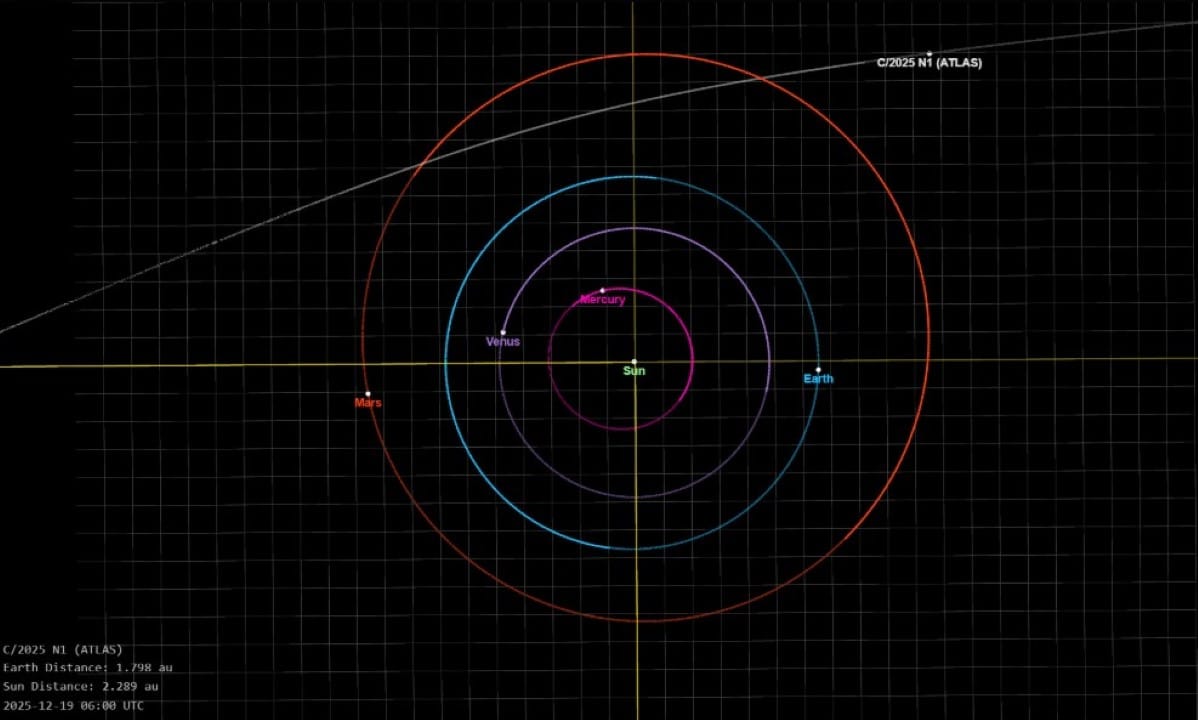
On this date, December 19, 2025, the3I/ATLASreaches its closest approach to Terra, at about 269 million kilometers. Essa safe distance allows intense observations without risk to the planet.
- The comet follows a hyperbolic trajectory, confirming its interstellar origin.
- Its current magnitude is around 11, visible with average amateur telescopes.
- Recent observations include Agência Espacial Europeia X-ray data.
Changes in color and activity
The transition from green to gold reflects changes in the composition of the gases released. Tons greens are generally associated with molecules such as cyanide and carbon, common in active comets. The golden predominance indicates a reduction in this emission, in line with the slowdown in offgassing.
This change coincides with the weakening of the external coma. Astrônomos interpret this as a sign that the comet stabilizes after perihelion, when high temperatures intensified the sublimation of ices. The reduction in activity allows for more precise studies of the inner regions, including possible previously observed collimated jets.
Toni Scarmato, responsible for the image, processed the data to highlight these variations. Suas captures contribute to global monitoring of the object, complementing observations from space telescopes such as Hubble and JWST.
Land approach observations
O 3I/ATLASpasses through the smallest distance from Terra this Friday, December 19, 2025. Localizado in the constellation of Leão, the comet has an estimated brightness of magnitude 11 to 12.
Terrestrial and space telescopes intensify monitoring during this period. Dados collected help refine models of the composition and behavior of interstellar objects. The comet poses no threat, remaining beyond the orbit of Marte.
- Minimum distance: approximately 1.8 astronomical units.
- Relative speed: around 240 thousand km/h.
- Next milestone: passing through Júpiter in March 2026.
These observations provide valuable comparisons with previous visitors such as ‘Oumuamua and Borisov.
Features of weakened coma
The weakening of the external coma represents one of the most interesting aspects of the recent images. Essa layer, composed of dust and released gases, loses density as the comet moves away from Sol. The phenomenon improves the visibility of internal structures, including jets and possible anti-tails.
Astronomers take advantage of this phase to analyze post-perihelion evolution. The reduction in the release of material suggests that reserves of volatile ices are decreasing, typical of long-period comets. In the case of3I/ATLAS, interstellar origin adds unique scientific relevance.
Studies indicate a composition with a low water content, just 4%, differing from Sistema Solar comets. Elementos and nickel predominate in some emissions, generating debates about formation in distant environments.
Implications for future studies
The changes observed in the3I/ATLASreinforce the importance of continuous monitoring. The color transition and weakening of the coma provide data on the dynamics of interstellar objects under solar influence. Futuras observations, including those scheduled for Júpiter, promise further insights.
The comet remains visible in amateur telescopes, moving through Virgem and Leão over the next few weeks. Sua magnitude should gradually weaken, reaching values above 12 by the end of December.
- Detected composition includes oxygen, hydrogen and dust.
- Ultraviolet observations reveal active plumes.
- Lack of visible fragmentation maintains apparent integrity.
Image capture details
Toni Scarmato used processing techniques to highlight color variations in the latest image. The record highlights the internal coma with greater definition, benefiting from the reduction of the external layer. Essas amateur captures complement professional data, enriching the set of observations.
Collaboration between professional and amateur astronomers accelerates the analysis of fast-moving events. In the case of3I/ATLAS, images like this help to understand jets and gaseous emissions.
The object remains under global scrutiny, with frequent updates from agencies such as NASA and ESA.
Post-perihelion evolution
After perihelion in October, the3I/ATLASdisplayed unexpected brightness, followed by stabilization. The current slowdown phase marks a transition to more passive behavior. Astrônomos monitor possible residual variations in activity.
The hyperbolic trajectory guarantees a definitive exit from Sistema Solar. Essa feature reinforces the interstellar status, distinguishing it from native comets.
Observations remain essential for cataloging unique properties such as extreme optical polarization and jet collimation.



