
Telescopes capture intense X-ray glow from interstellar comet 3I/ATLAS as it passes through the solar system


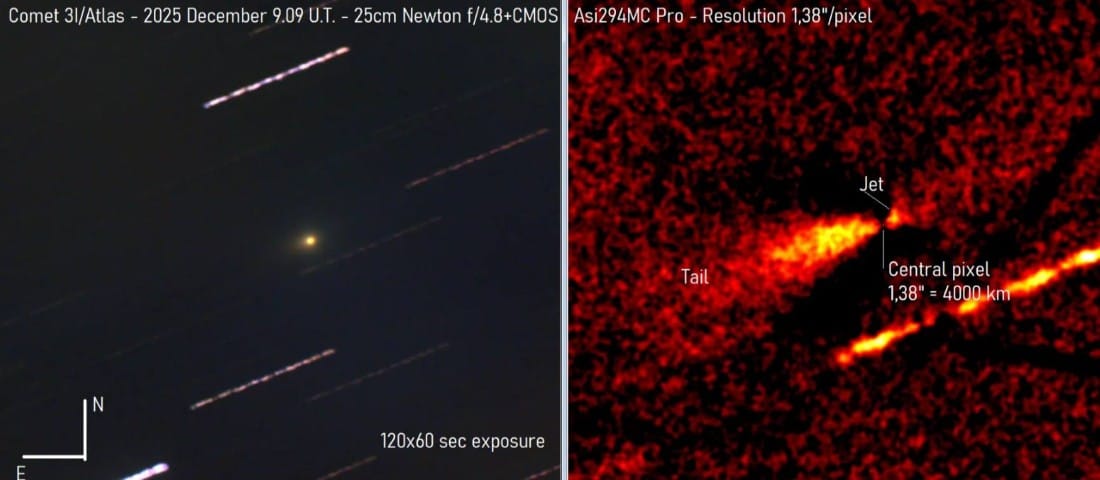
The interstellar comet 3I/ATLAS, the third confirmed object from outside the solar system, recorded detectable X-ray emission for the first time in its category. Observações coordinated by the space telescopes XRISM, from the Japanese agency JAXA, and XMM-Newton, from Agência Espacial Europeia (ESA), captured a diffuse halo of high-energy radiation extending for around 400 thousand kilometers from the comet’s nucleus.
These images reveal interactions between the solar wind and the gases released by the object, which travels in a hyperbolic trajectory through the solar system. The discovery occurred during the period when the comet was approaching Terra, in December 2025, offering unique data on its composition.
3I/ATLAS was discovered on July 1, 2025 by the ATLAS telescope system on Chile. Sua high speed and unbound orbit to Sol confirmed its interstellar origin soon after initial identification.
Comet discovery
Astronomers detected the object thanks to its unusual trajectory, which indicated origins outside the solar system. Subsequent Observações revealed cometary activity, with the release of gases and the formation of a coma.
The comet passed through perihelion, the closest point to Sol, in October 2025, at a distance of approximately 1.4 astronomical units. Sua maximum approach to Terra occurred on December 19, 2025, at approximately 270 million kilometers, without posing any risk.
X-ray observations
The XRISM and XMM-Newton telescopes took detailed captures of the X-ray emission. XRISM observed the comet for 17 hours in late November 2025, recording a diffuse glow associated with gas clouds around the nucleus.
XMM-Newton dedicated 20 hours of observation on December 3, 2025, producing images that show an intense red central point, representing low-energy radiation. Essas emissions arise when particles from the solar wind collide with neutral molecules released by the comet, ionizing them and generating X-rays.
The extension of the halo, equivalent to around 400 thousand kilometers, corresponds to the large-scale interaction with the solar environment. Preliminary Análises indicate the presence of elements such as carbon, nitrogen and oxygen in the observed region.
Emission mechanism
Solar system comets often exhibit X-ray emissions due to charge exchange between ions in the solar wind and neutral gases in the coma. In the case of 3I/ATLAS, this is the first confirmation of an interstellar object, unlike its predecessors ‘Oumuamua and Borisov, which did not present a detectable signal.
X-rays reveal light gases, such as hydrogen and nitrogen, that are difficult to observe at other wavelengths. Observações complementary telescopes like James Webb identified water vapor, carbon dioxide and carbon monoxide in the coma.
- Interaction with solar wind produces excited ions.
- Emission concentrated at low energies, visible in red in the images.
- Diffuse halo indicates extensive cloud of sublimated material.
- Data helps map distribution of light elements.
Comparison with previous objects
3I/ATLAS differs from the two previously known interstellar objects. 1I/’Oumuamua, discovered in 2017, showed no significant cometary activity or X-ray emission.
2I/Borisov, in 2019, exhibited a coma and tail, but attempts to detect it in X-rays were unsuccessful. 3I/ATLAS has greater activity and a larger estimated size, allowing for more detailed captures.
Its speed relative to Sol reaches high values, compatible with origins in another star system. Estudos suggest the comet may be billions of years old, carrying primordial material from distant planet formation.
Scientific implications
X-ray observations provide information about the chemical composition of objects formed in stellar environments other than our own. Elas allow us to compare sublimation processes and interaction with the solar wind in interstellar versus local comets.
Researchers use this data to refine models of comet evolution on hyperbolic trajectories. The combination with spectroscopy at other wavelengths enriches the understanding of the diversity of materials in interstellar space.
Current trajectory
After approaching Terra on December 19, 2025, the comet heads towards outer space. Sua speed guarantees definitive escape from solar gravity in the coming years.
Observations remain possible with ground- and space-based telescopes as long as the object remains accessible. The multi-instrument campaign involves agencies such as ESA, JAXA and NASA maximizing data collection before its permanent departure.
The 3I/ATLAS study represents a rare opportunity to analyze material from another star system in detail. X-ray emissions highlight differences and similarities with native comets, contributing to knowledge about the formation of planetary systems in Via Láctea.



