
Will the world end today? Interstellar comet 3I/Atlas reaches closest proximity to Earth today; understand myths and truths about the end of the world


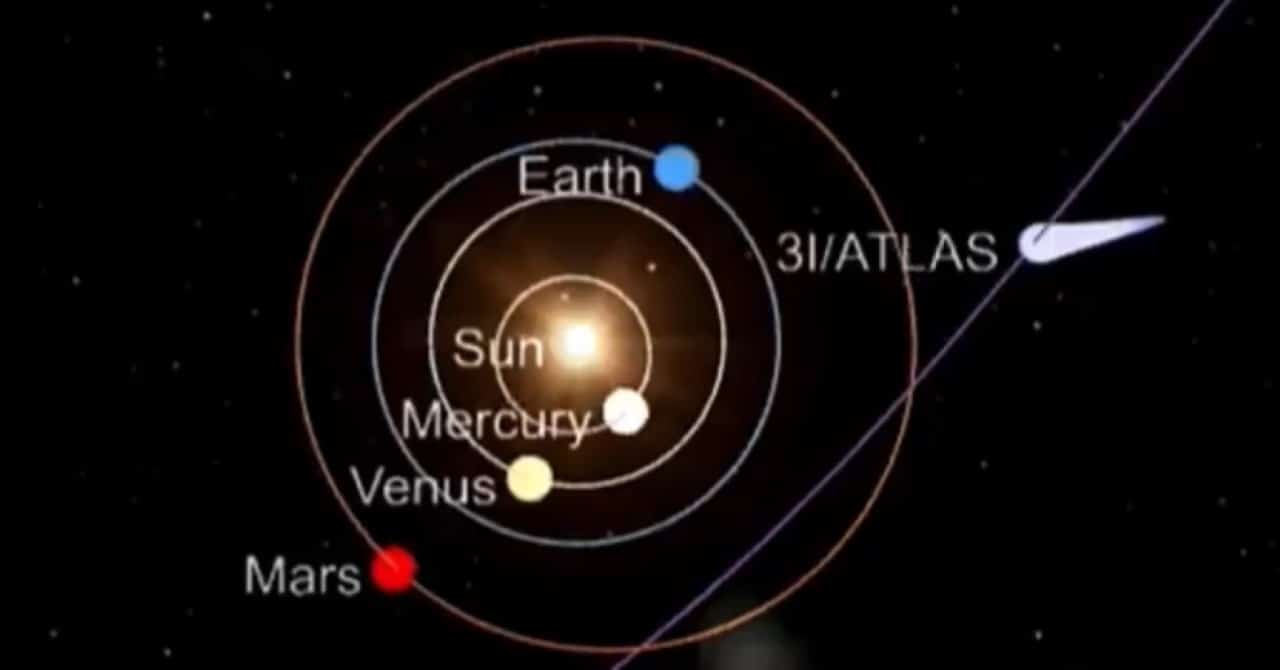
The interstellar comet 3I/Atlas, the third confirmed object coming from outside Sistema Solar, reaches its closest point to Terra this Friday, December 19, 2025. The minimum distance will be approximately 270 million kilometers, equivalent to around 1.8 astronomical units. Especialistas from NASA and international observatories confirm that there is no threat to life on the planet.
Discovered in July 2025 by the ATLAS telescope system at Chile, the object follows a hyperbolic trajectory that will return it to interstellar space after this passage. Observações recent studies show that the comet presents typical activity, with the formation of a coma and tail, but its chemical composition differs in some aspects from local comets.
Rumors circulating on social networks and online channels suggest that the passage could change the daily routine or even represent the end of the world. Astrônomos emphasize that the estimated size of the nucleus, between 440 meters and 5.6 kilometers, and the great distance eliminate any possibility of significant gravitational influence.
- The comet travels at speeds exceeding 200,000 km/h.
- Its likely origin is in another star system.
- Observations of Hubble revealed details of the teardrop-shaped coma.
Characteristics of the interstellar comet
3I/Atlas stands out for its hyperbolic trajectory, with eccentricity greater than other known objects. The Essa characteristic confirms its origin external to the Sistema Solar, unlike elliptical comets that orbit the Sol regularly. Estudos indicate that the comet may preserve primordial material billions of years old.
Observations carried out by Telescópio Espacial Hubble in November 2025 captured detailed images when the object was 286 million kilometers from Terra. The data reveals a reddish coma, indicative of dust, and emissions of gases such as cyanide and atomic nickel in concentrations similar to solar comets.
Origin and detailed trajectory
Astronomers calculate that 3I/Atlas entered Sistema Solar from the direction of the constellation of Sagitário, in the central region of Via Láctea. Sua speed relative to Sol reaches about 61 km/s, enough to escape solar gravity permanently. Perihelion occurred on October 29, 2025, at 1.36 astronomical units from Sol.
After approaching Earth, the comet will head towards the outer regions, passing close to Júpiter in 2026 before leaving Sistema Solar. Pesquisas suggest that the object may belong to the thick disk of Via Láctea, with an estimated age greater than that of Sistema Solar itself.
Pre-discoveries date back to June 2025, when the comet was crossing dense star fields. Equipes internationals confirmed comet activity shortly after initial detection, classifying it as the third interstellar visitor after ‘Oumuamua and Borisov.
Rumors versus scientific facts
Claims are circulating that 3I/Atlas could cause climate change or catastrophic impacts due to its passage. Agências space experts reiterate that the distance of 270 million kilometers makes any noticeable effect on Terra impossible. The object remains well beyond the orbit of Marte throughout the approach.
Experts compare the event to previous passages of interstellar comets, which did not cause observable changes. Continuous Monitoramentos by ground and space telescopes, including Virtual Telescope Project, allow real-time monitoring without signs of risk.
- Minimum distance: 270 million km.
- Core size: up to 5.6 km.
- Speed: over 200 thousand km/h.
- No detectable gravitational influence.
Observations and scientific opportunities
The comet offers a unique window to study material formed in another star system. Missões and ESA’s Juice captured data during a period of high post-perihelion activity. Imagens show complex tails and X-ray emissions caused by the solar wind interacting with neutral gases.
Telescopes like Gemini North recorded greenish hues in the coma in November 2025. Astrônomos continues observation campaigns, with the object visible in pre-dawn skies for amateur equipment until spring 2026.
Composition and observed differences
Spectral analyzes reveal the presence of carbon dioxide and atomic nickel, elements that help to understand planetary formation processes in distant environments. The elongated coma and the absence of intense outbursts indicate relative stability during the internal passage.
Comparisons with solar comets show similarities in concentrations of certain gases, but differences in the proportion of volatiles suggest origins at lower temperatures. Dados from XMM-Newton detected X-ray glow extending hundreds of thousands of kilometers.
Global event monitoring
Teams from NASA, ESA and independent observatories coordinate efforts to record the passage. Transmissões live allows public monitoring, highlighting the safety and scientific value of the phenomenon. The comet appears near the constellation Leão during closest approach.
After December 19, the brightness gradually decreases as the object moves away. Estudos Preliminaries point to cryovolcanism as a possible explanation for jets observed on the surface.
Legacy for astronomy
The visit of 3I/Atlas reinforces the rarity of detected interstellar objects. Sua analysis contributes to models of comet ejection by distant star systems. Futuras similar discoveries will depend on surveys like ATLAS, funded by NASA for planetary defense.
The event demonstrates the scientific community’s coordinated response capacity to cosmic visitors. Dados collected over the next few months will allow refinements in age estimates and primordial composition.



