
Astronomers confirm existence of runaway supermassive black hole RBH-1 traveling at 3.4 million km/h through space

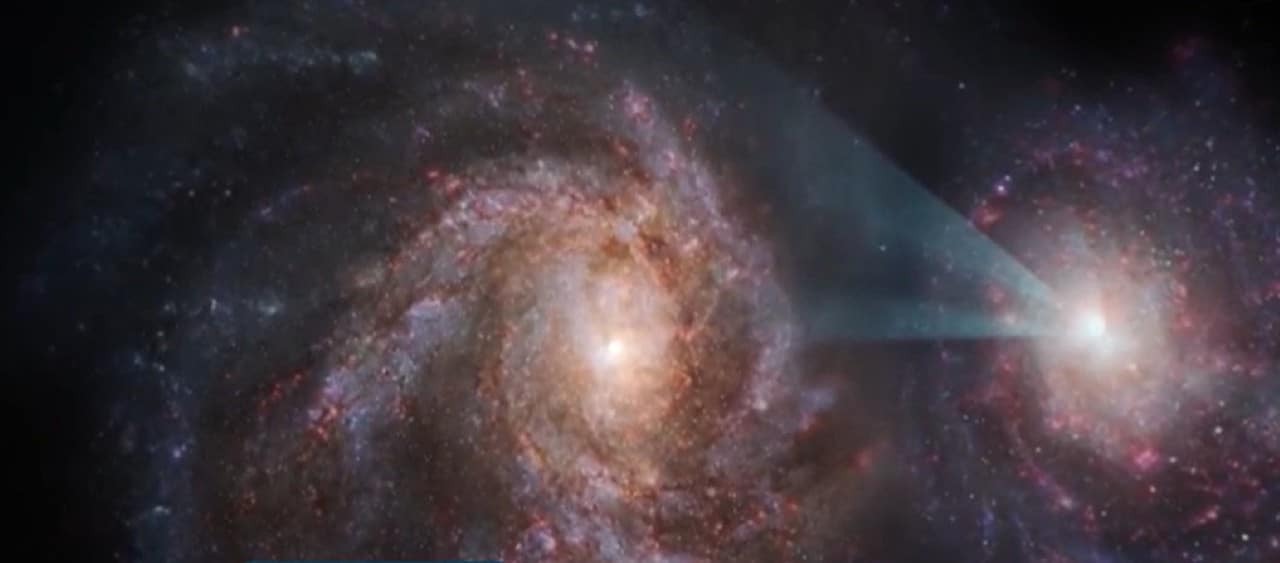
Astronomers led by researchers at Universidade and Yale announced the confirmation of the first runaway supermassive black hole, named RBH-1. Esse object, with a mass equivalent to at least 10 million times that of Sol, is moving at approximately 3.4 million kilometers per hour, or 954 kilometers per second, towards intergalactic space.
Observations carried out with Telescópio Espacial James Webb identified a shock wave in front of the black hole and a trail of star formation that extends for about 200 thousand light years. The structure is located at a distance corresponding to 7.5 billion light years from Terra. Essa discovery validates theoretical predictions about extreme ejections from supermassive black holes.
- RBH-1 was initially detected in 2023 through images from Telescópio Hubble.
- Data from the NIRSpec instrument on James Webb allowed measuring velocities of the heated gas.
- The analysis revealed spectral shifts that indicate supersonic motion.
Observations from James Webb
The Telescópio Espacial James Webb provided decisive evidence for the confirmation of RBH-1. Instrumentos infrared beams captured the gas compressed by the shock wave, revealing abrupt speed differences of about 600 kilometers per second.
These measurements showed a blueshift at the front of the structure and a redshift at the outer edges. Tal pattern can only be explained by the rapid passage of a massive object through the intergalactic medium.

Ejection mechanism
The ejection of RBH-1 probably occurred after the merger of two galaxies, which brought their central black holes together. The asymmetric release of gravitational waves generated a recoil capable of propelling the resulting black hole out of the galactic core.
Theoretical models indicate that speeds such as the one observed are compatible with this process. Outra possibility involves interaction with a third black hole, but the data favors gravitational recoil.
Star formation trail
The movement of RBH-1 compresses the gas around it, creating conditions for the birth of new stars along its wake. Essa trail extends for 200 thousand light years and represents an unexpected consequence of the object’s passage.
The compression of the intergalactic medium by the shock wave heats and densifies the material. Isso triggers gravitational collapse processes that form stars in previously empty regions.
The phenomenon demonstrates how escaping black holes can influence the distribution of matter in Universo. The observed star formation is equivalent to hundreds of millions of solar masses worth of new stars.
Features of the RBH-1
The RBH-1 black hole has an estimated mass of 10 million times that of Sol and is approximately 230,000 light-years away from its home galaxy. Sua speed allows you to permanently escape galactic gravity.
The associated structure, dubbed Coruja Cósmica, involves a pair of interacting galaxies. The trail’s favorable alignment with the line of sight of Terra facilitated accurate measurements.
Ancient theoretical predictions
Theories developed around 50 years ago predicted the possibility of supermassive black holes being expelled by gravitational recoil. Até now, clues existed, but no direct confirmation had been obtained.
The discovery of RBH-1 represents the first robust observational evidence of this phenomenon. Ela opens up avenues for searches for other objects similar to Universo.
Supermassive black holes often anchor the centers of galaxies and regulate their evolution. Casos of ejection indicate that galactic mergers can drastically alter this configuration.
Technical details of measurements
The James Webb observations mapped the velocity distribution in the surrounding gas. The difference between the material in front of and behind the shock wave confirmed the black hole’s supersonic motion.
Spectra revealed emission lines inclined with respect to Terra. Essa slope allowed accurate calculations of the radial velocity component.
Abandoned host galaxy
The galaxy that housed RBH-1 now lacks a central supermassive black hole. Simulações suggest that this does not significantly affect its long-term structure.
The absence of the gravitational core could alter future star formation patterns. However, total stellar mass remains dominant in galactic dynamics.



