
James Webb Telescope confirms oldest supernova, dating back 13 billion years in the cosmos


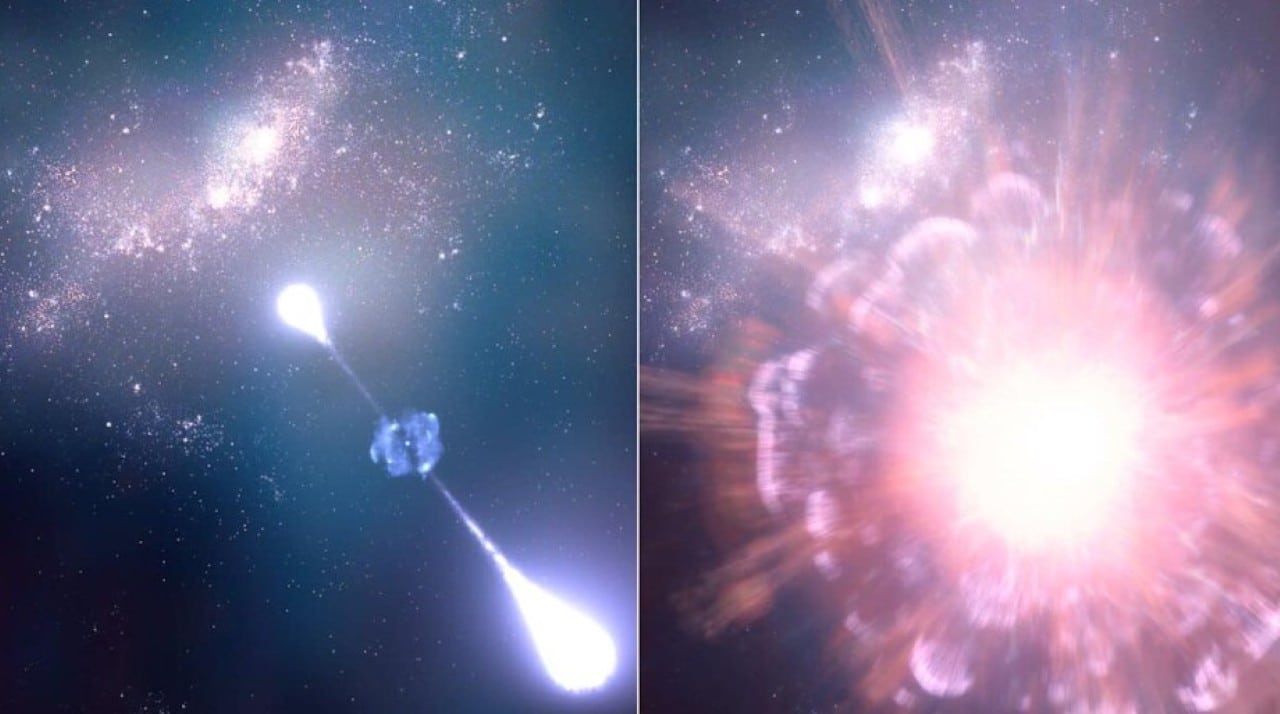
Telescópio Espacial James Webb made a monumental discovery by identifying the oldest supernova ever recorded, a cosmic event that occurred approximately 13 billion years ago. Essa stellar explosion occurred when Universo was only 730 million years old, which represents about 5% of its current age estimated at 13.8 billion years, redefining the previous record for observing a similar phenomenon. The detection provides new insights into the formation of the first generations of stars and galaxies at the dawn of cosmic time.
Astronomers have confirmed that the supernova, associated with the gamma-ray burst GRB 250314A, has characteristics surprisingly similar to modern stellar explosions, defying expectations about the differences in such remote events. Pela for the first time for such a distant phenomenon, Webb not only recorded the explosion, but also captured images of the host galaxy, providing crucial data about the primordial cosmic environment.
The journey of discovering the oldest supernova
The identification process began with the detection of a gamma ray burst by the Franco-Chinese SVOM satellite. Este instrument, launched in 2024, is specialized in capturing high-energy transient events in deep space, alerting the scientific community about the occurrence of a phenomenon of great magnitude.
In less than two hours after the initial alert, the Neil Gehrels Swift observatory, Nasa, was able to locate the exact source of the X-rays in the sky. Essa precise location was essential, as it allowed other observatories to be quickly directed to the region, optimizing subsequent observations.
Telescópio Óptico Nórdico, located at Ilhas Canárias, recorded an infrared afterglow. Essa detection was a crucial indication that the phenomenon in question could be extremely distant, requiring the observation capacity of even more powerful instruments.
Global synchrony in observing the cosmos
Hours after the initial Swift alert, the Very Large Telescope (VLT), located at Chile, estimated the age of the event at 730 million years after Big Bang. Todo this detection and initial estimation process occurred in a remarkably short time, less than 17 hours, demonstrating the efficiency of the observatory network.
Telescópio Espacial James Webb went into action with observations scheduled for July of the same year. Scientists had planned for this specific period because the supernova’s light, stretched by the continued expansion of Universo, reaches its peak brightness months after the initial burst, making it easier to capture.
Definitive confirmation of the supernova came via Webb’s NIRCam instrument, which is known for its sensitivity to infrared wavelengths. The images revealed a faint but distinct red dot that directly corresponded to the location of the starburst.
This speed of coordinated response between global observatories, including satellites in orbit and ground-based and space telescopes, highlights the ability of modern science to unravel cosmic phenomena of extreme distance and complexity, maximizing the chances of collecting valuable data.
Surprising similarities to recent supernovae
Researchers expected to find significant differences in stellar explosions this old. The theory suggested that early stars were probably more massive, had fewer heavy elements in their composition and had much shorter lives, which should be reflected in the nature of their supernovae.
However, the supernova observed by Webb revealed chemical traces and spectra surprisingly compatible with stellar collapses that occur in closer, more modern stars. Essa similarity challenges some preexisting models and suggests that starburst processes may have stabilized earlier in cosmic history than previously imagined.
Details of stellar and galactic composition
Detailed spectra of the supernova indicated a chemical composition similar to that of local supernovae, suggesting that starburst processes stabilized early in cosmic history. The likely formation of a black hole remnant was also inferred, with no profound variations expected for young Universo, offering a glimpse into the uniformity of certain astrophysical events over time.
The high-resolution images from Webb made it possible, for the first time, to identify the galaxy where the star exploded, a remarkable feat for such a distant event. The galaxy appears tenuous and compact, occupying few pixels in the captures, but even with this limitation, astronomers have already discerned regions of intense star formation within its primordial structure.
[[_0]
Unraveling the host galaxy
This observation of the faint, compact host galaxy opens new avenues for the direct study of galactic environments in the primordial Universo, promising to reveal more about the composition and formation of these ancient structures and how they influenced early cosmic evolution.
The scientific value of GRB 250314A
Gamma-ray bursts in the first billion years of Universo are exceptional, with only a handful recorded in this time range in the last 50 years. Esse fact makes GRB 250314A an invaluable object of study for science, given its rarity and the wealth of information it can provide.
The event highlights Telescópio James Webb’s ability to detect individual stars at such remote times, something that was unthinkable until recently. Isso represents a fundamental advance in understanding the formation of the first stellar generations and early cosmic evolution, opening new frontiers in astrophysics.
Implications for cosmic and stellar evolution
International teams of scientists have already received approval to observe more gamma-ray bursts with Webb. The main focus will be on afterglows, which provide unique fingerprints of the host galaxies and environments where these extreme events occur. Essas Additional research will help map galactic evolution in the young Universo in more detail, clarifying the conditions that led to the formation of heavy elements essential to life. Webb thus continues to significantly expand knowledge about cosmic origins, and observations like this are rewriting models of stellar and galactic evolution.



