
Visitor from another 3I/ATLAS system moves away from Earth after closest point


The interstellar comet 3I/ATLAS reached its closest approach to Terra on December 19, 2025, passing at a safe distance of approximately 270 million kilometers. Esse object, a third party confirmed to be of external origin to Sistema Solar, did not pose any threat of collision.
Discovered in July 2025 by the ATLAS system in Chile, the comet exhibited intense activity with a coma and tail during its trajectory. Sua hyperbolic orbit, with eccentricity greater than 6, confirmed the interstellar origin.
Coordinated observations by space and ground-based telescopes have recorded valuable data about their composition and behavior. The comet now moves away definitively, escaping the gravitational influence of Sol.
Discovery and confirmation
Comet 3I/ATLAS was initially detected on July 1, 2025 by telescopes from the ATLAS program. Observações pre-discovery date back to June, when the object was crossing dense star fields.
Its hyperbolic trajectory quickly indicated an origin outside of Sistema Solar. International Equipes confirmed the classification as an active comet in the following days.
Trajectory at Sistema Solar
The 3I/ATLAS entered Sistema Solar at speeds in excess of 60 km/s. Ele passed perihelion on October 29, 2025, 1.36 astronomical units from Sol.
After this phase, the comet headed towards Earth in December. In March 2026, it should pass close to Júpiter, receiving slight gravitational disturbance.
The high speed guarantees definitive output in the coming decades. The object will not return to Sistema Solar.
Observed activity
The comet developed an extensive coma and visible tail during its approach to Sol. Observações spectroscopy detected carbon dioxide, carbon monoxide and traces of water.
- Initial red coma due to dust
- Evolution to post-perihelic greenish tones
- Nickel and cyanide emissions in typical proportions
These characteristics indicate formation in an environment distinct from local comets. Activity remained stable without intense outbreaks.
Composition revealed
Analysis indicates richness in carbon dioxide and volatiles similar to solar comets. Atypical Proporções suggest origin in a distant protoplanetary disk.
X-ray data has detected unprecedented emissions for interstellar objects. The estimated core varies between 440 meters and 5.6 kilometers in diameter.
Multispectral observations provided clues about billionaire age. The comet may preserve primordial material from another star system.
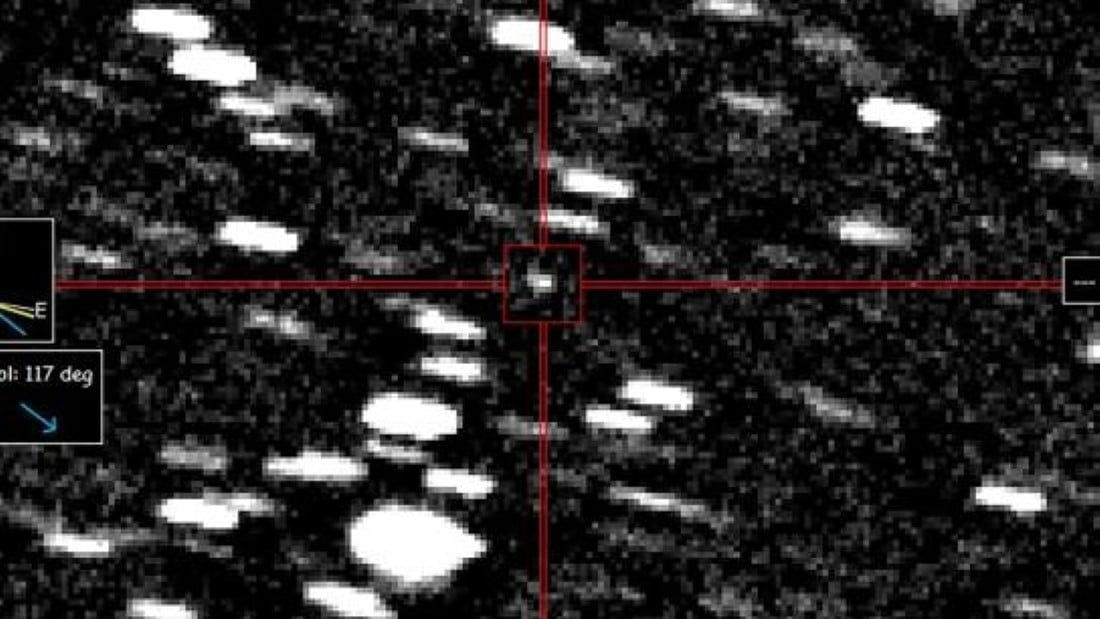
Comparison with predecessors
3I/ATLAS differs from ‘Oumuamua, which did not exhibit clear coma. Similar to Borisov, showed evident cometary activity.
Its speed is the highest recorded among the three objects. Orbital eccentricity surpasses previous visitors.
- ‘Oumuamua: elongated shape, without prominent tail
- Borisov: composition closer to local ones
- 3I/ATLAS: intense tail, unique emissions
These variations enrich studies on interstellar diversity.
Recent observations
Telescopes such as Hubble and James Webb captured detailed images of the coma. Registros of November showed an elongated structure.
Ground-based observatories followed the comet in the constellation Leão. The brightness gradually decreased upon approach.
Coordinated campaigns involved orbital missions. Dados continue to be analyzed by global teams.
Departure of Sistema Solar
3I/ATLAS now heads to external regions after passing through Terra. Sua trajectory will take you beyond the solar influence.
The object will escape completely in the coming decades. Essa single pass allowed collection of rare information.
Astronomers estimate that it originates from the thick disk of Via Láctea. Sua age may exceed that of Sistema Solar.
Scientific contributions
3I/ATLAS data advance models of external planetary formation. Comparações chemistry reveals variations in distant environments.
Multi-track observations establish protocols for future visitors. International coordination mobilized diverse resources.
Each interstellar object adds pieces to galactic understanding. Telescópios future ones will detect more similar examples.



