
Last meteor shower of 2025: Ursids reach peak with up to 10 shooting stars per hour

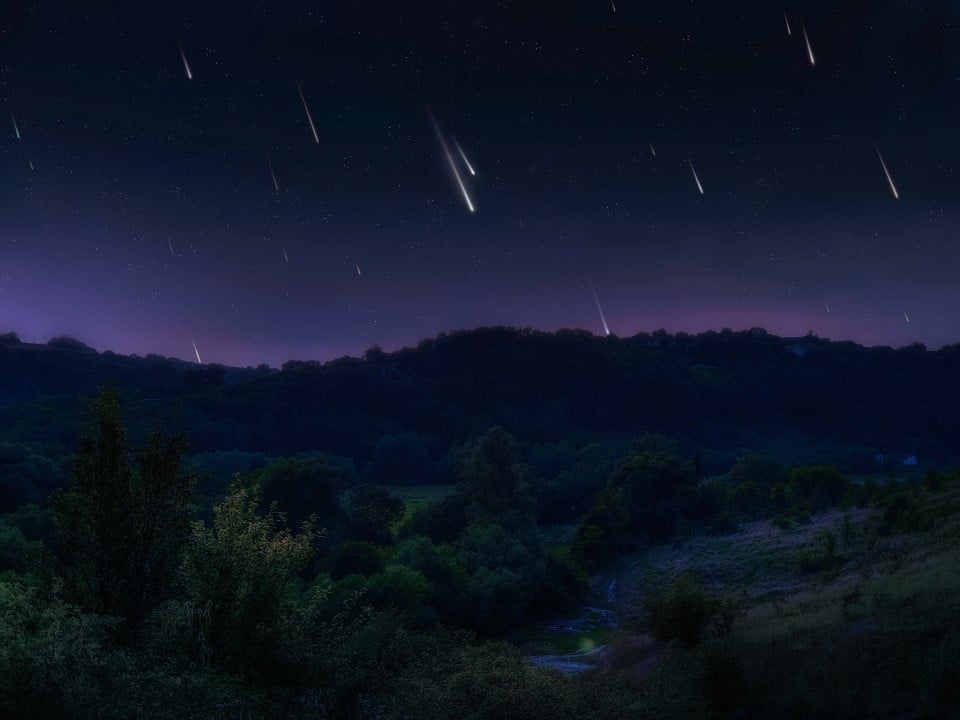
The Úrsidas meteor shower, the last of the year 2025, reaches its maximum activity between the night of December 21st and the early morning of December 22nd.
Observers at Hemisfério Norte can expect up to 10 meteors per hour under ideal conditions.
The phenomenon coincides with the winter solstice, offering long nights and dark skies due to its proximity to the new moon.
- Visible mainly on Hemisfério Norte.
- Radiant located in the constellation of Ursa Menor.
- Expected hourly rate between 5 and 10 meteors.
Origin of the phenomenon
The Úrsidas meteors appear when Terra passes through a debris stream left by comet 8P/Tuttle.
This periodic comet releases particles into its orbit around Sol.
The particles enter the Earth’s atmosphere and burn, producing luminous streaks in the sky.
The radiant, the point where the meteors appear to originate, is close to the star Kochab, in Ursa Menor.
The Geminídeas meteor shower reaches its peak between tonight and tomorrow morning, being considered one of the most intense and beautiful of the year. Under ideal conditions, it is possible to observe dozens of meteors per hour, many of them bright and with long trails in the sky.
— JAMES WEBB (@jameswebb_nasa)December 13, 2025
THE…pic.twitter.com/oPZdmnhhRf
Observation conditions
This year, the skies are particularly favorable for viewing Úrsidas.
The new moon occurred on December 20, leaving dark nights during its peak.
The radiant remains above the horizon all night for northern latitudes.
Experts recommend locations away from light pollution to maximize the chances of a sighting.
Activity is lower than that of Geminídeas, but surprises with higher rates have already occurred in previous years.
Tips to observe
Choose a dark place away from artificial lights.
Lie down or use a reclining chair to cover a wide area of the sky.
Allow your eyes to adapt to the darkness for at least 20 minutes.
- Wear warm clothes as December nights are cold.
- Observe for at least an hour to capture variations in activity.
- Direct your gaze north, but meteors can appear in any direction.
- No special equipment required, just direct vision.
Visibility by region
The Úrsidas meteor shower is almost exclusive to Hemisfério Norte.
At Hemisfério Sul, the radiant does not rise high enough in the sky for good observation.
At more northern latitudes, the radiant becomes higher, increasing the number of meteors visible.
Urban regions reduce the rate to less than 5 per hour due to light pollution.
Upcoming celestial events
The year 2026 begins with the Quadrântidas meteor shower in January.
This rain is known to produce brilliant fireballs.
The Lua of the Lobo, January’s full moon, coincides with part of the activity of the Quadrântidas.
Other phenomena, such as planetary conjunctions, mark the astronomical calendar for the new year.
Characteristics of meteors
The Úrsidas have an average speed when entering the atmosphere.
Luminous traces are of moderate duration.
Occasionally, they produce brighter meteors.
The constellation of Ursa Menor, with Estrela Polar, serves as a reference to locate the radiant.



