
Unprecedented stellar trail is generated by a supermassive black hole on a cosmic escape route


A runaway supermassive black hole, known as RBH-1, has been confirmed by astronomers, marking the first detection of this type of phenomenon. With a mass equivalent to 10 million times that of Sol, the cosmic object moves at an impressive speed of 954 kilometers per second, or 3.5 million kilometers per hour, through the vast intergalactic space, leaving behind an extensive and luminous trail of forming stars.
The discovery occurred in a pair of colliding galaxies, dubbed Cosmic Owl, located approximately 9 billion light years from Terra. Observações detailed data taken in 2025 by Telescópio Espacial James Webb were crucial to validating the preliminary evidence that Hubble had captured in 2023.
These analyzes unequivocally revealed the presence of a supersonic shock wave preceding the black hole, as well as a wake of compressed intergalactic gas that follows it, indicating an unprecedented star formation process.
Cosmic ejection dynamics
The ejection of RBH-1 is attributed to a complex scenario of the merger of multiple supermassive black holes, which occurred during the violent collision of the galaxies. Quando these cosmic giants come together, they release gravitational waves in an asymmetrical way, a phenomenon that generates a gravitational “kick”. Este recoil is powerful enough to propel the newly formed black hole out of the galactic center of its host galaxy, launching it on a lonely journey through the cosmos.
This particular dynamic often involves three-body interactions, where an “intruder” black hole collides with an already existing binary pair. The energy released by this gravitational recoil is what allows the object to reach such high speeds, overcoming the gravitational pull of the galaxy and transforming it into an intergalactic traveler.
Crucial Observations from James Webb
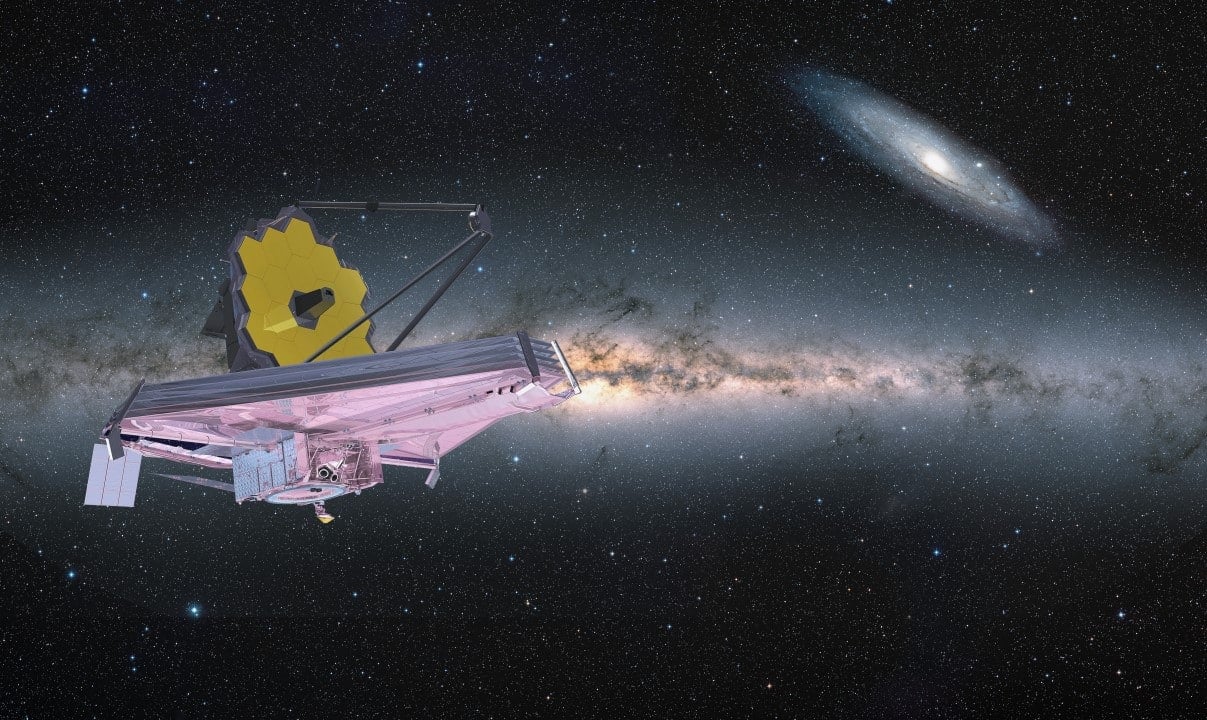
Telescópio Espacial James Webb played a fundamental role in elucidating this phenomenon. Utilizando their NIRSpec instrument, astronomers examined the 200,000 light-year linear structure initially identified by Hubble.
The data obtained by Webb confirmed the existence of a shock wave in front of the black hole, where intergalactic gas is intensely compressed and heated.
[[_0]
In the wake of the object, a trail of cooled gas forms which, under compression conditions, collapses and gives rise to new stars. The combined mass of these stars is estimated to be a staggering 100 million solar masses.
Detailed spectroscopic measurements confirmed significant variations in the speed of the gas, reaching 600 km/s at short distances, a data that is consistent only with the presence of a massive object in accelerated motion.
– Onda frontal shock indicates compression of intergalactic gas.
– Trilha posterior of young stars extends 62 kiloparsecs.
– Ausência of nuclear activity in the original galaxy corroborates the ejection.
– Velocidade measurement is directly related to the gas displacement.
The identity of RBH-1
RBH-1, with its mass of at least 10 million solar masses, is categorized as a supermassive black hole. Sua speed of 954 km/s enables him to definitively escape the gravitational pull of his home galaxy, consolidating his status as a cosmic wanderer.
Your journey through the Cosmic Owl galaxies creates a visible formation that resembles a wake left by a ship in the ocean. Observing from 9 billion light years away means we are witnessing an event that occurred when the universe was approximately half its current age.
Stars born amid escape
The supersonic movement of the black hole exerts considerable compression on the rarefied gas present in the intergalactic medium. Essa compression creates the ideal conditions for the gravitational collapse of the gas.
As a result, young, extremely hot stars emerge along the trail, becoming visible through infrared observations. The total mass of these new star formations could reach hundreds of millions of solar masses.
This phenomenon offers a unique opportunity to study star formation in environments other than traditional galaxies, expanding our understanding of the mechanisms of star creation in the universe.
Relevance to galactic mergers
Galaxy mergers are frequent cosmic events, especially prominent in the oldest eras of the universe, and confirmation of RBH-1 suggests that ejections from supermassive black holes may be more common than previously thought. Tais events release amounts of energy equivalent to billions of supernovae, exerting a significant influence on galactic evolution. By removing the central black hole, which plays a crucial role in regulating stellar growth, these phenomena fundamentally alter the developmental trajectory of galaxies. Future Pesquisas, using advanced telescopes like Nancy Grace Roman, may reveal more similar cases, deepening understanding of the dynamics and consequences of these cosmic collisions.
The discovery and validation process
The linear structure that led to the discovery was initially detected in 2023 by images of Hubble, being interpreted as an artifact. Contudo, subsequent analysis revealed the true nature of the trail, culminating in the hypothesis of a runaway black hole.
The peculiarity of galaxies Cosmic Owl
The Cosmic Owl galaxies have a distinctive ring shape, the direct result of a recent head-on collision. Analysis of their active nuclei indicates the previous presence of supermassive black holes, but the current absence of a strong nuclear signal in one of the galactic centers reinforces the RBH-1 ejection hypothesis.
This unusual configuration, reminiscent of owl eyes and beak in composite images, was a key factor that facilitated detection of the linear trail and subsequent identification of the fleeing black hole by telescopes.
The runaway black hole continues its journey through empty space, with the potential to interact with other galaxies in future eras. The shock wave it generates can even trigger new star formations in subsequent encounters.
This groundbreaking discovery opens new avenues for further studies of gravitational dynamics on cosmic scales and leads astronomers to plan systematic searches for similar objects in comprehensive astronomical surveys.



