
Astronomers monitor 3I/ATLAS, an interstellar visitor that generates facts and rumors on its trajectory through the Solar System


Interstellar comet3I/ATLASThis week completes its closest approach to Terra, around 270 million kilometers away, without posing any risk of collision. Descoberto on July 1, 2025 by the ATLAS telescope on Chile, the object is the third confirmed visitor from outside Sistema Solar, after ‘Oumuamua and Borisov. Sua hyperbolic trajectory and high speed, exceeding 200 thousand km/h, confirm the external origin.
Observations from telescopes such as Hubble and James Webb reveal a carbon dioxide-rich coma and typical cometary activity. The comet reached perihelion on October 29, within the orbit of Marte, and is now moving away from Sol.
- NASA and ESA missions have captured detailed images at multiple wavelengths.
- Data indicates a core between 440 meters and 5.6 kilometers in diameter.
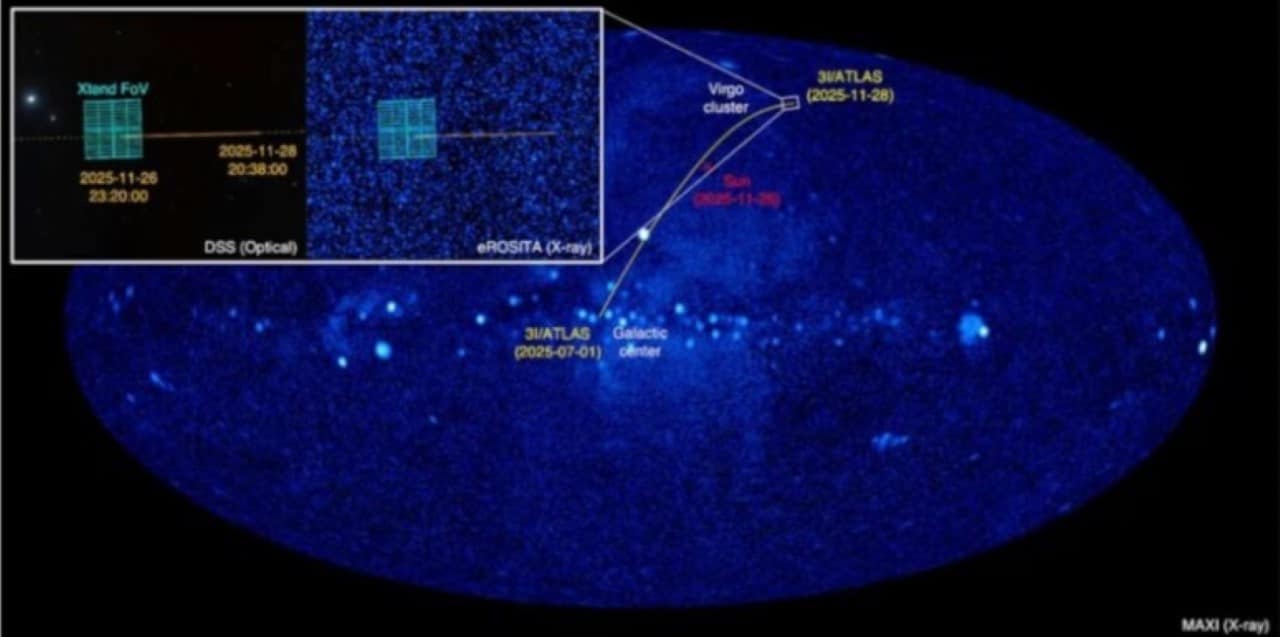
- X-ray and radio emissions have been detected for the first time from an interstellar object.
Discovery and initial trajectory
The ATLAS telescope identified 3I/ATLAS near the orbit of Júpiter, moving toward Sol. Observações initials confirmed a coma and diffuse tail, classifying it as an active comet. Sua excessive hyperbolic speed indicated that it is not tied to solar gravity.
Astronomers tracked prediscovery images until May 2025. The object exhibited non-gravitational acceleration, explained by gas ejection.
Chemical composition revealed
Spectroscopic analyzes detected an abundance of carbon dioxide in the coma, stretching hundreds of thousands of kilometers. Presença of atomic nickel and other elements suggests formation in an environment different from solar comets.
Studies propose cryovolcanism, with ice volcanoes releasing frozen materials. The composition indicates an age greater than 7 billion years, prior to Sistema Solar.
Space mission observations
Several probes recorded the comet during its passage. Hubble captured tail and anti-tail in images from July and November.
Missions at Marte, such as MAVEN and Mars Express, obtained close views in October. Parker Solar Probe and Juice also contributed unique data.
- Telescopes on the ground detected a characteristic green glow.
- X-ray emissions revealed extensive gas cloud.
- Post-perihelic changes included increased activity.
Speculations and denials
Rumors circulated associated the comet with technological origins or secret NASA protocols. Atrasos in image release were attributed to calibration and administrative outages, not obfuscation.
Experts have rejected alien hypotheses, reinforcing evidence of natural behavior. Observações consistent confirm cometary features.
Post-perihelic activity
After perihelion, 3I/ATLAS exhibited jets and acceleration explained by uneven sublimation of gases. Recent Imagens show a more prominent tail and varied brightness.
The object will approach Júpiter in March 2026, slightly changing its route before leaving Sistema Solar permanently.
3I/ATLAS provides valuable data on the formation of distant planetary systems. Sua passage highlights advances in telescopes and international coordination for studying rare objects.



