
Interstellar comet 3I/ATLAS moves away after closest approach to Earth in December 2025 in the solar system


The interstellar comet3I/ATLASit reached its closest approach to Terra on December 19, 2025, passing at a safe distance of approximately 270 million kilometers. Esse point marks the end of its closest passage through the planet, without any risk of collision, while the object begins its return journey to the external regions of Sistema Solar. Descoberto in July 2025 by the ATLAS system, the comet represents the third confirmed object of interstellar origin to cross our cosmic neighborhood.
Astronomers intensely monitored this approach, using ground- and space-based telescopes to collect data on its composition and behavior. 3I/ATLAS exhibited activity typical of comets, with the release of gases and dust, which allowed detailed observations even at great distances.
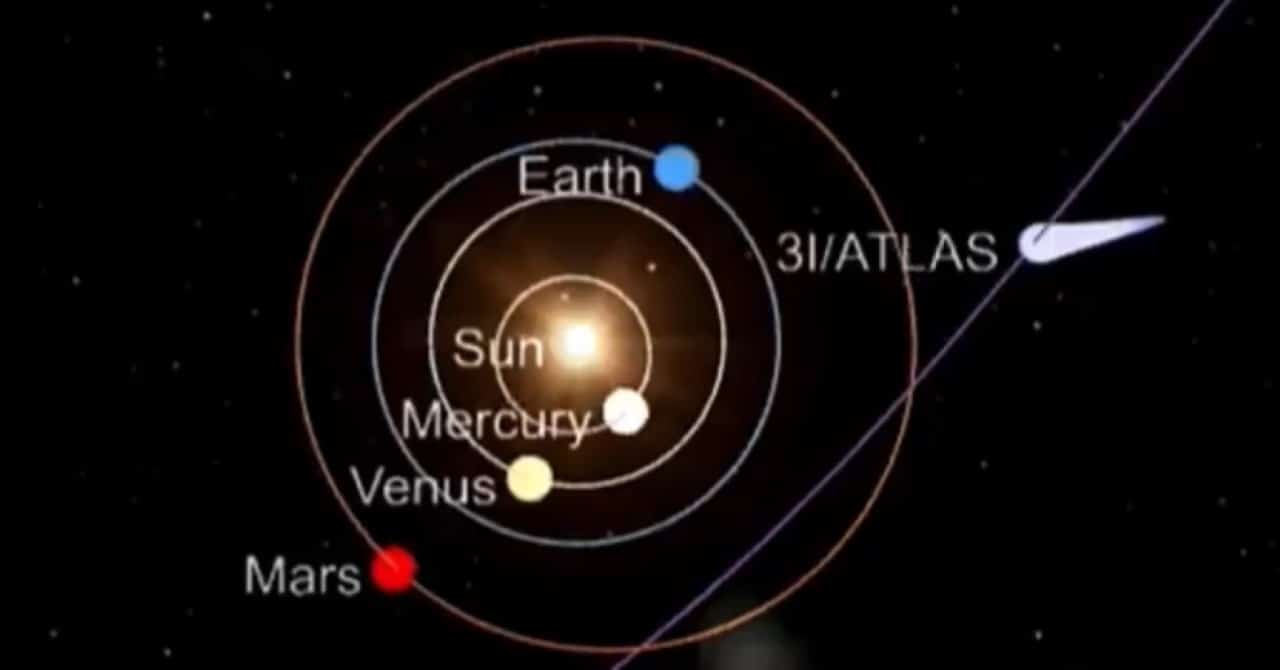
- Minimum distance from Terra: 270 million km (1.8 astronomical units).
- Relative speed: greater than 200 thousand km/h.
- Perihelion (approximation to Sol): occurred on October 29, 2025.
These parameters confirm its hyperbolic trajectory, characteristic of objects not gravitationally bound to Sol.
Discovery and confirmation of interstellar origin
The NASA-funded ATLAS telescope system located at Chile detected the comet on July 1, 2025. Initial Observações indicated an unusual trajectory, suggesting origin outside of Sistema Solar, which was quickly confirmed by global analyses.
The object was given the designation 3I/ATLAS, making it the third known interstellar after 1I/’Oumuamua (2017) and 2I/Borisov (2019). Sua high speed and orbital eccentricity greater than 1 reinforce this classification.
Pre-discoveries in archived images go back to June 2025, allowing for early refinement of the orbit.
Trajectory through Sistema Solar
3I/ATLAS entered Sistema Solar from the direction of the constellation Sagitário, passing within the orbit of Marte. Seu perihelion occurred in October 2025, about 210 million kilometers from Sol, where it exhibited an unexpected increase in brightness due to ice sublimation.
After this phase, the comet headed towards Terra for the December approach, maintaining a safe distance. Agora, he heads for a distant encounter with Júpiter in 2026, before definitively leaving Sistema Solar in the 2030s.
The hyperbolic trajectory guarantees that it will not return, making the current observations unique for studying primordial material from another star.
This pass allowed comparisons with local comets, revealing similarities in activity but subtle differences in composition.
Highlighted scientific observations
Telescopes like Hubble have captured detailed images of the comet’s nucleus and coma, estimating its diameter at between 440 meters and 5.6 kilometers. Missões as Parker Solar Probe and probes at Marte recorded data at multiple wavelengths, including X-rays for the first time from an interstellar object.
The comet showed a dust and ion tail, as well as an anti-tail in some phases. Análises indicate the presence of water, carbon dioxide and other compounds, similar to Sistema Solar comets.
Studies suggest an age greater than 7 billion years, originating in the thick disk of Via Láctea.
These observations enrich the understanding of the formation of distant planetary systems.
Composition and recorded activity
The 3I/ATLAS presented a reddish coma, indicative of dust, and released gases when approaching Sol. Observações revealed a relative excess of certain elements, such as nickel, slightly differentiating it from native comets.
Cryovolcanic activity has been suggested in recent images, with eruptions of underground ice. The brightness exceeded expectations during perihelion, allowing detections by solar satellites such as SOHO and STEREO.
Spectroscopic data confirms the presence of carbon monoxide and other volatiles.
These traces provide clues about conditions in ancient star systems.
Legacy of 3I/ATLAS observations
The comet’s passage mobilized a global network of instruments, including James Webb and planetary missions. The data collected will continue to be analyzed in the coming years, contributing to models of interstellar objects.
Estimates indicate that such visitors are rare, but advances in surveys increase the chances of future detections. 3I/ATLAS reinforces chemical diversity in interstellar space.
Amateur observations with medium telescopes were possible in brighter phases, engaging the astronomical community.
This unique visit expands knowledge about Via Láctea beyond Sistema Solar.
Monitoring continued until the comet became very faint, marking the end of a valuable scientific opportunity.



