
Powerful solar flare X1.9 causes challenges for monitoring comet 3I/ATLAS in 2025


Administração Nacional Oceânica and Atmosférica (NOAA) recorded an X1.9-class solar flare last Monday, December 1, 2025.
Strong activity in the active region of Sol resulted in a coronal mass ejection (CME), a phenomenon that could directly impact space research and monitoring instruments. Cientistas around the world are adjusting their protocols to mitigate potential interference and ensure accurate data collection about the comet.
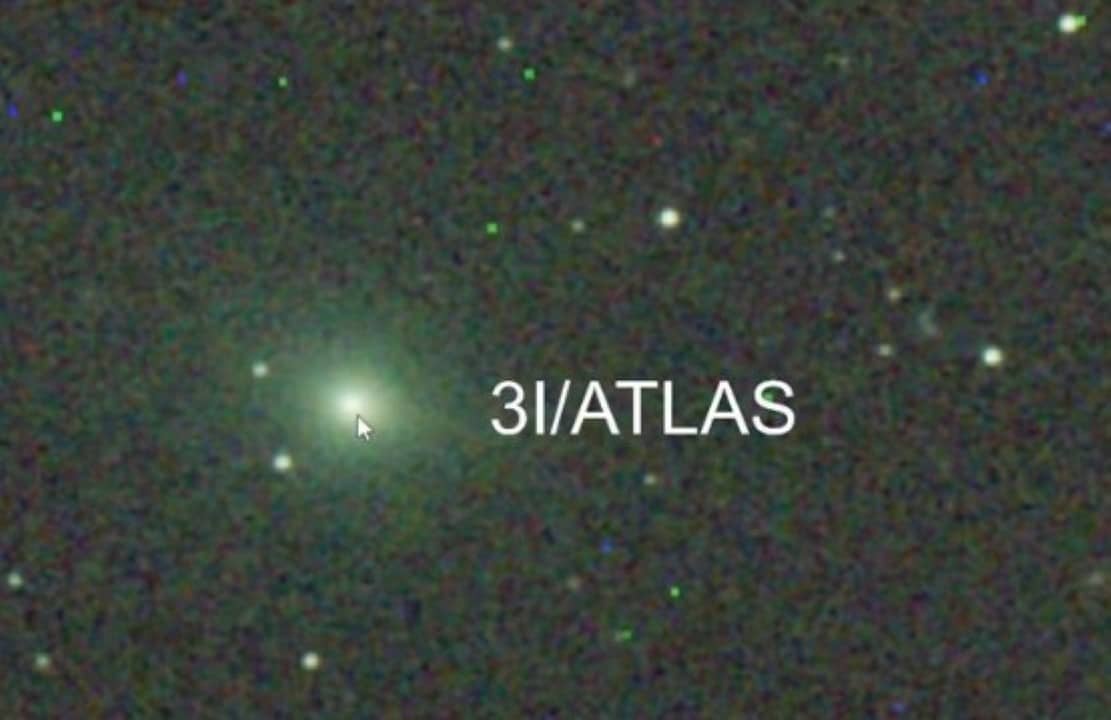
3I/ATLAS, discovered in July 2025 by the ATLAS system at Chile, represents the third confirmed interstellar object, following 1I/ʻOumuamua and 2I/Borisov. Sua hyperbolic trajectory confirms its origin outside of Sistema Solar, making each observation crucial to understanding exoplanetary systems.
Impact of X1.9 eruption on measurements
The temporal coincidence of the solar eruption with the approach of the comet arises in a period of intense solar activity, with the solar wind reaching speeds exceeding 650 km/s. Esta dynamics create a complex environment for capturing data, affecting the comet’s ionic tail and deflecting particles. The solar region affected by the eruption will rotate to face Terra in the coming days, increasing the potential for magnetic disturbances that could interfere with satellites and communications systems.
Electrons in geosynchronous orbit recorded peaks of 8,300 pfu, indicating an intensification of the flow of energetic particles. Essa overhead significantly complicates readings from space telescopes designed to detect subtle signatures of celestial objects. Equipes researchers are working to develop new image processing algorithms that can filter out noise generated by solar activity and preserve the integrity of data collected from 3I/ATLAS.
The magnetic component Bz, which dropped to -6 nT, signals an instability in interplanetary magnetic fields. Essa condition enhances magnetic reconnections that alter the comet’s interaction with the interstellar plasma. Tais variations can mask valuable information about the organic composition of the comet’s nucleus, which is believed to preserve elements from its home star system.
Solar event details
The X1.9-class solar detonation released an amount of energy equivalent to billions of atomic bombs, propagating a visible shock front across the entire surface of Sol. Este event destabilized a nearby magnetic filament, triggering a secondary explosion on the opposite side of the star, which was observed by several observatories.
Observatories like NASA’s Solar Dynamics Observatory captured the process in real time, providing crucial data on the magnitude and spread of the eruption. Regiões of plasma were evacuated, with a noticeable dimming in X-ray images. The resulting coronal mass ejection travels at high speeds and, although directed partially out of Terra’s direct line of sight, could still cause disruptions to the Earth’s space environment within days.
Notable Features of 3I/ATLAS
Comet 3I/ATLAS exhibits an inexplicable acceleration in its trajectory, accompanied by rotational pulses detected by high-precision spectrometers. Jatos of non-radial gas emerges from its coma, which has grown from 13 thousand km in June to 18 thousand km in July 2025, an indication of persistent activity even at a distance of 1.4 AU from perihelion.
Its chemical composition includes reddish micrometric dust, similar to that found on D-type asteroids, but with irradiated tholin emissions, suggesting complex organic chemistry. Telescópios terrestrials in Chile and Havaí confirmed the diffuse coma in July, with a 3 arcsecond tail. The lack of large explosions of gas and dust until August indicated relative stability, however, the recent solar flare may amplify its emissions.
Observations from the TESS satellite indicate that the comet has been active since May 2025, when it was at a distance of 6.4 AU from Sol. Pesquisadores of Instituto of Astrofísica of Esta peculiarity reinforces the scientific value of 3I/ATLAS for the study of exoplanetary systems and the formation of comets.
Scientific preparations for the passage
Astronomers around the world are mobilizing global observing networks, including Vera C. Rubin Observatory, to track the movement of comet 3I/ATLAS through the constellations of Virgem and The comet’s luminosity is expected to fall below magnitude 12, requiring the use of medium-sized telescopes for its detection and analysis.
NASA integrates data from several missions, such as Parker Solar Probe and SOHO, to model the impacts of the flare on the heliospheric environment. Predictions indicate that 3I/ATLAS will maintain its nuclear integrity, despite the possibility of intense jets of gas and dust being released due to interaction with the solar wind.
Anomalies observed on the comet
The hyperbolic trajectory of 3I/ATLAS exceeds the speeds expected for objects approaching Sistema Solar, with subtle deviations that suggest as yet unidentified external gravitational influences. Radio Emissões imaged by the MeerKAT radio telescope, in África of Sul, show OH absorption lines with periodic patterns, defying standard cometic models.
The comet’s nucleus, estimated to be 3.5 miles in diameter, demonstrates remarkable resistance to thermal stress, unlike other comets that have fragmented. Recent Imagens Gemini South reveal a broad coma with no visible fragmentation after perihelion. Essa resilience raises questions about the existence of ice crusts, such as carbon dioxide, protecting deposits of water ice inside.
Contributions from space telescopes
Telescópio Espacial Hubble captured images in July 2025, at a distance of 446 million km from Terra, revealing a broad tail pointing east. Telescópio Espacial James Webb (JWST) is analyzing spectra to identify organic compounds preserved in the comet, while the TESS satellite detected early activity in May, indicating atypical behavior.
Probes such as Hera and Europa Clipper performed dives into the comet’s ionic tail in November, recording the phenomenon of magnetic draping, where the comet’s magnetic field lines interact with the solar wind. Data from these missions should reach Terra in February 2026, due to thermal and communication limitations, providing a unique chemical profile of 3I/ATLAS, comparable to that of 2I/Borisov, but with a predominance of larger-grained dust.
Chronology of passage through Sistema Solar
Comet 3I/ATLAS entered Sistema Solar with a speed of 137 thousand km/h, being officially detected on July 1, 2025. Pré-observations, dated June 14, already confirmed its hyperbolic nature.
Its perihelion, the point of closest approach to Sol, occurred on October 29, 210 million km from the star. The closest passage of Marte occurred on October 3, at a distance of 29 million km. The closest approach to Terra is scheduled for December 19, 2025, at a distance of 1.8 astronomical units, or around 270 million kilometers, without any risk of collision. Passage by Júpiter in 2026 will alter its final route into interstellar space. The December 1st flare coincides with solar rotation, increasing risks to radio frequency communications in the Ásia and Austrália regions.



