
Study reveals that impact of the DART mission on an asteroid ejected blocks with unexpected momentum

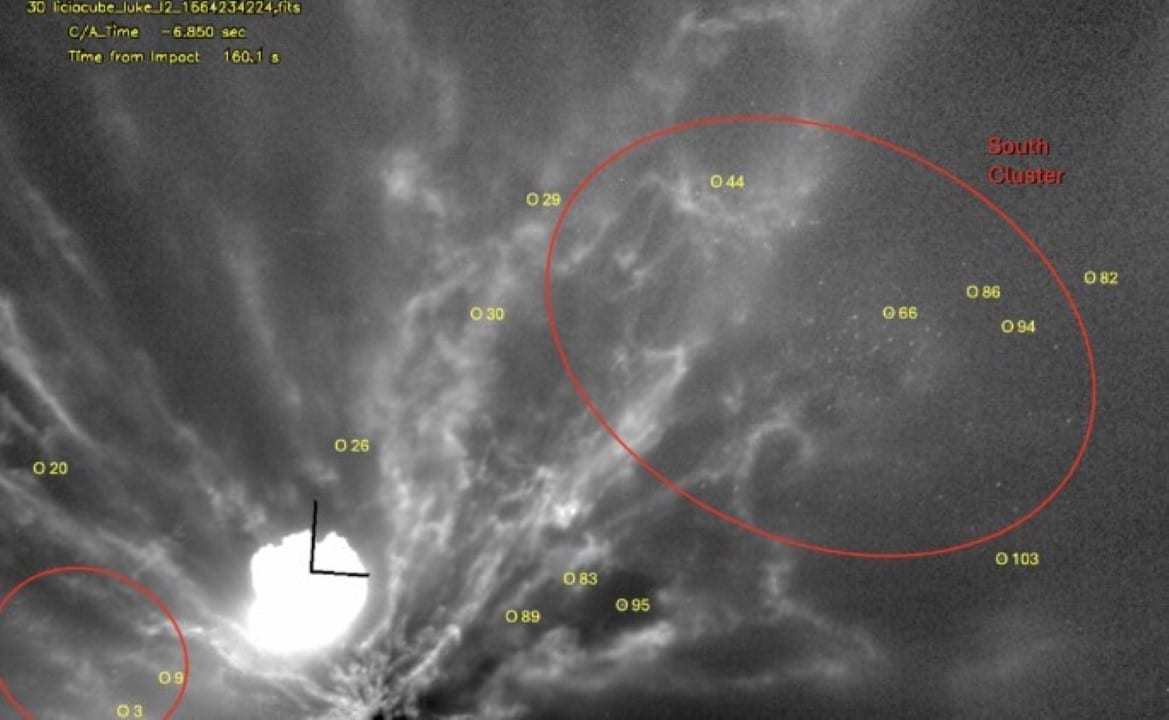
In September 2022, NASA carried out the intentional impact of the DART probe on the asteroid Dimorphos, a satellite of the larger body Didymos. The objective was to test the kinetic impact deflection technique for planetary defense. The test reduced the orbital period of Dimorphos by more than 30 minutes, exceeding initial expectations.
A recent study, published in July 2025 in The Planetary Science Journal, analyzed images captured by the Italian probe LICIACube. The data shows that the impact ejected more than 100 large boulders, with significant secondary effects on the asteroid’s dynamics.
The researchers identified 104 boulders with sizes between 0.2 and 3.6 meters in radius.
Asymmetric distribution of debris
LICIACube images revealed that the boulders did not disperse evenly. Mais of 70% were concentrated in a southern plume, forming two distinct groups.
These clusters indicate secondary impacts from DART solar panels on surface boulders such as Atabaque and Bodhran.
The average speed of the fragments reached 52 meters per second.
Momentum transfer greater than expected
Calculations show that the ejected boulders carried more than three times the momentum of the DART probe. Grande part of this energy acted perpendicular to the original trajectory of the impact.
This additional effect could have tilted the orbital plane of Dimorphos by up to one degree.
The asteroid’s rubble-pile composition, with loose rocks and voids, explains the chaotic ejection.
🌌 The DART mission continues to surprise! ✨
—Sacani (Space Today) – AKA Gordão Foguetes (@SpaceToday1)July 9, 2025
We just discovered that the historic impact with Dimorphos not only changed its orbit, but also launched GIANT rock fragments into space! 🪨💥
Imagine 3.6 meter rocks flying at 187 km/h… It’s like a high-speed train…pic.twitter.com/K79v24exPv
Comparison with previous mission
The Deep Impact mission, in 2005, hit comet Tempel 1 and produced a symmetric and predictable plume.
Tempel 1 had a more uniform surface, with small particles.
Dimorphos, being a cluster of rocks, generated filamentary and chaotic structures in the ejecta.
This difference highlights the importance of surface composition in impacts.
Contribution of solar panels
Researchers believe DART’s solar panels first collided with prominent boulders.
These secondary shocks fragmented the rocks and directed the jets of debris.
The southern cluster probably originates from fragments of the boulder Atabaque, with a radius of 3.3 meters.
Observations from LICIACube
The Italian probe passed through the system minutes after the impact and captured sequences of images.
These photos made it possible to track the three-dimensional positions and speeds of the boulders.
The data complements terrestrial observations and reveals details impossible to detect from a distance.
Next steps with mission Hera
Agência Espacial Europeia plans to launch the Hera probe, arriving at the Didymos-Dimorphos system in 2026.
Hera will map the asteroid’s current shape, the crater formed and the changed rotation.
The mission will refine momentum transfer estimates, including contributions from ejecta.
The results will help update models for real applications in planetary defense.
Features of ejecta field
The debris field formed an asymmetrical cone of dust with filaments and streamers.
Boulders up to meters in size ejected in preferred directions.
The clustered distribution suggests unknown mechanisms acting on the ejection.
- Ejecta cone with larger opening on the north-south axis.
- Absence of material in certain directions.
- Speeds ranging up to 52 m/s.
- Total mass of tracked boulders equivalent to a sphere with a radius of 4.6 meters.
Implications for impact models
Previous models did not fully capture the effects on rubble-pile asteroids.
The rocky, uneven surface of Dimorphos introduced unpredictable physics.
Future strategies need to consider composition and presence of large boulders.
Kinetic deflection remains viable but requires greater accuracy in predictions.



