
NASA’s Mars Reconnaissance Orbiter Achieves Milestone of 100,000 Photos of Mars in Two Decades of Exploration


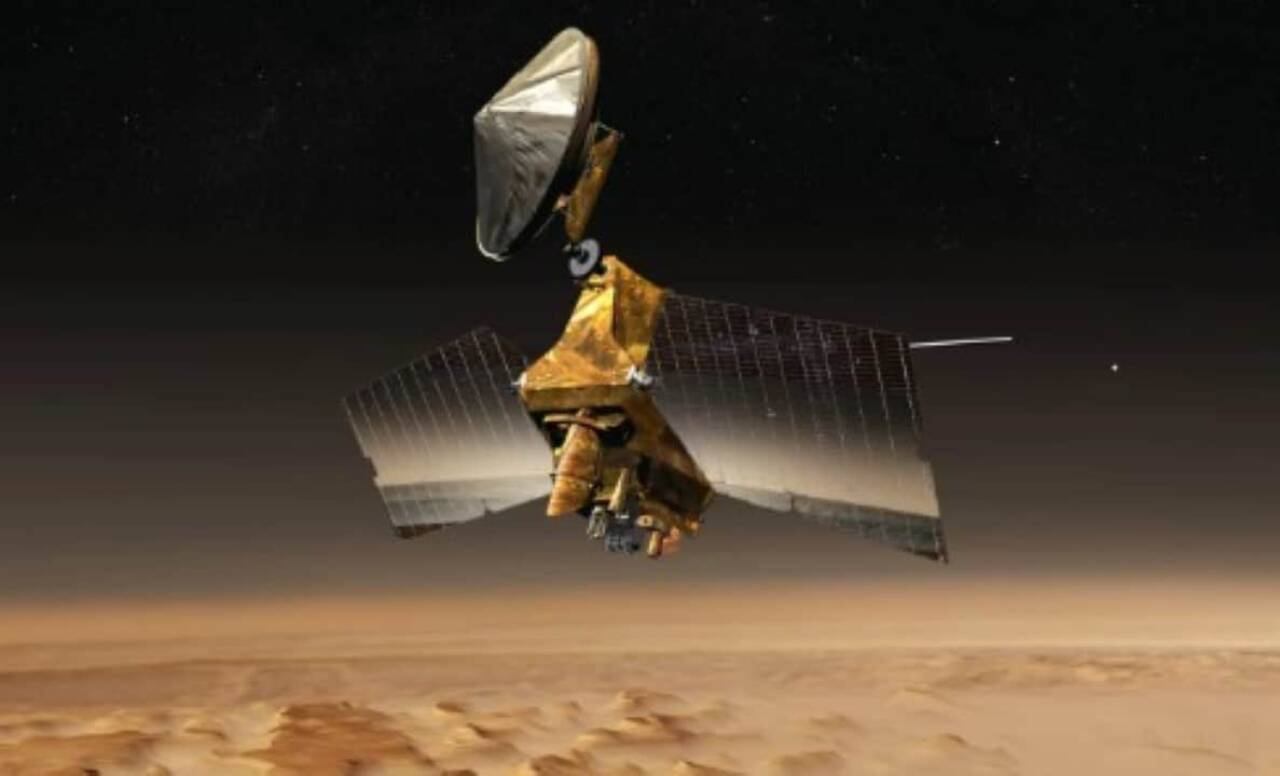
NASA’s Mars Reconnaissance Orbiter (MRO) achieved a remarkable feat by capturing its 100,000th image of Planeta Vermelho. Este milestone underscores the impressive longevity and continued relevance of the mission, which is dedicated to unraveling the mysteries of the Martian surface and its geological history. The probe has been crucial for monitoring environmental changes and looking for signs of past conditions for life.
The most recent recording, carried out with the powerful HiRISE high-resolution camera, brought to light a vast area of active sand dunes. MRO’s ability to identify and document dynamic changes in the landscape of Marte is critical for scientists to better understand the planet’s geological and climate processes.
This important event occurs as the probe approaches the mark of two decades of uninterrupted observation in Martian orbit. Lançada in August 2005 and inserted into the orbit of Marte in March 2006, the spacecraft maintains a rigorous data collection routine, providing a constant flow of valuable information to the global scientific community.
Analysis of the Martian surface
The historic image was taken on October 7, highlighting the region known as Syrtis Major. Essa area is characterized by rock formations, craters and extensive dark dune fields, presenting a complex and rich geological setting for study. Syrtis Major is one of the largest and darkest albedo features in Marte, easily visible from Terra by telescopes.
Located southeast of Cratera Jezero, a site of great interest that houses the bed of an ancient lake, Syrtis Major has been a focal point for MRO observations. The detailed study of this region contributes significantly to the understanding of the interactions between the atmosphere and the Martian surface, revealing details about the composition of the soil and the presence of minerals.
Dune dynamics and Martian winds
Syrtis Major has already been examined on several occasions by Mars Reconnaissance Orbiter, allowing comparative analyzes over time. Observações previews indicate that the region’s dunes move slowly, driven by the action of Martian winds, which, although tenuous, are capable of sculpting the landscape over years. Esse phenomenon is vital to understanding the current geodynamics of the planet.
The HiRISE camera has proven indispensable not only for highlighting the remarkable distinctions between Marte and Terra, but also for documenting the ongoing evolution of the Martian landscape. The advance of sand fields and small landslides on steep slopes are some of the processes that the probe can monitor with unparalleled precision, offering a unique temporal record.
Furthermore, analyzing these surface changes is essential for investigating the forces that have shaped the planet throughout its history. Compreender whether Marte ever presented an aquatic environment more conducive to life in the past is one of the big questions that these ongoing observations seek to answer, linking current dynamics to climate evolution.
Mission persistence and productivity
The longevity of the Mars Reconnaissance Orbiter mission is a testament to space engineering and scientific planning. Projetada for an initial lifetime, the probe exceeded expectations, continuing to operate and provide crucial data that supports countless research and future manned and robotic missions to the planet. Sua operational stability is a key factor in continued success.
Data compiled by the space agency indicates that the volume of information accumulated by MRO corresponds to an impressive average of approximately 5,000 images per year. Essa’s uninterrupted productivity over nearly two decades illustrates the mission’s ability to maintain an intense pace of data collection, ensuring a vast and detailed repository on Marte.
Understanding Martian geology and climate
MRO’s continuous monitoring of the surface of Marte plays a key role in reconstructing the planet’s climatic and geological history. By observing how dunes, craters and other formations change over time, scientists can infer past events that shaped the Martian environment, including the possible presence of liquid water in distant eras.
The ability to document these transformations helps researchers develop more accurate models of the atmosphere and the surface’s interaction with the elements. Tais information is vital to determine whether, at some point, Marte had the ideal conditions for the emergence and sustenance of life forms, one of the primary objectives of space exploration. Analysis of sediment layers and wind erosion provide clues about the composition and events that affected the Martian crust.
Observations beyond the red planet
Although the main dedication of the MRO mission is the study of Marte, the probe, on certain occasions, directs its instruments to observe deep space. Essa flexibility allows the spacecraft to contribute to other areas of astronomy, demonstrating its versatility and the robustness of its scientific equipment.
In October, the probe recorded the interstellar comet 3I/ATLAS at a distance of approximately 30 million kilometers. Essa observation was particularly notable because it involved an object from outside our solar system, providing unique data on the composition and behavior of comets from other stars.
Even though it was not originally designed for this specific type of astronomical observation, the 3I/ATLAS image confirmed typical characteristics of a natural comet. The detection of a small nucleus surrounded by a coma of gas and dust reinforced MRO’s unexpected capabilities and its usefulness in singular cosmic events.
Legacy of Mars Reconnaissance Orbiter
The legacy of Mars Reconnaissance Orbiter spans almost two decades, establishing it as one of the most successful missions in the exploration of Marte. Sua contribution to understanding the planet, from the dynamics of its dunes to the search for signs of water and life, is invaluable and continues to shape future space exploration strategies. MRO remains a fundamental pillar in Mars research.



