
Calculated encounter with Jupiter in 2026 exposes the anomalies of the interstellar object 3I/ATLAS

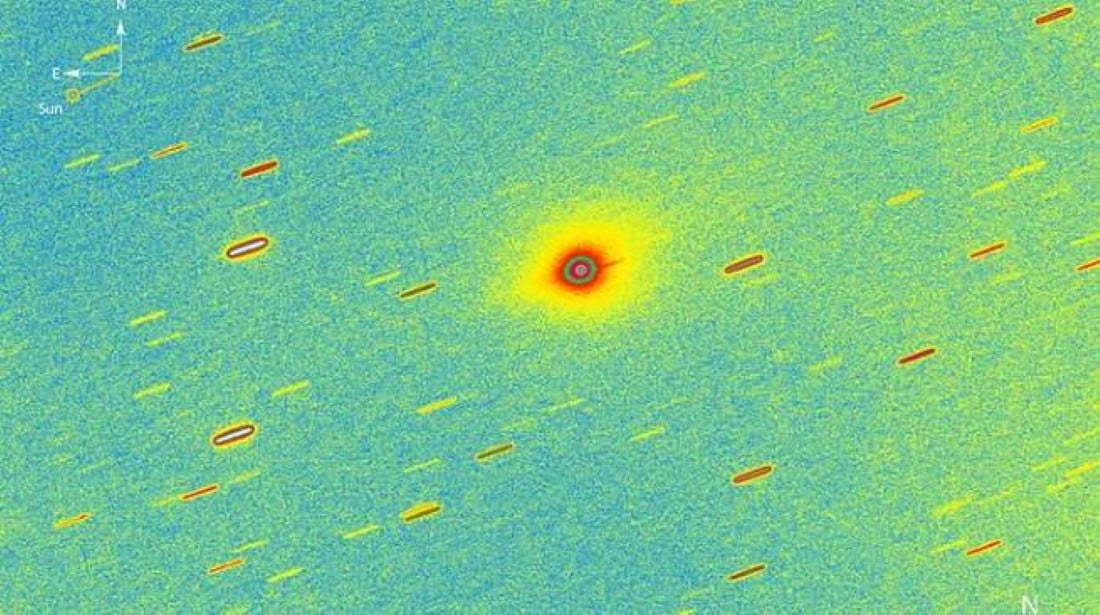
An object of interstellar origin, cataloged as 3I/ATLAS, is on a route that intrigues astronomers around the world. Descoberto in 2025, its trajectory was calculated with surprising precision, indicating an encounter with the planet Júpiter in March 2026, at a gravitationally strategic point. The characteristics observed so far, such as mass and acceleration, deviate from the standards known for natural celestial bodies.
The mass of the nucleus of 3I/ATLAS is estimated to be up to a million times greater than that of the first known interstellar visitor, 1I/’Oumuamua, and a thousand times greater than that of comet 2I/Borisov. Essa’s monumental size, combined with its speed, defies statistical models about how often objects of this scale could enter our solar system.
The central point of the mystery lies in the date of March 16, 2026. On Neste day, 3I/ATLAS will reach its minimum distance of Júpiter, coinciding almost perfectly with the radius of Hill of the gas giant, a region where the planet’s gravity becomes dominant over that of Essa complex orbital maneuver appears to be the result of a non-gravitational acceleration detected during its approach to Sol.

A trajectory calculated with unprecedented precision
The 3I/ATLAS route is not only precise but also strategically planned. The object follows a retrograde orbit, moving in the opposite direction to most planets, but with a notable alignment of up to 5 degrees with the plane of the solar ecliptic. Essa feature allows it to make close approaches to tens of millions of kilometers of planets like Marte and Vênus before its final encounter with Júpiter, as if it were mapping points of interest in the inner solar system.
Furthermore, the orbital calculation reveals a fascinating detail: the object’s arrival was timed in such a way that it will remain practically invisible to telescopes based on Terra during perihelion, the point of its closest approach to Sol. Essa peculiar configuration minimizes the opportunity for detailed observations at a time when the object would be at its brightest, raising questions about the nature of its trajectory and whether such occultation was intentional.
Acceleration that defies the laws of gravity
Observations conducted by multiple observatories between July and November 2025 confirmed that 3I/ATLAS has an anomalous acceleration, not explained solely by the force of gravity of Sol. Imagens captured by the HiRISE high-resolution camera, during the approach of Marte, recorded a jet of luminous material being expelled in the direction of Sol, in front of the object’s core.
This phenomenon is radically different from the tails of dust and gas observed in thousands of known comets, which are always pushed in the opposite direction to Sol by radiation and the solar wind. The presence of a frontal jet suggests a controlled propulsion mechanism, which would be used to make fine adjustments to the trajectory.
It is this constant acceleration that allows 3I/ATLAS to reach the sphere of Hill and Júpiter with a minimum margin of error, estimated at just 60 thousand kilometers. The predicted distance to perijove, the closest point to Júpiter, is 53.445 million kilometers, a value that aligns almost exactly with the planet’s Hill radius of 53.502 million kilometers.
Chemical composition suggests artificial origin
Spectroscopic analyzes of the gaseous plume emitted by 3I/ATLAS revealed another extraordinary feature that differentiates it from any comet ever studied. Foi detected an abnormally high abundance of nickel in relation to iron, a proportion that exceeds by orders of magnitude the values recorded in comets in our solar system.
This chemical signature is uncommon in natural rock objects, but is often found in industrially produced metal alloys. The presence of materials with this composition reinforces speculation about the unnatural nature of the object, which appears to be built with processed materials.
The core’s speed also remains higher than that of previous interstellar objects, indicating that it not only entered our system with high kinetic energy, but also has the ability to actively maneuver.
The combination of an exotic metallic composition, colossal mass and controlled acceleration makes up a profile that deviates significantly from what one would expect from a wandering asteroid or comet, driving more daring theories about its origin and purpose.
Statistically unlikely mass and frequency
The arrival of an object as massive as 3I/ATLAS every decade, following the discoveries of ‘Oumuamua and Borisov, presents a major statistical puzzle for the scientific community. The estimated density of rocks and debris in interstellar space is simply not enough to explain the regular entry of bodies of this size into the inner solar system. Para For a natural object of this magnitude to be captured by solar gravity, the amount of rocky material wandering between the stars would have to be much greater than current models predict. Essa discrepancy between theory and observation suggests that 3I/ATLAS may not be a random event, but rather an object that was deliberately targeted into our system. The combination of its high mass and high velocity further reinforces the hypothesis of directed selection, drastically differentiating it from its confirmed interstellar predecessors.
Other anomalous indicators observed
Among the data collected, the extreme negative polarization of the light reflected by the object stands out, an unprecedented characteristic among known comets, including the interstellar 2I/Borisov. Esse polarization pattern may indicate a surface with unique texture and material composition.
Scientists also theorize that the frontal jet, in addition to its propulsive function, could act as a protective shield. When traveling at a speed of 60 km/s, the object is vulnerable to micrometeorite impacts, and the plume of gas and dust in front of it could serve to vaporize or deflect these small particles before they reach the main nucleus.
Connection with signal Wow! 1977
One of the most intriguing aspects of 3I/ATLAS is its origin direction in the sky. Foi verified that its trajectory coincides, with a margin of just 9 degrees, with the source of the famous “Wow!” signal, a powerful and anomalous narrowband radio transmission detected in 1977 by the Big Ear radio telescope. The probability of such a close alignment occurring at random is calculated to be less than 1%, adding yet another layer of mystery to this interstellar visitor’s mission.
Next steps for scientific monitoring
Observatories around the world, along with space telescopes, maintain continuous tracking of 3I/ATLAS and will continue to monitor it intensively until its encounter with Júpiter. Novas high-resolution images and detailed spectral data are expected in the coming months, which could help unlock some of its secrets.
The arrival of the object to the neighborhood of Júpiter will occur in the region of the points of Essa choice of destination suggests sophisticated planning, as these points are considered privileged locations for establishing observation posts or bases in the solar system.



