
Interstellar comet 3I/ATLAS reveals straight tail and compact nucleus in astronomer’s unprecedented image

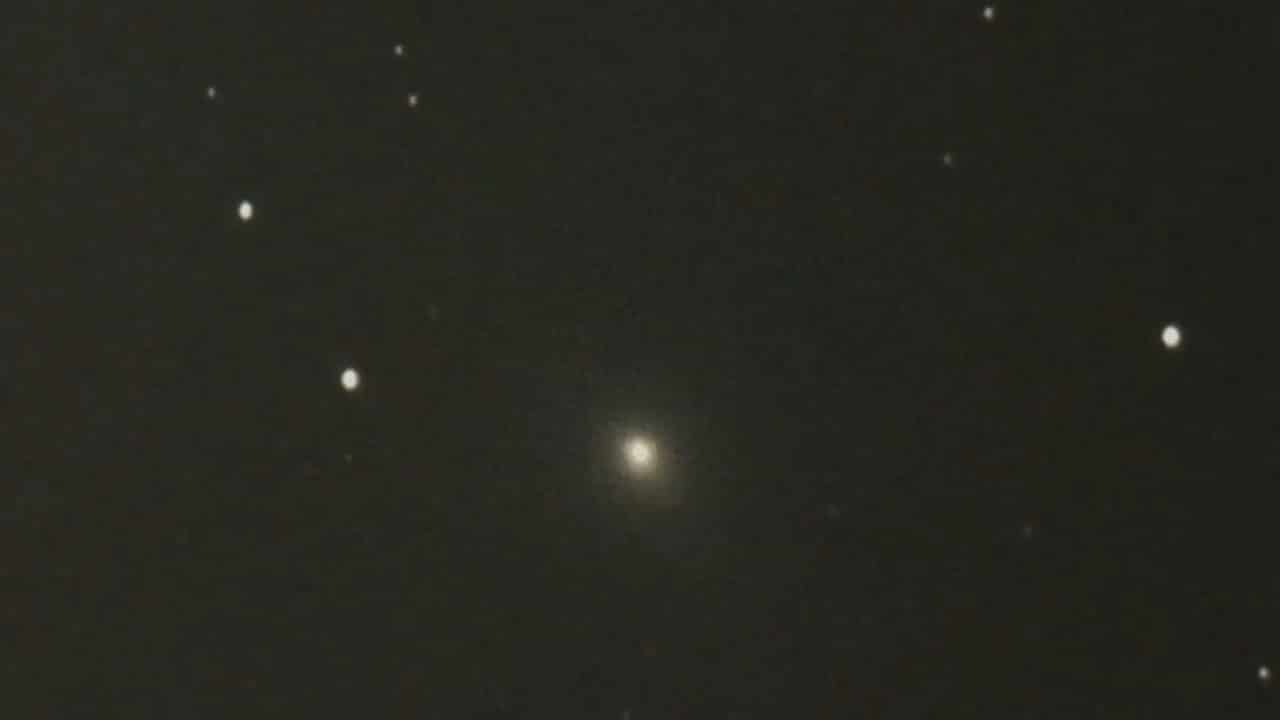
An astronomical observation carried out in late 2025 brought to light surprising characteristics of the interstellar comet 3I/ATLAS, an object originating outside our Sistema Solar. The image, captured by Japanese astronomer Mitsunori Tsumura, reveals a structure that defies conventional comet models, with a perfectly straight tail and a symmetrical bright coma, generating new questions about its composition and origin.
The recording was made on November 22, 2025, using a 0.5 meter telescope, and the recently released data shows atypical behavior for a celestial body of this nature. The anomalies, such as the absence of the expected curvature in the tail and the uniformity of its coma, suggest that 3I/ATLAS is composed of materials with properties different from those found in comets in our own system.
The discovery, made by the ATLAS monitoring system in July 2025, triggered a global observation campaign. Cientistas from around the world are now focused on analyzing the material ejected by the comet, seeking to understand the fundamental differences in its formation, which occurred in a distant and unknown star system.
🚨 3I/ATLAS X__NM2____ X__NM3____ Assomiglia più a qualcosa… pic.twitter.com/FDMbvLKYfe
—Astronomy Vibes (@AstronomyVibes)November 26, 2025
The thin tail that defies solar predictions
One of the most intriguing aspects of comet 3I/ATLAS is its tail, which remains remarkably narrow and collimated throughout its visible length. Normalmente, interaction with the solar wind – a constant stream of charged particles emitted by Sol – causes a comet’s tail to disperse and widen as it moves away from the nucleus. However, 3I/ATLAS’s tail resists this dispersion, maintaining a linear, focused shape.
This characteristic suggests that the dust and gas particles that compose it are more resistant to solar radiation pressure or have different cohesive properties. While initial observations of other interstellar visitors, such as 2I/Borisov, have also pointed to unusual structures, 3I/ATLAS exhibits an even greater degree of linearity, indicating a possibly denser composition or much more controlled and uniform material ejection dynamics than expected.
Perfectly straight structure and precise orbit
Analysis of the image of Tsumura confirms the total absence of curvature in the comet’s tail. In Sistema Solar comets, orbital velocity combined with solar wind pressure typically imposes an arched shape on the dust tail. The absolute straightness of 3I/ATLAS indicates that its high hyperbolic trajectory speed completely dominates external forces.
This phenomenon reinforces its interstellar nature, since its speed is too high to be captured by the gravity of Sol. The orbital data is so precise that it shows the influence of non-gravitational accelerations, probably caused by the sublimation of ice on its surface.
These subtle forces are being monitored with extreme precision. Projections indicate that the comet’s orbit will take it to a distance of 53.5 million kilometers of Júpiter, a value that coincides almost perfectly with the radius of Hill of the giant planet, the boundary of its gravitational dominance.
Predictions for 2026 point to a passage at 53.445 million kilometers, a number that validates the most recent orbital analyzes and demonstrates astronomers’ ability to accurately track the journey of this cosmic visitor.
A symmetrical glow in the central coma
The 3I/ATLAS coma, the cloud of gas and dust that surrounds the nucleus, displays an almost perfectly spherical and uniform luminosity. Esta is another characteristic that differentiates it from typical comets, whose irregular nuclei and chaotic rotation usually generate anisotropic jets of material, resulting in asymmetrical comas and variations in brightness.
The uniformity observed in 3I/ATLAS suggests that the gas and dust emission processes are stable and occur homogeneously across the entire surface of the nucleus. Isso may indicate a more consistent surface composition or a sublimation mechanism that does not depend on specific points of activity, such as cracks or exposed areas.
Estimates based on observations of Telescópio Espacial Hubble suggest the core’s diameter could be as large as 5.6 kilometers, although data from August 2025 indicates a possibly smaller size, up to 440 meters. Essa discrepancy, together with an atypical luminosity decay, points to a highly controlled emission of material, even though spectral analyzes suggest the presence of ancient interstellar ice formed under exotic conditions.
Secondary filament raises new questions
A more detailed analysis of the image revealed a secondary structure, a faintly glowing filament that runs parallel to the main tail. The angular separation between the two structures is minimal, which makes the phenomenon particularly curious for experts.
In traditional comets, it is common to observe the separation between the ion tail (gas) and the dust tail, which follow slightly different paths. However, the proximity and parallelism of the 3I/ATLAS filament suggest a different mechanism, perhaps multiple streams of material being ejected without the expected divergence, adding yet another element of mystery to the object.
Compact nucleus and lack of diffusion
The comet’s heart, its nucleus, appears in the image as a near-stellar condensation, without the diffusion of dust that normally creates a bright, extensive halo. In common cometary structures, nuclei emit diffuse clouds that often contain clumps, glow knots, and streaks, reflecting irregular and dynamic surface activity. In the case of 3I/ATLAS, the concentration of light in the center is exceptionally high and clean, with no visible textures. Essa absence of complexity in the central region reinforces the idea of a homogeneous coma and, consequently, a uniform tail. The observation has been consistent across multiple spectral bands since the comet reached its perihelion, the closest approach to Sol, at 1.4 astronomical units in October 2025. The proximity to Marte during its trajectory has allowed data from missions such as its origin.
Interstellar trajectory and continuous monitoring
Comet 3I/ATLAS follows a clear hyperbolic path, confirming that it is not gravitationally bound to Sol. Sua trajectory indicates an origin in the direction of the constellation of Sagitário, a region opposite the solar apex, the point to which the Sistema Solar moves relative to nearby stars.
State-of-the-art observatories, such as Telescópio Gemini Sul and Nordic Optical Telescope, confirmed that the comet was already active in May 2025, when it was still 6.4 astronomical units away from Sol. Análises spectra reveal that the reddish composition of its coma is evolving, indicating a surface that changes as it heats, with detections of elements such as nickel and iron in August, metals rarely seen in comets in our system.
Implications for planetary science
The detailed study of objects like 3I/ATLAS offers a unique window into the chemical composition and physical conditions of other stellar systems. Cada new discovery about their unusual properties provides valuable clues about the diversity of planet formation processes in the galaxy, challenging and expanding current knowledge about the evolution of solar systems.



