
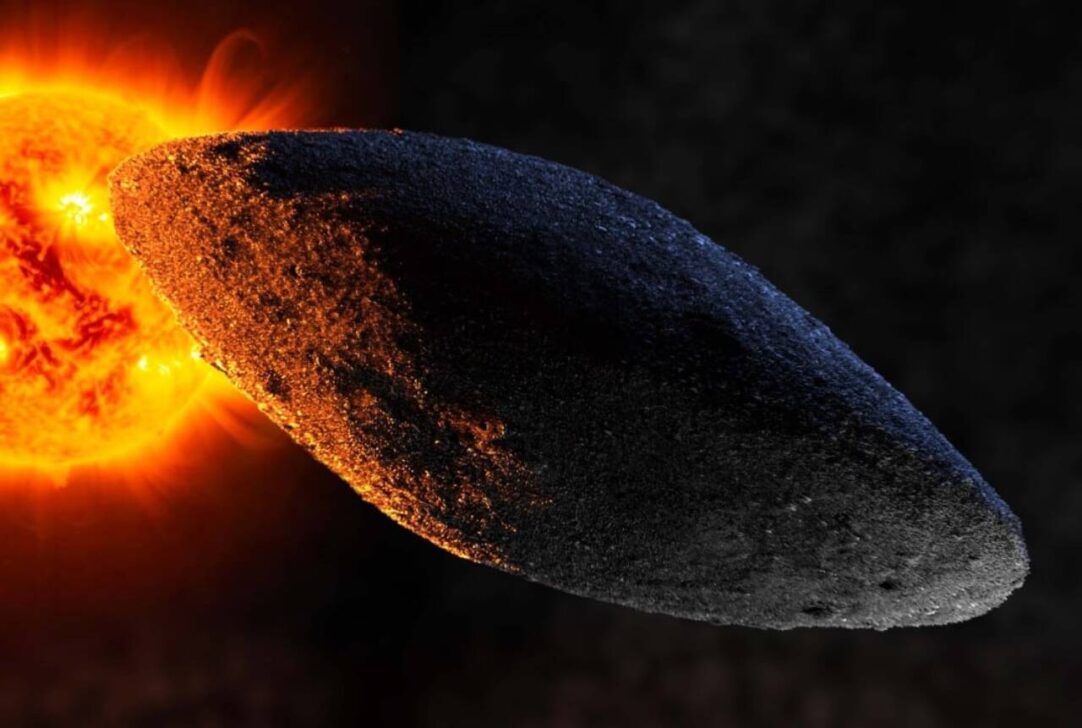
A cosmic object of origin external to our Sistema Solar, identified as comet 3I/Atlas, is currently transiting our galactic neighborhood at an impressive speed of 57 kilometers per second. Esta speed, combined with a trajectory confirmed to be hyperbolic, provides astronomers with certainty that this is a visitor from a distant star system, offering a rare opportunity to study material from other parts of the galaxy.
The passage of 3I/Atlas represents a significant milestone for astronomy, being only the third confirmed interstellar object to be observed in our Sistema Solar. Ele follows in the footsteps of the enigmatic ‘Oumuamua, detected in 2017, and comet 2I/Borisov, observed in 2019. Analysis of their journey and composition helps build a more complete picture of the dynamics of celestial bodies traveling between stars.
Due to its high speed, Sol’s gravity is not sufficient to capture 3I/Atlas in a closed orbit. Instead, the comet will have its path slightly deflected by solar mass before being hurled back into deep space, continuing its interstellar journey. Observatórios around the world monitor every movement to collect as much data as possible during this brief visit.
What defines a hyperbolic trajectory
The hyperbolic trajectory is the definitive signature of an interstellar visitor. In terms of celestial mechanics, this route describes an open path, in which the object has excessive kinetic energy and speed to be trapped by the gravitational field of the central body, in this case, our Sol. Diferentemente of elliptical orbits, which are closed and characterize planets and comets in our own system, the hyperbola indicates that the object came from very far away and is just passing through. The speed of 3I/Atlas, far greater than the escape speed of Sistema Solar at its current location, means that its energy is positive, ensuring that it will not return. Esse calculation is fundamental to differentiate a local object from a cosmic “immigrant”, as native bodies, even in very long orbits, are gravitationally bound to the Sol and eventually return to the point of origin.
Visitor discovery and identification
Celestial bodies like 3I/Atlas begin their journeys in distant star systems, being ejected into the interstellar vacuum through complex gravitational interactions or cataclysmic events, such as supernova explosions. Após millions of years traveling through space, these objects can cross the path of other systems, like ours.
Identification of these travelers depends on sky scanning programs, such as ATLAS (Asteroid Terrestrial-impact Last Alert System), which continuously monitor the sky in search of moving objects. Once a candidate is detected, observatories around the world collaborate to take precise measurements of its position and speed.
With enough data, astronomers can calculate the object’s orbit. Confirming a hyperbolic trajectory, as in the case of 3I/Atlas, is the crucial step that validates its extrasolar nature, allowing the scientific community to direct its resources towards in-depth study during the short observation window.
Chemical composition and clues to its origin
Preliminary spectroscopic studies of 3I/Atlas are vital to unlocking the secrets of its home star system. Analysis of the light reflected by the comet and emitted by its coma — the cloud of gas and dust surrounding the nucleus — makes it possible to decompose its chemical composition. Scientists look for signatures of elements and molecules, such as water, carbon monoxide, cyanide and other organic compounds, to understand what the comet is made of.
Although many of these components are common in comets from our Sistema Solar, the proportions can vary drastically. An atypical abundance of certain gases, for example, may indicate that the comet formed in an environment with temperatures and chemical conditions very different from those found in the protoplanetary disk that gave rise to Sol and its planets. Essas Chemical “fingerprints” offer a direct glimpse into the diversity of planetary building materials in the galaxy.
Comparison with other cosmic travelers
The first interstellar visitor, ‘Oumuamua, intrigued scientists for its elongated shape and for exhibiting a non-gravitational acceleration that was not accompanied by a visible coma, sparking debate about its nature.
The second, 2I/Borisov, looked much more like a traditional comet, with a well-defined coma and tail, being the first to allow a detailed analysis of its composition, which revealed a surprising amount of carbon monoxide.
3I/Atlas, as the third member of this exclusive group, adds a crucial data point. Cada new detection allows scientists to carry out comparative studies, looking for patterns or differences that could reveal more about the population of interstellar objects.
3I/Atlas’s superior speed relative to its predecessors also provides valuable information for dynamical models that attempt to explain how these objects are ejected from their home systems and travel through the galaxy.
Observed non-gravitational acceleration
One phenomenon observed in comets, and which has been particularly debated in the case of ‘Oumuamua, is non-gravitational acceleration. Quando a comet approaches a star, solar heat sublimes the ices on its surface, releasing jets of gas and dust.
These jets work like small thrusters, generating a subtle thrust that can alter the object’s trajectory in ways that cannot be explained by gravity alone. Compreender and modeling this effect is critical to accurately calculating a comet’s orbit and confirming its interstellar origin.
The Challenges of Tracking Interstellar Objects
Detecting interstellar objects is an extremely challenging task. Eles can appear from any direction in the sky, move at very high speeds and remain visible for a relatively short period of time, requiring advanced monitoring systems and agile global collaboration between observatories.
The ability to identify these cosmic travelers has improved significantly with advances in telescope technology and data processing algorithms. Cada new discovery, like that of 3I/Atlas, represents a unique opportunity to investigate the composition of other star systems without the need to send expensive space missions.
Future of Interstellar Object Astronomy
The expectation is that, with the entry into operation of new generation observatories, such as Observatório Vera C. Rubin, the number of interstellar objects detected will increase exponentially. Essa new era of astronomy will allow statistical studies on the frequency, composition and origin of these visitors, transforming what are today rare discoveries into a rich new area of research into the formation of planets and galactic dynamics.