
James Webb Observatory reveals images of the most distant supernova and redefines astronomy

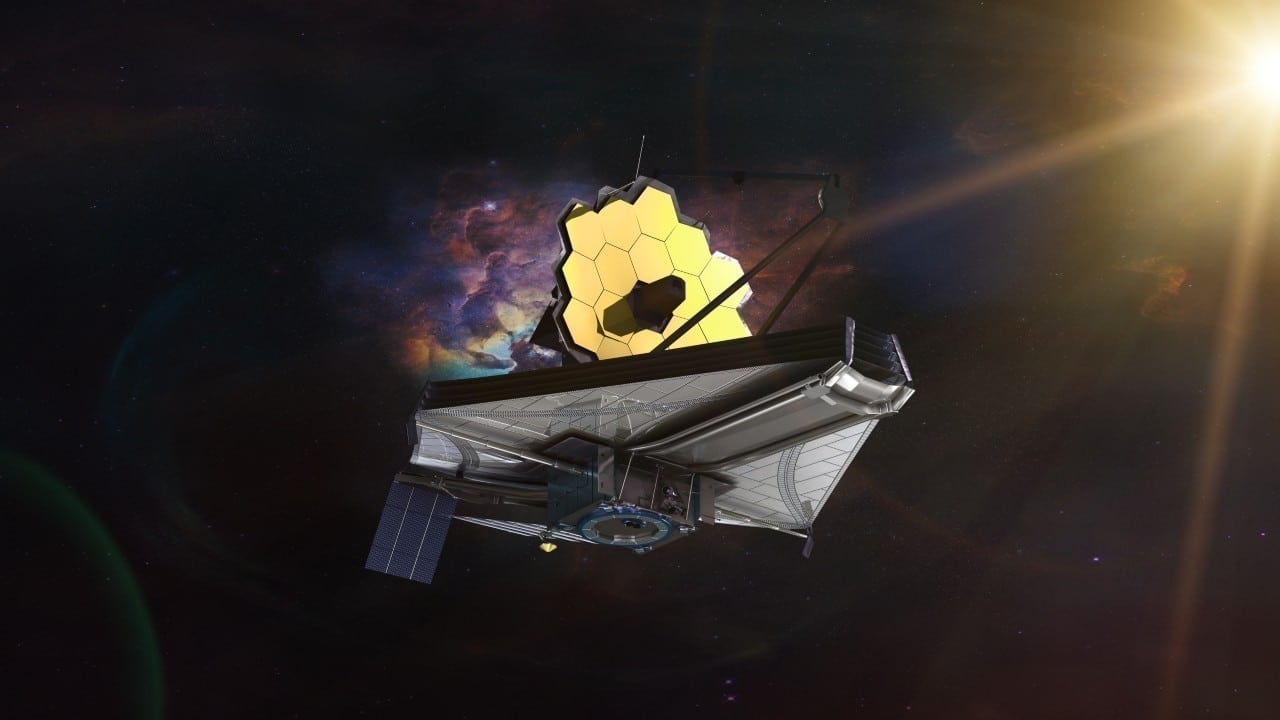
One of the most impactful discoveries of Telescópio Espacial James Webb (JWST) was the record of the oldest supernova ever observed, a stellar explosion that occurred when the universe was a fraction of its current age. Essa observation offers an unprecedented window into the earliest chapters of cosmic history, allowing scientists to directly study the conditions and processes that governed the formation of the first stars and galaxies.
Operated jointly by NASA, Agência Espacial Europeia (ESA) and Agência Espacial Canadense (CSA), the space observatory represents the most advanced astronomy tool ever built. Sua The ability to capture infrared light with extreme sensitivity allows us to penetrate dense clouds of cosmic dust and see objects that are at immense distances, whose light took more than 13 billion years to reach us.
Launched on December 25, 2021, the telescope continues to exceed expectations in its mission to unlock the mysteries of the universe. The information collected not only confirms existing theories, but also raises new questions that challenge consolidated knowledge about the evolution of the cosmos, from the birth of stars to the formation of planets with the potential to harbor life.
The journey to the L2 lagrange point
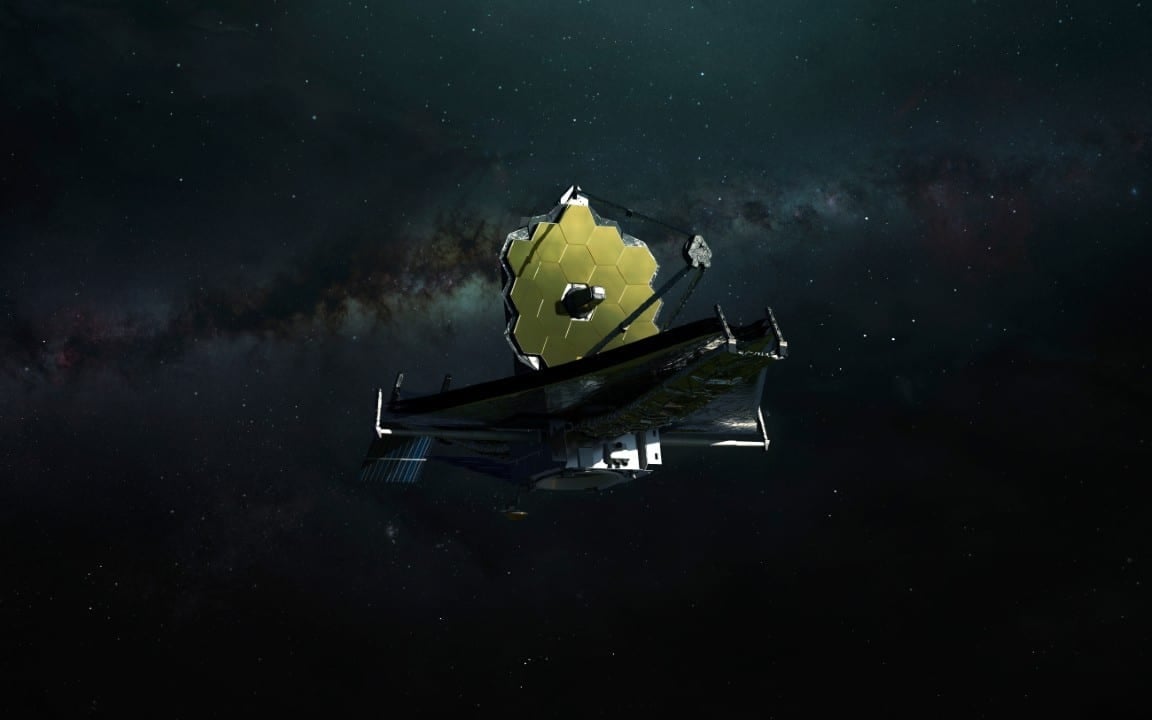
The launch of James Webb aboard the Ariane 5 rocket, from Guiana Francesa, was just the beginning of a complex sequence of operations. During its first month in space, the telescope performed a series of critical maneuvers, including deploying its tennis court-sized, five-layer solar shield and unfolding its iconic 6.5-meter-diameter primary mirror. Cada step was carried out with millimeter precision, ensuring that the observatory arrived intact and functional at its final destination.
Its orbital position, known as second Ponto from Lagrange (L2), 1.5 million kilometers from Terra, is strategically advantageous. Nesse site, the telescope can keep the Terra, the Lua and the Sol aligned behind it, allowing the solar shield to efficiently block the light and heat from these bodies. Essa thermal stability is essential to keep instruments cooled at extremely low temperatures, an essential condition for detecting faint infrared signals coming from the depths of the universe. The success of the launch and the efficiency of the maneuvers allowed fuel to be saved, extending the mission’s useful life far beyond the initially projected ten years.
The stellar explosion that illuminates the early universe
The detection of the most distant supernova represents a milestone in modern astronomy. Este cataclysmic event is the death of a massive star, and its observation at such a remote time offers direct data on the first generation of stars that formed after Big Bang.
These primordial stars were composed almost exclusively of hydrogen and helium, the elements forged at the beginning of the universe. Acredita were hundreds of times more massive than our Sol and lived short, intense lives.
When they exploded as supernovae, they seeded the cosmos with the first heavy elements, such as carbon, oxygen and iron. Esses elements were the raw material for the formation of stars, planets and, eventually, life itself as we know it.
Analyzing the light from this ancient supernova allows astronomers to test models of stellar evolution and nucleosynthesis. Information about its brightness, color and duration helps determine the mass and composition of the original star, validating theories about how the universe became chemically enriched over time.
Revolutionizing the study of early galaxies
Beyond individual stars, James Webb is radically transforming understanding of the formation of the first galaxies. Deep-field observations have revealed a population of galaxies in the young universe that are surprisingly massive, bright and well-structured, much more so than cosmological models predicted. Essas findings suggest that the processes of star formation and galaxy assembly may have been much faster and more efficient in the first few hundred million years of the cosmos than previously thought. The presence of complex structures such as bars and disks in distant galaxies challenges the idea of gradual, hierarchical evolution, where small structures slowly merge to form larger galaxies. Essa tension between observation and theory is driving a complete overhaul of galaxy formation models, forcing scientists to reconsider the role of cold gas, dark matter and supermassive black holes in accelerating early galactic growth.
Atmospheric analysis of distant worlds
One of the most promising fields explored by Webb is the study of exoplanets, worlds that orbit other stars. Utilizando the transit spectroscopy technique, the telescope analyzes the starlight that passes through a planet’s atmosphere.
This analysis makes it possible to identify the chemical composition of the atmosphere, revealing the presence of molecules such as water vapor, methane, carbon dioxide and others. Tais detections are crucial steps in the search for biosignatures, that is, chemical clues of biological processes.
Planetary systems like TRAPPIST-1, which hosts several rocky planets in its star’s habitable zone, are priority targets. Data collected by Webb has already begun to provide the first detailed glimpses of atmospheric conditions on these worlds, helping to determine whether they could support liquid water on their surface.
New iconic images of the cosmos
James Webb’s ability to see in the infrared produced images that have already become milestones in space exploration. The new view of the “Pillars of Criação” in Nebulosa of
Likewise, records of colliding galaxies, such as Quinteto of Stephan, show in unprecedented detail the shock waves and gas flows generated by the gravitational interaction. Essas images are not only visually spectacular, but also powerful scientific tools that allow you to study the dynamics of star formation in extreme environments.
The accelerated growth of black holes
The telescope is also providing crucial information about supermassive black holes at the centers of galaxies. Observações of Webb identified quasars, which are extremely luminous galactic nuclei powered by these black holes, at very early times in the history of the universe.
The existence of black holes with masses hundreds of millions of times that of Sol, when the universe was less than a billion years old, is a big puzzle. Isso because traditional models of black hole growth cannot explain how they became so large in such a short time, which points to mechanisms of formation and accretion of matter that are still unknown.
A data legacy for the scientific community
With a lifespan that could span two decades, James Webb is just at the beginning of its scientific journey. The vast archive of data it generates is made available to the global scientific community, ensuring that its discoveries inspire new research and advance human knowledge of the cosmos for many years to come, cementing its legacy as the leading space observatory of its generation.



