
Discovery of interstellar object 3I/ATLAS reveals trillions of visitors to the solar system

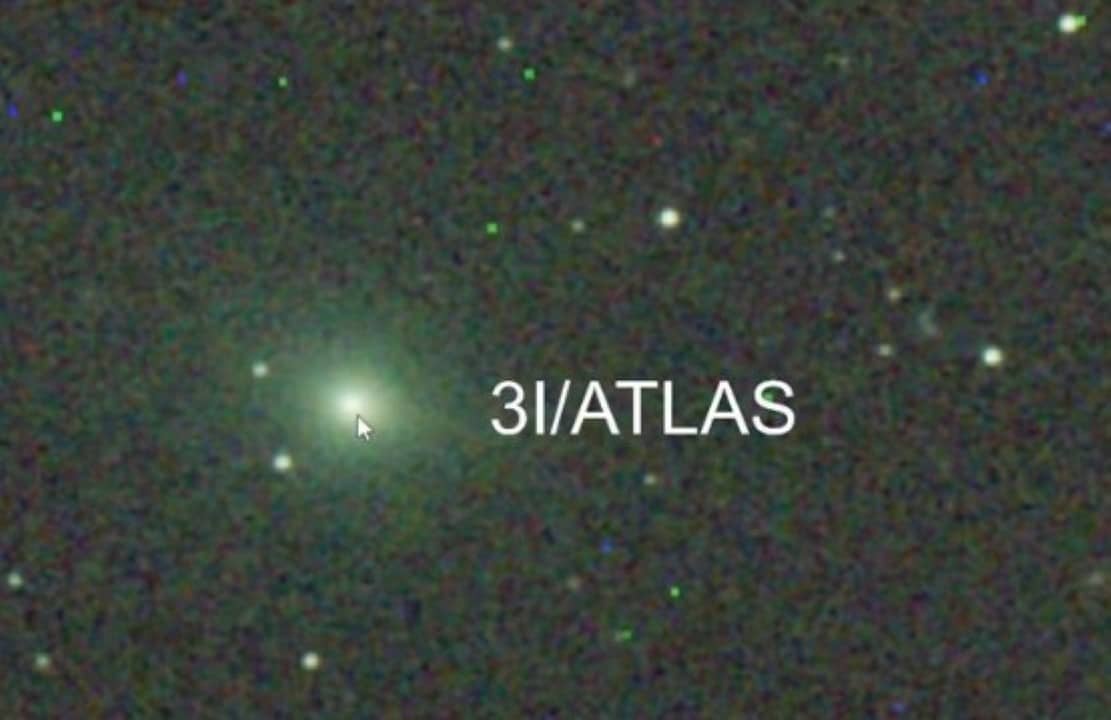
Scientists and astronomers at Projeto Galileu and Universidade of Harvard have confirmed detailed data about the interstellar object 3I/ATLAS, identified as the third visitor from outside the solar system to be officially recorded. The discovery, originally made on July 1, 2025, gained new contours after processing images of Telescópio Espacial Hubble captured in December.
The celestial body reached its closest point to Sol on October 29, 2025, maintaining a distance of approximately 203 million kilometers from the central star. Especialistas indicate that this event marks a unique opportunity to study the chemical composition of materials formed in other star systems in Via Láctea.
Population estimates and cosmic origin
Calculations based on trajectory and detection frequency indicate that 3I/ATLAS is not an isolated phenomenon, but a representative of a massive population of wandering objects. Estima It is believed that there are about a trillion similar bodies within the solar system, extending to the limits of Nuvem and Oort.
- The approximate mass of an object measuring one kilometer in diameter reaches one billion tons.
- The predominant composition of these space visitors includes hydrogen, helium and heavy elements.
- The processing of interstellar matter suggests that each star produces an immense volume of comets.
Statistical analysis reveals that the Via Láctea galaxy may harbor up to $10^{23}$ objects with characteristics similar to 3I/ATLAS. Essa population density implies that visits by interstellar bodies to our planetary system occur regularly over billions of years, although technological detection is recent.
Observation and monitoring technology
Monitoring such visitors requires a multi-layered infrastructure to ensure the accuracy of data collected during the rapid passage of these objects. Observatório Rubin, located at Chile, acts as the first line of defense and identification, covering the southern sky in search of high-speed anomalies.
The need for a complementary observatory in the northern hemisphere is defended by researchers to guarantee global space coverage. High-resolution Imagens are fundamental to distinguish between natural rocks and possible artifacts of technological origin, using optical interferometry methods.

Exploration proposals at Lua
One of the most advanced concepts discussed by the scientific community involves installing a 100-meter-long optical interferometer on the surface of Lua. The absence of a lunar atmosphere allows images to be captured without the turbulence that affects terrestrial telescopes, enabling the resolution of kilometric details at great distances.
This structure would be integrated into the Programa Artemis efforts, leveraging the logistics of lunar missions to expand the frontier of precision astronomy. The ability to resolve the shape and surface of objects like 3I/ATLAS would allow a definitive classification of their geological or artificial nature.
Space interception missions
The third stage of the interstellar study strategy focuses on developing space missions capable of intercepting and landing on these moving objects. The main objective is to collect direct samples for analysis of the basic components of life and the history of star formation outside our immediate environment.
The classification of these bodies follows rigorous criteria to determine whether they represent threats or opportunities for unprecedented scientific knowledge. Tais missions require advanced propulsion and autonomous navigation systems, given the extreme speed at which visitors traverse the inner solar system before returning to deep space.
Photographic record and technical data
The most recent 3I/ATLAS image was taken on December 28, 2025, showing a prominent jet known as the antitail, directed toward Sol. The recording was made with an exposure of 4,800 seconds, using highly sensitive equipment that revealed the complex structure of the interstellar comet’s coma.
This visual record confirms the object’s volatile activity as it reacts with solar radiation, facilitating the measurement of its outgassing rate and brightness. Data collected through the end of December serves as the basis for mathematical models that predict the density of dark matter and dust in the interstellar medium through which the object traveled.
Historical trajectory through the solar system
The 3I/ATLAS object spent the last 8,000 years transiting the region under the gravitational influence of Sol before its official discovery last summer. Sua high speed is the main indicator that it has enough energy to escape solar attraction and continue its journey towards other star systems.
The current pass offers the best observation window since Oumuamua and Borisov, allowing direct comparisons of orbital morphology and behavior. Cientistas now awaits final data collection before the object moves away to regions beyond Netuno’s orbit, once again becoming invisible to current instruments.



