
Fusion reactors can produce dark matter particles on walls

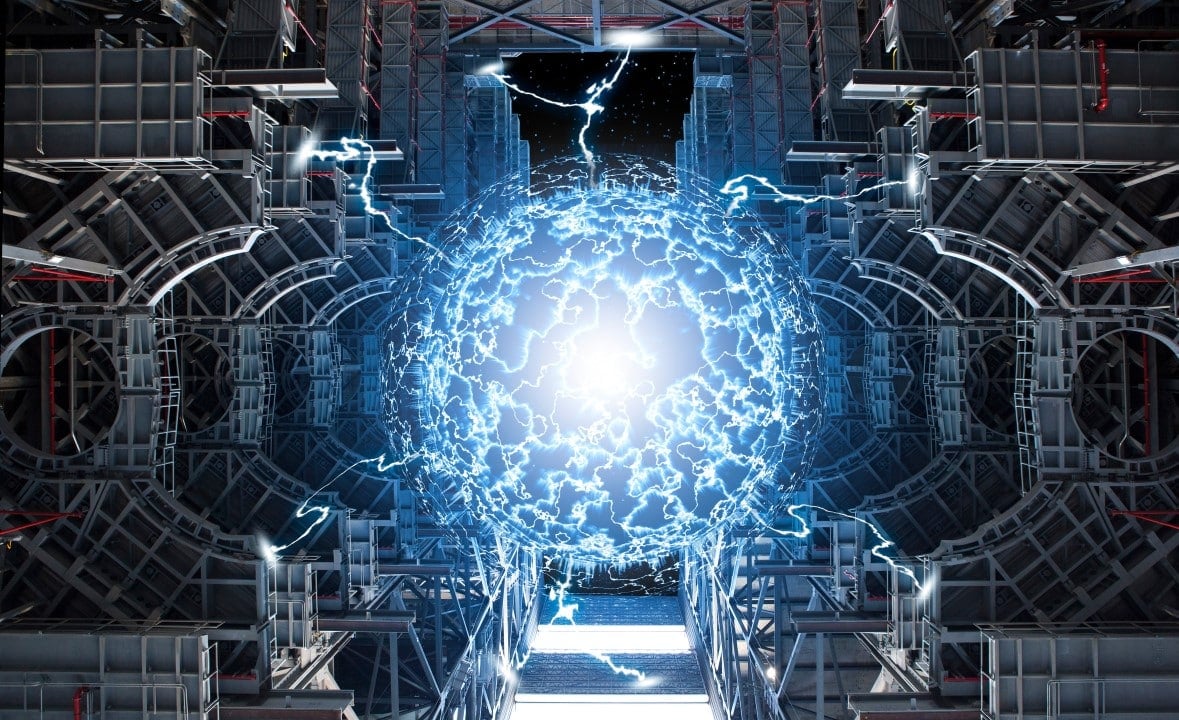
A theoretical study published in Journal of High Energy Physics indicates that nuclear fusion reactors, designed to produce clean energy, may inadvertently generate dark matter candidate particles. The research, led by professor Jure Zupan, from Universidade of Essas hypothetical particles are considered one of the main explanations for dark matter, which represents about 84% of the mass of the universe.
The reactors analyzed use deuterium and tritium as fuel, with lithium cladding to reproduce tritium. Durante fusion reactions, fast neutrons escape the plasma and collide with the wall materials.
These collisions excite atomic nuclei, which can emit axions as they return to the ground state.
Production mechanisms in reactor structures
The high-energy neutrons released in fusion reactions mainly interact with lithium and steel in the walls.
A process occurs when the neutron is captured by a nucleus, leaving it excited and leading to the emission of axions.
Another channel involves the scattering of neutrons, which lose speed and release braking radiation, capable of generating light particles.
These mechanisms differ from solar processes, allowing detectable fluxes in terrestrial reactors.
Axions as candidates for dark matter
Axions are light particles, without electrical charge and with minimal interactions with ordinary matter.
They emerged as a theoretical solution to problems in quantum chromodynamics and explain gravitational effects observed in galaxies.
Despite intense searches using dedicated detectors, no confirmation has occurred so far.
The proposal turns reactors like ITER, at França, into dual tools for energy and particle physics.
Practical detection proposal
The researchers suggest installing heavy water tanks about 10 meters from the reactor.
In these tanks, axions could interact with deuterium, separating it into free protons and neutrons, a signal distinguishable from noise such as solar neutrinos.
Comparisons between on and off operation would help isolate real events.
The method requires precise nuclear data on fusion materials, which are still partially unknown.
Advantages of using existing reactors
The approach takes advantage of infrastructure already under construction for fusion energy.
Deuterium-tritium reactors generate an intense flux of neutrons, superior to that of fission reactors of similar power.
Without changes to the core design, nearby detectors could look for signs of new physics.
The study paves the way for experiments complementary to the current searches for dark matter.
Connection with cultural references
The idea of producing axions in fusion reactors appeared indirectly in episodes of the series The Big Bang Theory.
Fictional characters attempted to solve the problem, but failed by considering only plasmatic processes.
The current research addresses this limitation by focusing on interactions with walls.
This highlights how scientific concepts inspire entertainment and vice versa.
Implications for future projects
Projects like ITER and future commercial reactors could incorporate detectors from the planning stage.
The theoretical production of axions or similar particles reaches levels potentially observable outside the shield.
Improvements in nuclear simulations will refine flow predictions.
The energy-research duality reinforces the scientific value of nuclear fusion.
- Neutron capture by lithium generates tritium and excites nuclei.
- Nuclear excitation leads to preferential emission of axions at specific transitions.
- Braking radiation in scattering contributes to additional production.
- Estimated flow outperforms equivalent processes in fission reactors.



