
Hubble reveals alternating double jets on interstellar comet 3I/ATLAS

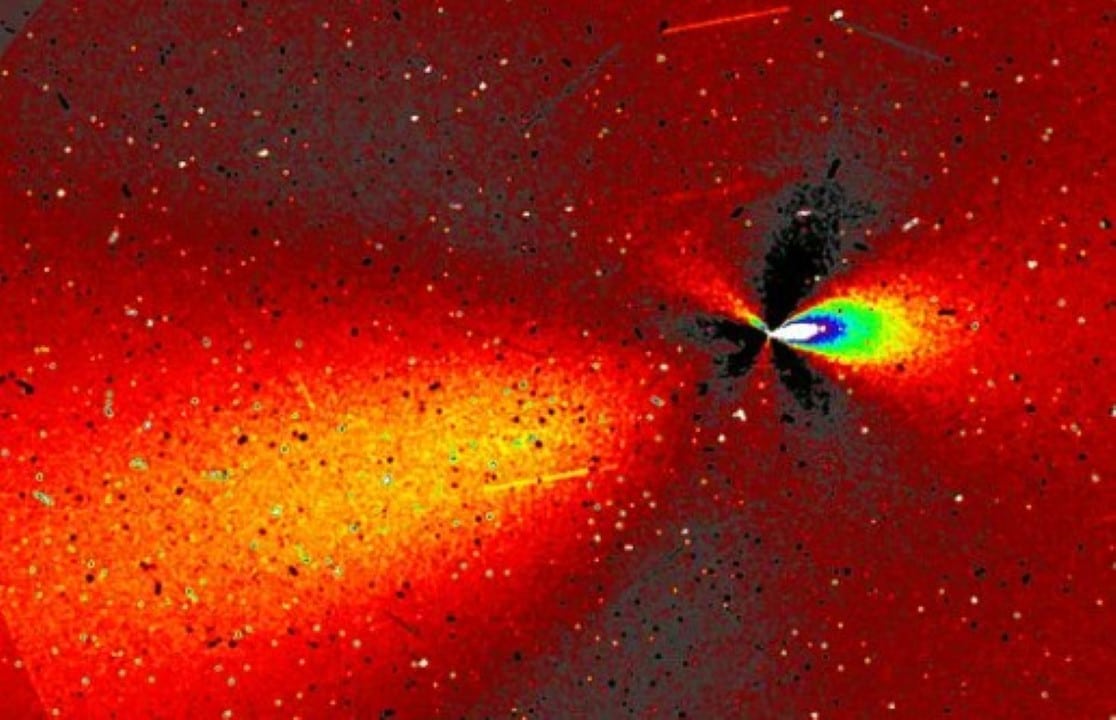
Telescópio Espacial Hubble recorded images of the interstellar comet 3I/ATLAS on December 12 and 27, 2025. The captures show a double structure of jets with varying brightness between them. One of the emissions gains intensity while the other decreases in a repeatable manner.
The object, the third confirmed of interstellar origin, maintains a persistent sunward tail after perihelion. The jets show consistent geometric alignment throughout the observations. Astrônomos analyze whether the behavior indicates a coherent rotational mechanism.
3I/ATLAS was discovered in July 2025 by the ATLAS system on Chile.
Recent observations of Hubble
The December images use the Wide Field Camera 3 camera.
They reveal narrow jets that alternate in dominance.
Filter processing highlights the double structure.
- Exposures of 170 seconds captured morphological details.
- The variation occurs in periods separated by 15 days.
- There are no signs of random dissipation in the emissions.
Anti-tail characteristics
The comet has maintained a visible sunward extension since July.
After perihelion in October, the feature persists with significant length.
Post-November observations confirm asymmetric teardrop.
🚨 ALERT: 3I/ATLAS IS SHEDDING UNUSUALLY LARGE PARTICLES 🚨
— 3I/ATLAS updates (@Defence12543)December 26, 2025
⚠️New analysis of interstellar object 3I/ATLAS (C/2025 N1) suggests something extraordinary is happening in its sunward jet — this visitor from another star system appears to be releasing particles far larger than the…pic.twitter.com/S6zVnAUKT2
Jet behavior
Astronomers identify oscillation or wobbling in the jets.
The alternation suggests rotation of the nucleus with estimated period.
Data indicate dust ejection at different speeds.
- Small particles come out at 22 m/s.
- Larger grains at about 2 m/s.
- Mass loss rate compatible with active comets.
Context of the interstellar object
3I/ATLAS travels at high hyperbolic speed.
Its trajectory confirms origin outside of Sistema Solar.
Comparisons with 1I/’Oumuamua and 2I/Borisov highlight cometary activity.
Dual structure analysis
Processed images show jets in opposite directions.
Brightness anticorrelation indicates shared mechanism.
Experts assess the influence of nuclear rotation.
The core has an estimated diameter of less than 1 km.
Monitoring Perspectives
Observations continue as the object moves away.
Next meeting with Júpiter takes place in March 2026.
Data helps refine models of interstellar comets.
Composition and activity
Ultraviolet spectroscopy reveals sublimated gases.
The coma is reddish in color due to organic compounds.
Dust ejection maintains diffuse halo around the nucleus.
3I/ATLAS monitoring provides data on objects in other star systems. The December images highlight structured patterns that differentiate the behavior of typical comets.



