
Passage of the 3I/ATLAS object points to a trillion celestial bodies in the solar system

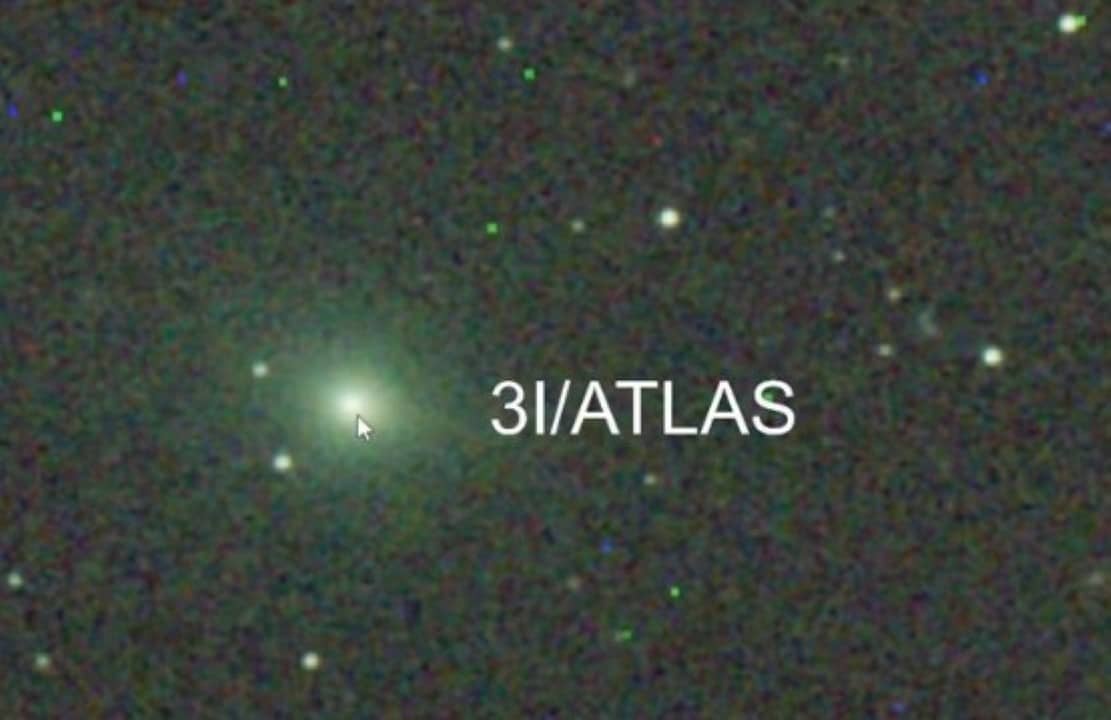
The scientific community has confirmed new data about 3I/ATLAS, the third officially recorded interstellar object crossing our solar system. The analysis, conducted by researchers from Projeto Galileu and Universidade of Harvard, used images captured by Telescópio Espacial Hubble to detail the nature and trajectory of the cosmic visitor, whose initial discovery occurred on July 1, 2025.
This celestial body represents an unprecedented opportunity to directly study materials formed in other stellar systems. Sua passage offers astronomers a sample of the chemical composition of regions distant from Via Láctea, allowing the validation of theoretical models about the formation of planets and comets in extrasolar environments.
The most significant event in its trajectory occurred on October 29, 2025, when 3I/ATLAS reached perihelion, its closest point to Sol. At the time, the object was at a distance of 203 million kilometers from our star, a crucial moment to observe the interactions of its surface with solar radiation and the subsequent release of gases and dust.

The origin and journey of the cosmic messenger
The hyperbolic trajectory of 3I/ATLAS is the main evidence of its extrasolar origin, indicating that it has sufficient speed to escape the gravitational pull of Sol and continue its journey through deep space. Antes before being detected, the object spent the last 8,000 years transiting the outermost regions of the solar system, a long journey that brought it from Nuvem to Oort to the inner solar system. The analysis of its orbit allows us to infer not only its origin, but also the conditions of the interstellar medium it crossed. The object’s composition, rich in volatiles, suggests that it was formed in a cold protoplanetary disk, similar to the one that gave rise to comets in our own system, but around another star. Essa discovery reinforces the theory that planetary formation processes are universal and that the ejection of bodies like this is a common byproduct of the evolution of stellar systems throughout the galaxy.
A trillion invisible neighbors
The detection of 3I/ATLAS is not seen as an isolated event, but as confirmation of a vast population of interstellar objects. Cálculos statistics based on the detection frequency of the three known visitors suggest that there may be up to a trillion similar bodies roaming the solar system at any given time, most concentrated within the boundaries of Nuvem and Oort.
This population estimate transforms our understanding of the dynamics of the solar system, implying that it is constantly being traversed by material from other stars. The presence of these objects provides a mechanism for the exchange of organic and volatile materials between stellar systems, a process that could have implications for the origin of life.
Considering that an object just a kilometer in diameter can have a mass of a billion tons, the total mass of these cosmic visitors to the galaxy is immense. Models indicate that Via Láctea can house up to 10²³ objects with similar characteristics, an astronomical number that highlights the scale of the production of comets and asteroids in other systems.
The regularity of these visits, occurring over billions of years, has only recently become detectable thanks to advances in monitoring technology. Cada new detection improves statistical models and helps refine estimates about the density and distribution of these wandering bodies in interstellar space.
Challenges of global space surveillance
Effective monitoring of interstellar objects, which move at extreme speeds, requires a coordinated, high-capacity network of observatories. Atualmente, the Observatório Vera C.
However, coverage of just the Southern Hemisphere leaves a significant gap in sky surveillance. Pesquisadores defend the urgency of building a complementary observatory in the northern hemisphere to guarantee global and continuous coverage. Early identification is crucial as the observation window for these objects is short. High-resolution Imagens, obtained through techniques such as optical interferometry, are essential for determining the nature of these bodies, distinguishing natural rocks and comets from possible artifacts of technological origin.
Details revealed by sunlight
The most recent, detailed image from 3I/ATLAS, captured on December 28, 2025, revealed a notable feature: a jet of dust and gas known as the “antitail,” which points directly toward Sol. Este phenomenon, recorded with a long exposure of 4,800 seconds, confirms the object’s intense activity as its icy surface reacts to solar radiation, a process known as outgassing. Analysis of this structure provides valuable data on the composition and rotation of the comet’s nucleus.
Future interstellar exploration projects
The scientific community is already discussing ambitious proposals to study future interstellar visitors in even greater detail. One of the most advanced ideas is the installation of a 100-meter optical interferometer on the surface of Lua. The absence of an atmosphere on the natural satellite would eliminate the turbulence that distorts images from ground-based telescopes, allowing for unprecedented resolution.
Such a project could be integrated into NASA’s Programa Artemis, taking advantage of the infrastructure and logistics of future lunar missions. With this capability, it would be possible to resolve the shape and surface details of objects like 3I/ATLAS, providing a definitive answer about their nature, be it geological or artificial.
The final step in the exploration strategy is the development of interception missions. Essas space probes would be designed to reach, and perhaps even land on, an interstellar object during its brief passage through the solar system. The objective would be to collect physical samples for analysis in the laboratory, which would represent a monumental leap in the study of astrobiology and star formation.
Historical context: ‘Oumuamua and Borisov
3I/ATLAS joins an exclusive list of confirmed interstellar visitors, which includes 1I/’Oumuamua (discovered in 2017) and 2I/Borisov (discovered in 2019). Cada one of these objects presented unique characteristics, expanding knowledge about the diversity of celestial bodies in the galaxy.
While ‘Oumuamua was a rocky, elongated object with an enigmatic trajectory, Borisov resembled a typical comet from our solar system, but with a different chemical composition. The passage of 3I/ATLAS now offers a third sample, allowing direct comparisons of morphology, composition and orbital behavior, essential for building a more complete picture of these cosmic messengers.
The chemical composition of other worlds
Preliminary spectroscopic analysis from 3I/ATLAS indicates a composition rich in hydrogen, helium and heavy elements, consistent with raw material found in star-forming regions. The mass of an object one kilometer in diameter, estimated at one billion tons, carries with it a chemical record of its stellar system of origin. Studying these components allows scientists to investigate the abundance of elements in other parts of the galaxy, providing clues about the chemical evolution of Via Láctea and the conditions necessary for the formation of habitable planets.



