
3I/ATLAS anti-tail jet with gas above 5 thousand km may deny the nature of a comet

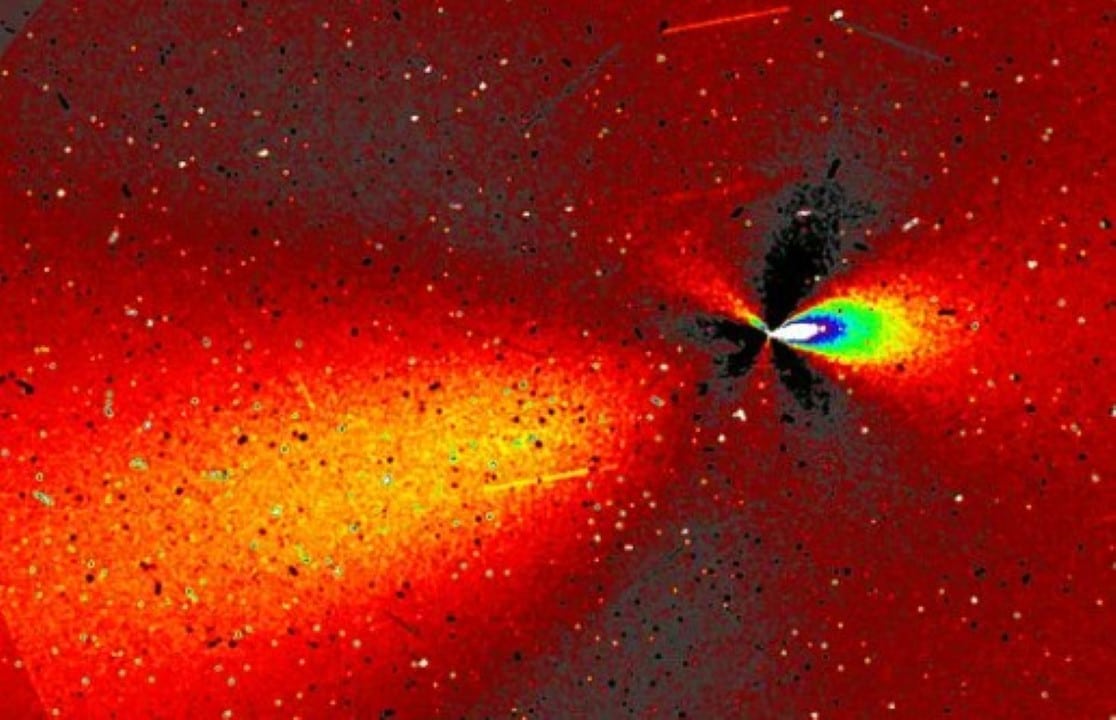
Scientists are investigating the unique behavior of the interstellar object 3I/ATLAS, whose characteristics challenge traditional understandings of comets. Observações recent views of its anti-tail jet, which extends in the direction of Sol, point to phenomena that could redefine its astronomical classification. The astronomical community is seeking additional data to confirm whether the presence of gas at distances greater than 5,000 kilometers from the nucleus contradicts the hypothesis that it is a natural comet.
In-depth analysis of the components expelled by 3I/ATLAS reveals unexpected complexity. Enquanto dust particles are observed hundreds of thousands of kilometers away, the behavior of the gas is the focus of the debate. Essas differences in the range of ejecta are crucial to determining the exact origin and composition of the object.
Investigations are fundamental to improving knowledge about celestial bodies of interstellar origin. The rarity of objects like 3I/ATLAS makes every detail observed and every calculation performed an important step towards expanding our understanding of the universe.
Difference in dust and gas propulsion

Dust and gas particles from 3I/ATLAS interact in different ways with the space environment. Dust, for example, is propelled by solar radiation pressure, allowing it to reach significant speeds and extend for hundreds of thousands of kilometers after perihelion. Esse phenomenon has already been documented in previous observations.
In contrast, the ejected gas faces much greater resistance from the solar wind. Este constant flow of charged particles, emanating from Sol, exerts pressure on the gas that can drastically limit its dispersion. Entender these interactions are vital to correctly interpret observational data and their implications.
The critical limit of 5 thousand kilometers
Recent calculations indicate that if 3I/ATLAS is a natural comet, the gas in its anti-tail jet should not extend beyond approximately 5,000 kilometers from its nucleus. Este limit is determined by the balance between the propulsion pressure of the gas and the opposing force of the solar wind. The mass density of the gas in its jet decreases inversely with the square of the distance, while the density of the solar wind maintains a consistency in its location.
The mass loss rate of 3I/ATLAS, estimated at around 500 kg/s after perihelion, and the gas exit velocity, limited to around 0.2 km/s (dictated by the sublimation of CO2 on its surface at a temperature of 200 Kelvin), are key factors in these calculations. Esses parameters, considered typical for comets that eject volatiles, result in a stopping distance of 5 thousand kilometers for the gas. Esse radius coincides with the bright halo (coma) observed in 3I/ATLAS images, including those from the Hubble telescope.
If future observations confirm the presence of gas at significantly greater distances, the natural comet theory could be ruled out. The solar wind would act to sweep the gas away from the Sol, directing it towards the object’s tail, while larger dust particles, above 10 microns, would continue to travel in the anti-tail direction.
This discrepancy between the behavior of gas and dust offers a unique opportunity to test the true nature of 3I/ATLAS. The absence of gas beyond the calculated limit would be a strong indication of its formation as a typical comet. The search for this evidence is a pillar of ongoing astronomical research.
Advanced propulsion hypotheses
An alternative to the natural comet theory is the possibility that 3I/ATLAS uses a type of technological propellant. Essa hypothesis gains strength if the gas is detected in much greater extents than predicted for a comet. Tal scenario suggests an ejection mechanism different from the sublimation of ordinary ices.
For chemical propellants, which have an exhaust velocity of around 5 km/s, the gas could be detected up to 25 thousand kilometers from the nucleus. Já ion thrusters, with even higher ejection speeds, close to 90 km/s, would allow the gas to reach distances of up to 100 thousand kilometers. Essas projections provide clear markers for future observations.
Detection of gas at these extended distances would be a strong indication of advanced technology behind the object’s propulsion. Spectroscopic analysis and identification of specific molecular traits are essential tools to validate or refute this theory. Science continues to explore all possibilities.
How to test for the presence of gas
Verifying the existence of gas along the 3I/ATLAS anti-tail jet requires specific observational methods. One technique involves tracking molecular tracers, such as carbon dioxide (CO2) or carbon monoxide (CO), along the axis of the jet. Measuring the spatial profile of these tracers, relative to sunlight scattered by the dust, would reveal the true extent of the gas.
This approach allows scientists to compare the distributions of gas and dust, identifying whether the gas persists at distances that exceed the 5,000-kilometer limit. The accuracy of these measurements is crucial to differentiating between a natural comet process and a scenario involving artificial propulsion.
Observatories in search of answers
The scientific community is pinning hopes on large ground- and space-based observatories to collect the necessary data. Telescópios as Keck, VLT (Very Large Telescope) and ALMA (Atacama Large Millimeter/submillimeter Array) can provide detailed ground observations. The high resolution of these instruments is essential for resolving the jet’s fine structures.
Space observatories, such as SPHEREx and the Webb space telescope, offer the advantage of observations free from atmospheric interference from Terra. Suas detection capabilities at different wavelengths are particularly valuable for identifying and mapping gas molecules. Obtaining this data will allow for a deeper, evidence-based understanding of the true nature of 3I/ATLAS, consolidating learning through direct observation.



