
Interstellar comet 3I/ATLAS displays oscillating jets in rare Sun-facing anti-tail


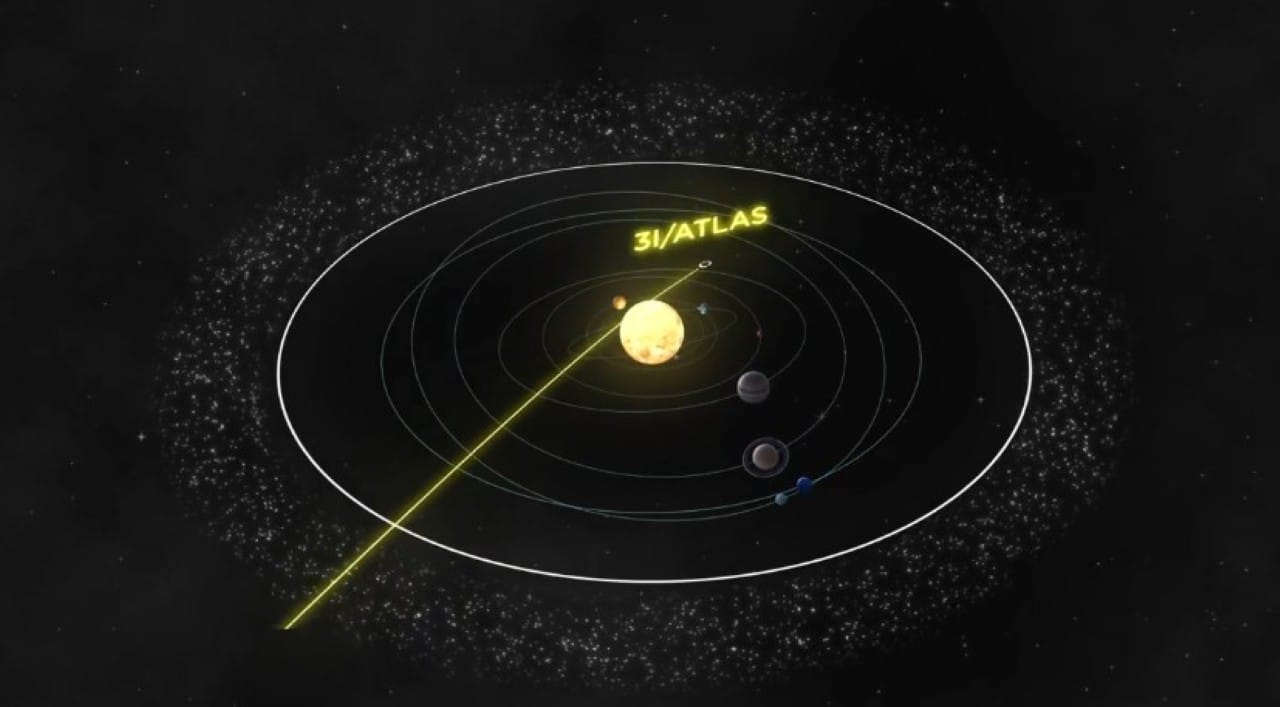
The interstellar comet 3I/ATLAS, also designated C/2025 N1 (ATLAS), continues to provide valuable data to astronomers even after its closest approach to Terra on December 19, 2025, when it passed approximately 270 million kilometers from the planet. Descoberto on July 1, 2025 by the ATLAS system in Chile, the object follows a hyperbolic trajectory and has already surpassed the perihelion point on October 30, 2025, approximately 210 million kilometers from Sol. Recent Observações highlight an unusual structure in the tail, with jets that exhibit periodic oscillating movement.
The anti-tail, a rare feature that appears to extend towards Sol, has reached significant extent in some measurements, reaching around 1 million kilometers. Essa formation results mainly from the observation geometry and the distribution of dust along the orbit. Dentro of this structure, researchers identified jets that change position regularly, with a cycle of approximately 7 hours and 45 minutes.
Jet structures reveal core rotation
Observations of the oscillating jets were carried out over 37 nights between July and September 2025. Astrônomos used the Telescópio Gêmeo of Dois Metros in the Observatório of the Esse periodic pattern indicates that the comet nucleus rotates around itself every approximately 15 hours and 30 minutes, with a small margin of uncertainty due to the geometry of the jets.
Active regions on the surface of the nucleus release gas and dust when exposed to sunlight during rotation. The Esse mechanism is common in Sistema Solar comets, but gains special relevance in the case of 3I/ATLAS. The object, formed around another star, experiences intense solar heating in our environment for the first time.
Anti-tail highlights interstellar material
The presence of the anti-tail is due to the observation perspective, when larger dust particles appear to move against the direction of solar radiation. The structure evolved over the months, changing from a fan facing Sol to a more pronounced tail after perihelion. Imagens captured by different instruments confirm the continuous activity even in the withdrawal phase.
Multimission monitoring expands scientific data
NASA coordinated observations with multiple space missions to follow the comet from different angles. Telescópios as well as Hubble, Parker Solar Probe and instruments on Marte recorded variations in the coma and tail. The Parker probe captured daily images between October and November 2025, while the Europa Clipper observed the object in November from a distance of about 164 million kilometers.
This integrated approach allows us to separate real structures from optical effects. The comet reappeared in the sky in December 2025 after a period of invisibility close to Sol. Observatórios Earthlings continued tracking in the pre-dawn sky.
Searches for artificial signals do not detect anomalies
Instituto SETI performed intensive observations through the Breakthrough Listen program. On December 18, 2025, the 100-meter Telescópio Green Bank searched for signals at frequencies from 1 to 12 GHz. Não candidates for technosignatures were found up to sensitivity levels of about 100 millivolts.
Other facilities, such as Allen Telescope Array and MeerKAT, have participated in the searches since July 2025. Hydroxyl Detecções confirmed natural chemical processes expected in comets. The results reinforce the object’s classification as natural astrophysics.
Next steps on the exit path
The comet heads towards interstellar space and is expected to pass close to Júpiter in March 2026. Essa geometry offers new observation opportunities with different angles. Após this passage, the object will become progressively more distant and fainter for telescopes.
Astronomers plan continuous monitoring as long as the comet remains visible with small equipment. Ferramentas online from NASA helps with position tracking. 3I/ATLAS represents a unique opportunity to compare the composition of comets formed in different stellar systems.
Studying this interstellar visitor advances understanding of the diversity of icy bodies in the galaxy. Sua normal activity in the solar environment highlights similarities between distant planetary systems.



