
Interstellar comet 3I/ATLAS reveals brightness in X-rays and origin of another star system


The comet3I/ATLAS, discovered on July 1, 2025 by the ATLAS system at Chile, represents the third interstellar object confirmed to visit Sistema Solar. Sua hyperbolic trajectory, with a speed exceeding 200 thousand km/h, indicates an external origin, probably ejected from another star system billions of years ago. The object passed perihelion on October 29, 2025 and reached closest approach to Terra on December 19, at around 270 million kilometers.
Observations carried out by space telescopes revealed a diffuse halo of X-rays around the nucleus on December 3, 2025. Essa emission results from interactions with the solar wind, including charge exchanges and the release of gases such as oxygen and carbon. Trata is the first detection of this phenomenon in an interstellar object.
The comet’s nucleus has an estimated diameter of between 440 meters and 5.6 kilometers, composed of ice, gases and rocks. The coma has a green glow, caused by molecules such as carbon diatoms or cyanide, observed by Gemini North in November 2025.
Hyperbolic trajectory
The orbit of 3I/ATLAS is not gravitationally bound to Sol, unlike common comets. Ela entered Sistema Solar from the direction of Sagitário, with an escape velocity that will take it back to interstellar space. Essa characteristic confirms its external origin and prevents future return.
Astronomers calculated that the gravitational deflection by the Sol changed the trajectory by just 16 degrees. The comet accelerated to about 246,000 km/h at perihelion, before slowing down as it moved away.
Chemical composition
Spectroscopic analyzes indicate a high proportion of carbon dioxide in relation to water, unusual in Sistema Solar comets. Detectaram also high nickel content compared to iron, as well as methanol and possible traces of cyanide.
These differences suggest formation under different conditions from another planetary system. The coma evolved over the months, with reddish dust and larger grains than usual.
- Excess CO2 → Indica sublimation at greater distances than Sol.
- Presence of nickel → Difere of observed solar patterns.
- Relative absence of water → Sugere drier composition than local comets.
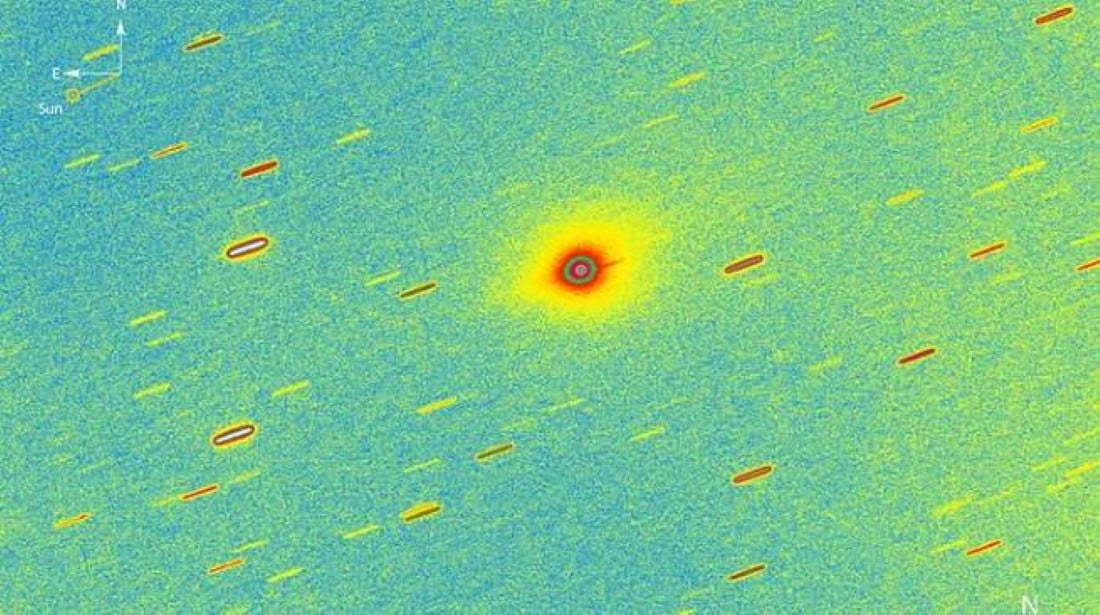
Key Observations
Telescopes such as Hubble, James Webb, XMM-Newton and XRISM have captured detailed images and data. Hubble recorded double jets of ejecta, linked to the rotation of the nucleus, in December 2025.
Missions such as Parker Solar Probe and Europa Clipper obtained unique views during perihelion and land approach. Observações in ultraviolet detected hydrogen and oxygen in the coma.
The comet exhibited anti-dust tail, pointing towards Sol due to geometric effects, observed between December 17th and 21st.
Intense green glow
The greenish glow appeared in November 2025, the result of the excitation of carbon and cyanide molecules by solar radiation. Essa coloration stood out in images of Gemini North, differentiating 3I/ATLAS from typical comets.
Intensity increased rapidly after perihelion, exceeding initial predictions. The phenomenon is related to the release of volatile gases from the primordial nucleus.
New X-ray halo
XMM-Newton identified diffuse X-ray emission on December 3, 2025. Esse glow originates from collisions between solar wind particles and neutral coma atoms.
The detection marks the first of an interstellar object, providing data on interactions in environments outside of Sistema Solar. Anomalias in the emission point to gases such as oxygen and carbon released.
This observation complements studies of solar comets, but reveals particularities of 3I/ATLAS.
Current leave
After approaching Earth in December 2025, the comet heads towards the outer regions of Sistema Solar. Ela will cross the orbit of Júpiter in 2026 and continue accelerating into interstellar space.
Observations continue with ground- and space-based telescopes as brightness permits. The current magnitude is around 13 to 15, requiring professional equipment.
The 3I/ATLAS flyby offers a rare opportunity to study primordial material from another star system. Dados collected improve models of planetary formation in distant environments.



