
New Hubble photos show double, anti-tail jets on comet 3I/Atlas


Telescópio Espacial Hubble captured images on December 12 and 27, 2025 that show a double jet structure on the interstellar comet 3I/Atlas. Essas observations, made with exposures of 170 seconds each, reveal a more prominent jet forming an antitail directed towards Sol and a weaker one in the opposite direction. The comet, which passed perihelion on October 29, 2025, remains active as it moves away from Sistema Solar.
The processed images highlight variations in the intensity of the jets between the two dates. Essa configuration raises questions about the rotation of the nucleus and the origin of the activity. Astrônomos analyze the data to understand the unusual behavior of this object coming from another star system.
Recent observations of Hubble
Hubble’s WFC3 UVIS instrument operated at a central wavelength of 0.5851 microns to record sharp details of comet 3I/Atlas. Photos from December show the antitail as the dominant jet, extending hundreds of thousands of kilometers.
This structure differs from common Sistema Solar comets, where the jets generally direct away from Sol. The simultaneous presence of two jets suggests complex dynamics in the comet’s nucleus.
- Main jet: forms the visible antitail towards Sol.
- Secondary jet: weaker, in line with previously observed activity.
- Temporal variation: intensity alternates between the images from December 12th and 27th.
These elements indicate possible oscillation related to the rotation of the object.
Interpretations of the double structure
Astronomers consider that the jets emerge from opposite sides of the nucleus of comet 3I/Atlas. Solar Energia accumulated during perihelion may have transferred to the night side, activating the weaker jet.
Another possibility involves differences in the composition of the ejected particles. Grãos of larger dust forms the extensive antitail, while smaller particles react faster to solar radiation pressure.
The orbital curvature of just 16 degrees by solar gravity preserved pre-perihelion characteristics. Previous Observações, in July 2025, already showed an elongated jet with a seven-degree oscillation.
Interstellar trajectory context
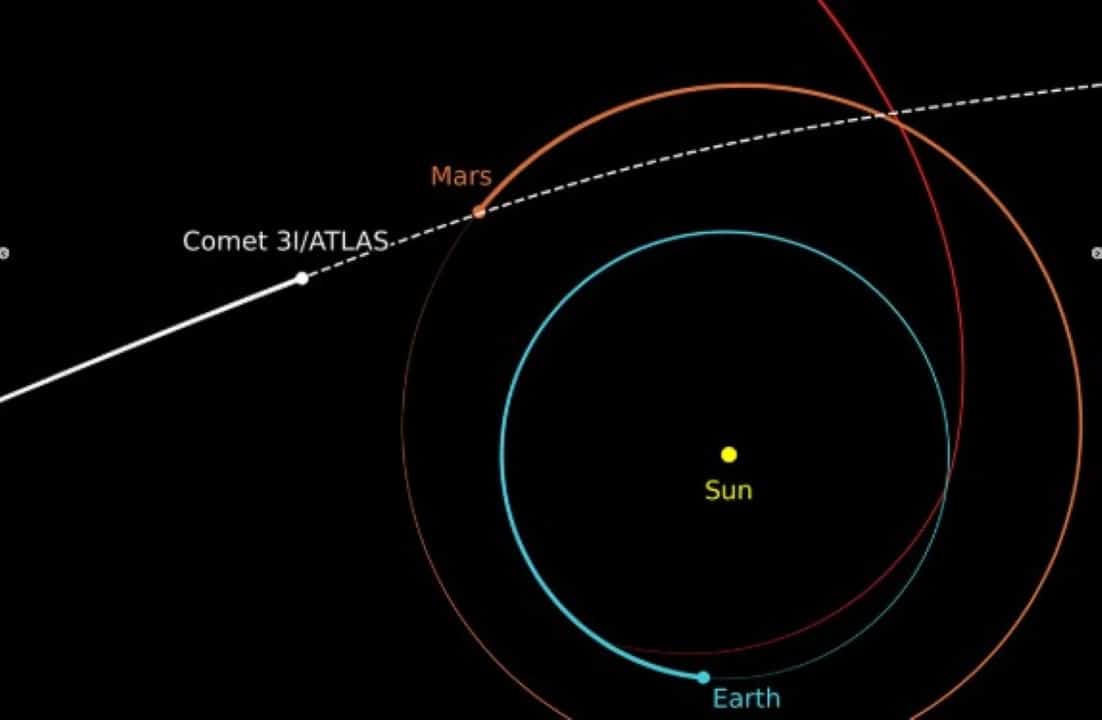
Comet 3I/Atlas entered Sistema Solar on a hyperbolic trajectory, confirming its origin outside it. Seu perihelion occurred in October 2025, without significant changes in the orientation of the rotation axis.
Persistent post-perihelion activity includes ejection of dust and gas at varying speeds. Partículas smaller ones reach 22 m/s, while larger ones move at about 2 m/s.
This data contributes to understanding rare interstellar objects. The comet remains visible to telescopes as it recedes.
Details of processed images
Processing with the Larson-Sekanina filter enhances rotational gradients in the Hubble photos. The December 12 image shows the antitail prominent in the lower left corner.
In the December 27 capture, the sunward jet maintains close collimation. Ambas reveal coma around the nucleus, extending hundreds of thousands of kilometers.
Post-perihelion activity
Comet 3I/Atlas maintains ejection of material even as it moves away from Sol. Observações indicate mass loss equivalent to a significant percentage of the estimated minimum core.
Dust particles with radii of 1 to 100 microns dominate the visible jets. The narrow collimation suggests sources close to the poles of the nucleus.
Variations in the brightness of jets compatible with a rotational period of around 16 hours. Essa oscillation explains changes observed since July 2025.
Composition and origins
Spectroscopic analyzes reveal the presence of organic compounds irradiated in the coma. The reddish color resembles D-type asteroids and other interstellar comets.
The comet possibly originated in the thick disk of Via Láctea, which is more than 7 billion years old. Dados from Hubble and other instruments refine estimates of the core to between 440 meters and 5.6 kilometers.
Complementary observations from missions such as JWST and ground-based telescopes enrich the understanding of this rare visitor.



