
Russia announces reuse of ISS modules for new orbital station in 2030

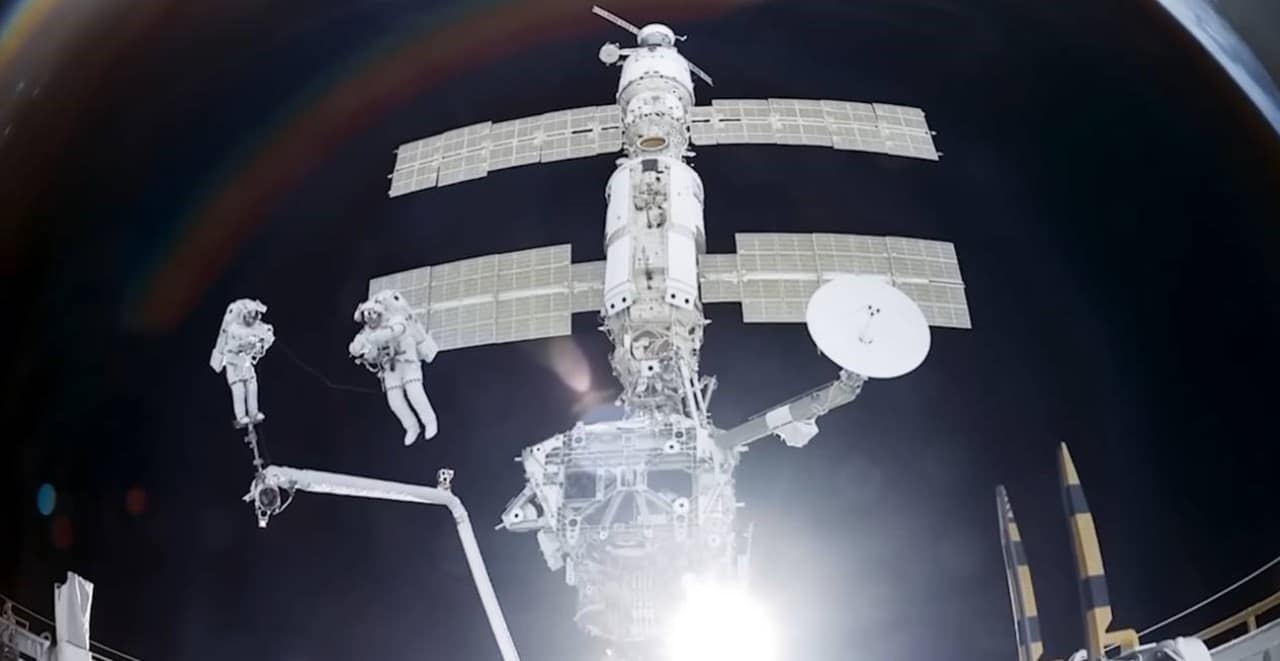
Roscosmos has announced a significant change in its plans for the national orbital station. The director of Instituto of Problemas Biomédicos of Academia Russa of Ciências, Oleg Orlov, revealed that the agency’s scientific and technical council approved the use of the Russian segment of Essa strategy envisages the separation of the Russian modules in 2030, when the ISS is deactivated.
The initial plan called for the construction of a completely new station, with module launches starting in 2027. However, the current approach prioritizes the reuse of existing modules, such as Zvezda, Nauka and Prichal, with the addition of new components before and after separation. Essa decision allows for resource savings and operational continuity.
The ISS has been operating since 1998 and involves a partnership between Rússia, Estados Unidos, Europa, Japão and Canadá. Decommissioning is scheduled for 2030, with controlled re-entry of the main part at Oceano Pacífico.
Current configuration of the Russian segment
The Russian segment of the ISS includes six main modules that provide propulsion, accommodation and research. Esses components form the backbone of future ROS.
- Zvezda: Módulo core service, launched in 2000, responsible for attitude control and life support.
- Nauka: Módulo multifunctional laboratory, coupled in 2021, equipped for scientific experiments.
- Prichal: Universal docking Nó, recently added, allows connection of multiple ships.
- Poisk and Rassvet: Módulos smaller for searches and storage.
- Zarya: Primeiro ISS module, launched in 1998, provides initial power and propulsion.
These modules have accumulated decades of continuous operation. Reuse requires extensive maintenance to ensure safety.
Reasons for strategic change
The decision reflects adjustments in priorities due to budgetary and geopolitical constraints. Inicialmente, ROS would be launched into polar orbit to observe the Russian Ártico.
Now, the station will maintain the ISS’s 51.6-degree inclination, facilitating launches from existing cosmodromes. Essa change simplifies logistics and reduces costs with new rockets. The approval came after analyzes by a special commission in recent months.
Rússia extends participation in the ISS until 2028, aligning with international partners. The separation will occur in a controlled manner in 2030.
Additional modules planned
New components will be integrated into the Russian segment still attached to the ISS. Esses additions expand scientific and operational capabilities.
An energy and science module is expected to be launched in the coming years. Outros include lock compartment and additional nodes. Após separation, modified Progress ships will control orbit and attitude.
The final configuration aims for full autonomy, with regular visits by cosmonauts via Soyuz or new ships.
separation technician
The undocking operation requires precise coordination to avoid risks to the remaining ISS. The Russian modules provide essential propulsion for the current station.
After separation, the international part will be deorbited by an American vehicle. The Russian segment will remain in independent orbit. Testes and simulations guarantee technical feasibility.
Experts highlight the need to repair leaks and aging systems before 2030.
Evolution of Russian plans
Projects for the national station have evolved since 2009, with the initial concept of a piloted orbital complex. In 2021, Rússia announced its intention to leave the ISS to focus on its own station.
Initial plans included seven new modules by the mid-2030s. The current version prioritizes reuse to accelerate deployment. Essa approach maintains Russian presence in low Earth orbit.
ROS will solve scientific and national security tasks unavailable on the current segment of the ISS.
Operational preparation
The transition includes cosmonaut training and ground infrastructure development. Lançamentos of cosmodromes like Baikonur and Vostochny support the project.
Ongoing maintenance of the Russian segment on the ISS serves as preparation. Microbiological and structural Monitoramento identifies repair priorities. The station will serve experiments in microgravity and space technology.
Rússia seeks selective international partnerships for future commercial modules.
The new configuration represents a pragmatic solution for the continuity of the Russian manned space program. ROS will inherit the legacy of the ISS while incorporating necessary upgrades.




