
Supermassive black hole is spotted traveling at 954 km/s and leaving a trail of stars in space


An unprecedented discovery has shaken the astronomical community with the confirmation of a supermassive black hole traveling rogue through the cosmos. The object, cataloged as RBH-1, moves at an astonishing speed of 954 kilometers per second, which is equivalent to traveling from São Paulo to Rio to Janeiro in less than half a second. Esta is the first direct evidence of a cosmic giant of this magnitude being ejected from its home galaxy.
The detection was carried out at a distance of approximately 7.5 billion light years from Terra, using the advanced capabilities of Telescópio Espacial James Webb. The black hole, with a mass estimated to be at least 10 million times that of our Sol, does not travel invisibly. Ele leaves behind a luminous and revealing trail, a trail of gas and newborn stars that stretches a colossal distance.
This phenomenon validates theories that for decades existed only in computer simulations, suggesting that violent interactions between galaxies can result in the expulsion of their central black holes. The observation of RBH-1 opens a new window into understanding the dynamics of the universe and the evolution of galactic structures, proving that these massive objects do not always remain anchored to their cosmic homes.
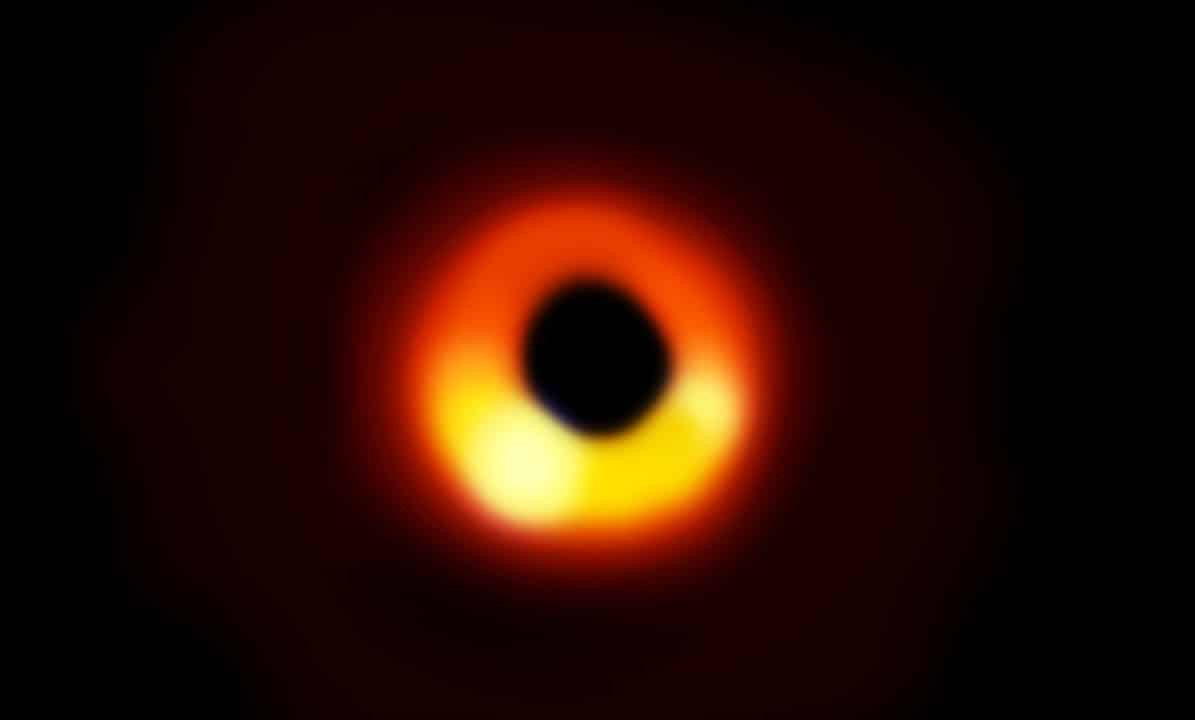
The 200,000 light-year cosmic trail
The trail left by the RBH-1 black hole is one of the most impressive features of the discovery. With an extension of around 200 thousand light-years, almost twice the diameter of Via Láctea, this wake is a direct consequence of the object’s high-speed passage through the intergalactic medium. At the forefront of the movement, a powerful shock wave is formed, similar to what a supersonic plane creates in the atmosphere. Essa wave compresses the rarefied gas of space, heating it and ionizing it. Most notable, however, is what happens behind this shock wave. The compressed gas becomes dense enough to collapse under its own gravity, triggering an intense star formation process. Essencialmente, the runaway black hole is seeding new stars in its path, creating a luminous trail that serves as an indelible marker of its journey through the cosmic void.
How the James Webb telescope performed the confirmation
Confirming the movement and nature of the RBH-1 was a triumph of the technology on board the Telescópio Espacial James Webb. Embora Previous images of Telescópio Espacial Hubble had already captured the linear structure, its true nature was uncertain. Foi the NIRSpec (Near-Infrared Spectrograph) instrument of the James Webb that provided the definitive proof. By analyzing the light coming from the gas around the object, astronomers were able to accurately map its speed.
Spectroscopy revealed a classic pattern of supersonic motion. The gas in front of the black hole exhibited a “blueshift”, indicating that it was moving towards the telescope, pushed by the shock wave. Nas edges and rear, the gas showed a “redshift”, moving away. Essa abrupt variation in velocity throughout the structure confirmed that it was a massive object piercing the intergalactic medium at extraordinary speed, and not a static anomaly in a distant galaxy.
The origin of the runaway giant
The most plausible explanation for the ejection of such a massive object involves one of the most cataclysmic events in the universe: the merger of galaxies. Quando two galaxies collide, their respective central supermassive black holes spiral toward each other, eventually merging into a single, larger black hole.
During this fusion process, gravitational waves, ripples in the fabric of space-time, are emitted. If this emission of waves is not perfectly symmetrical in all directions, it can generate a gravitational “kickback” or recoil, propelling the newly formed black hole in a specific direction with immense force.
This RBH-1 event represents observational validation of these theoretical predictions. The energy required to accelerate 10 million solar masses to 954 km/s is colossal, highlighting the violence and scale of the forces involved in galactic collisions.
Unique characteristics of the RBH-1 object
Unlike the supermassive black holes we know of, which reside at the centers of massive galaxies like ours, RBH-1 is a solitary object. Ele is not accompanied by a cluster of stars or a complete galactic structure, only by a small cloud of matter that was gravitationally captured during its escape.
Its speed, which corresponds to 0.32% of the speed of light, is enough to ensure that it escapes any gravitational pull from its parent galaxy, condemning it to a perpetual journey through intergalactic space.
Interaction with the surrounding gas not only creates stars, but also makes the invisible visible. Buracos black people, by definition, do not emit light. Detection was only possible because of the secondary effects of its passage, such as the shock wave and the star trail.
Astronomers consider that the observation was favored by a fortunate alignment, which allowed the trail to be seen in profile from Terra, facilitating the spectroscopic measurements that were crucial for confirming the phenomenon.
New frontiers for astrophysics
The discovery of RBH-1 challenges the traditional conception that supermassive black holes are fixed and stable points at the hearts of galaxies. Fica It is evident that, under extreme circumstances, they can be dislodged and become wandering objects, crossing the cosmos and influencing environments very far from their point of origin.
This implies the possible existence of an entire population of “homeless” supermassive black holes in the universe. Most of them would be completely invisible to us unless, like RBH-1, they interact detectably with intergalactic gas. The search for more objects like this now becomes an exciting new area of research in astrophysics.
Details of the gravitational ejection process
The gravitational recoil mechanism is a phenomenon predicted by Teoria of Relatividade Geral of Einstein. Quando two black holes of different masses or rotations merge, the emission of gravitational waves is not uniform. Most of the energy is released in a specific direction, and by conservation of momentum, the resulting black hole is propelled in the opposite direction, like a gun recoiling after a shot.
In even rarer scenarios, interaction with a third supermassive black hole during a triple galactic merger can drastically amplify this gravitational slingshot effect, resulting in even higher ejection velocities. Continued analysis of RBH-1 and its environment may help determine which of these scenarios is most likely for its origin.
The future of searching for errant objects
With the first confirmation in hand, astronomers now know what kind of signature to look for. Regiões of the sky where past galaxy mergers have occurred will become priority targets for telescopes like James Webb and future observatories. The expectation is that, with the improvement of technology and observation techniques, more of these fugitive cosmic giants will be found, allowing a more accurate census of this hidden population and a deeper understanding of the violent and dynamic history of the formation of structures in the universe.



