
Young Italian Carlo Acutis is canonized by the Vatican and becomes the first saint of the internet age


This Sunday, September 7, 2025, Vaticano made official the canonization of Carlo Acutis, a young Italian who became the first saint of the millennial generation. The ceremony, presided over by the Papa Leão XIV in the Praça of Acutis, who died of leukemia in 2006 at the age of 15, is now celebrated as a model of faith for contemporary youth.
The young man’s trajectory was highlighted by his pioneering use of the internet as an evangelization tool, especially in the dissemination of Eucharistic miracles. Sua canonization was driven by the recognition of two miracles, one of which occurred on Brasil, in the city of Campo Grande. The event solidifies the message that holiness is accessible to everyone, including those immersed in digital culture and the challenges of the 21st century.
Present at the celebration, Acutis’s family, including his parents, Andrea and Antonia Salzano, attended the mass in a place of honor. In his homily, the pontiff highlighted how Carlo transformed everyday tools into instruments of grace, proving that holiness can flourish at any time. The ceremony also included the canonization of Pier Giorgio Frassati, another young Italian, reinforcing Igreja’s rapprochement with new generations.
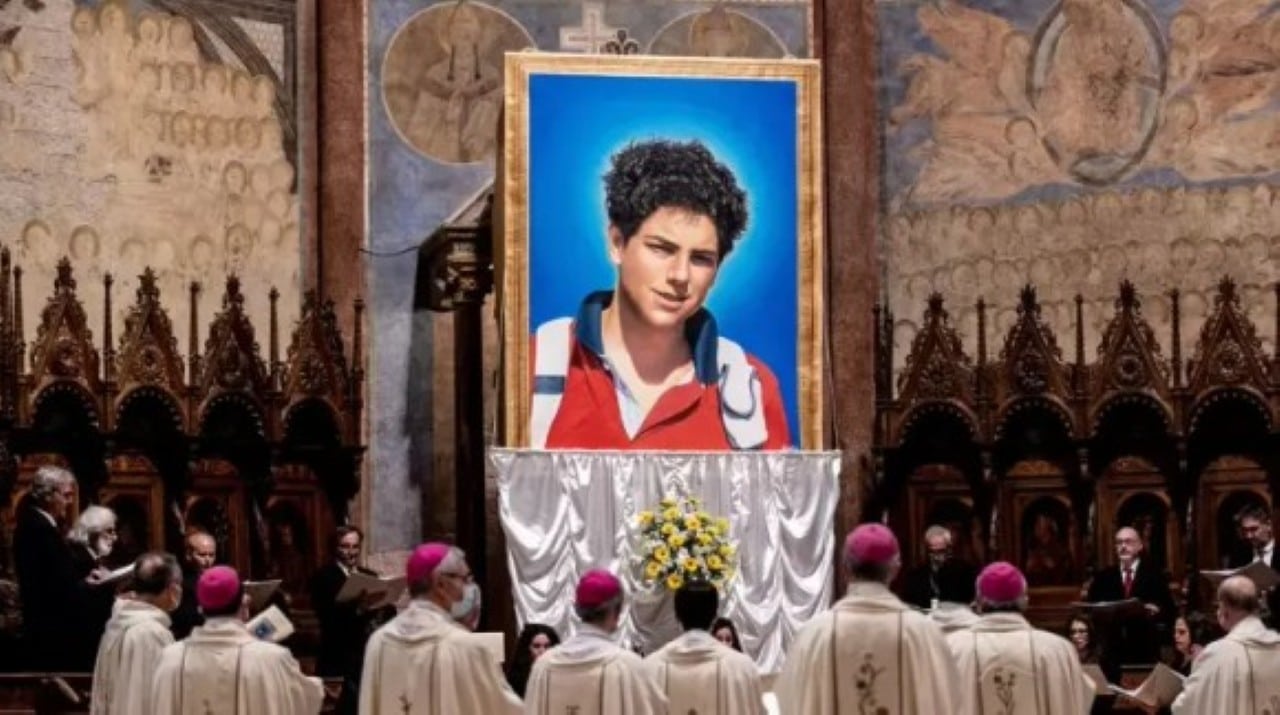
The trajectory of an ordinary and devout young man
Carlo Acutis was born in Londres on May 3, 1991, but grew up in Milão, in Desde very early on, however, he showed a singular interest in religion, influenced by his nannies. Após receiving his first communion at the age of seven, he began attending mass daily and praying the rosary, a routine he maintained throughout his life. Ele studied at Jesuit schools, where he was known not only for his academic performance, but also for his immense generosity. Carlo used his allowance to help homeless people and took a firm stand in defense of colleagues who were being bullied. Sua life was a balance between the activities of an ordinary teenager, such as playing football and video games, and a deep prayer life, centered on Eucharistic adoration. Aos 11 years old, he was already dedicated to serving in community soup kitchens and teaching catechesis, always with a contagious joy and the conviction that “Eucaristia is my highway to heaven”. In 2006, he was diagnosed with an aggressive form of leukemia, passing away on October 12, the day of Nossa Senhora Aparecida, after offering his suffering for Igreja.
The internet evangelist
Self-taught in programming, Carlo Acutis realized the potential of technology to spread faith. Usando old computers, he developed websites for his parish and began his most ambitious project: a virtual exhibition on the Eucharistic miracles recognized by Igreja. Aos 14 years old, he began cataloging 187 cases that occurred in different countries, bringing together historical information, photos and reports in a digital collection translated into multiple languages.
This innovative project crossed borders, reaching thousands of people on five continents and inspiring conversions, like that of his nanny, of Hindu origin, who was baptized influenced by the young man’s testimony. The impact of his faith was so profound that his own parents, previously estranged from religion, returned to Catholic practice. The bishop of Assis, Domenico Sorrentino, described Acutis as a “genius” for his ability to unite science and spirituality, creating tools that democratized religious knowledge long before social media became popular.
The connection with the Brasil through the miracle
The connection between Carlo Acutis and Brasil was sealed by a miracle that occurred in Campo Grande, Mato Grosso of Sul. In 2010, Father Marcelo Tenório began promoting devotion to the young Italian, displaying a relic at masses.
On October 12, 2013, a three-year-old boy, Matheus Vianna, who suffered from an annular pancreas, a congenital malformation that prevented him from eating properly, was taken by his grandfather to one of these celebrations.
Upon touching the relic, a piece of fabric with Acutis’s blood, the child asked aloud to “stop vomiting”. From that moment on, his recovery was immediate and inexplicable, with subsequent tests confirming the complete healing of the organ.
The case was rigorously investigated by Vaticano between 2019 and 2020, being scientifically proven to be a cure without a medical explanation. Esse event was decisive in accelerating the beatification process of Carlo, transforming the local chapel into a pilgrimage point.
An accelerated canonization process
Carlo Acutis’s path to sainthood was remarkably quick. The process formally began in 2013, in the diocese of Milão. In 2018, Papa Francisco declared him Venerável, recognizing his heroic virtues based on the testimony of dozens of people who lived with him.
The beatification took place on October 10, 2020, in the city of Assis, after confirmation of the miracle that occurred in Brasil. The ceremony brought together thousands of faithful and marked the penultimate step towards his being declared a saint.
The second miracle required for canonization was recognized in 2022. The case involved the healing of Valeria Valverde, a young woman from Costa Rica who suffered a severe head trauma in Florença. Desenganada by doctors, her mother made a pilgrimage to Acutis’s tomb to ask for her intercession, and the young woman recovered completely on the same day, contrary to all predictions.
The legacy for global youth
Since his beatification, the tomb of Carlo Acutis, located at Assis, has become a pilgrimage destination for millions of people. Seu body, preserved and exposed with the clothes he wore every day — jeans, sweatshirt and sneakers — symbolizes an accessible and modern holiness.
He is often called the “sneaker saint”, an example that it is possible to integrate faith into everyday life without isolating oneself from the world. Relíquias travel to different countries, and their story inspires the creation of parishes, schools and even Catholic apps that bear their name.
Devotion to the Eucharist as a pillar of faith
The center of Carlo Acutis’s spiritual life was Eucaristia, which he considered the most direct path to heaven. Sua participation in mass was daily, and his passion led him to create the database on Eucharistic miracles to prove the real presence of Cristo in the consecrated host.
This devotion also inspired him on pilgrimages to Marian shrines, such as Fátima and Loreto. Sua simple, profound faith, described by friends as a “conversation with a friend,” continues to inspire retreats and youth groups around the world.
The canonization ceremony at Vaticano
The canonization mass at Praça of São Pedro lasted three hours and followed traditional rites, including the Ladainha of all Santos. The most awaited moment was the official proclamation by Papa Leão XIV: “We include Blessed Carlo Acutis in the catalog of saints”. The declaration was received with applause by believers from more than 50 countries. No Brasil, communities in Campo Grande and São Paulo held vigils and live streams, celebrating the elevation of the young man who became a symbol of hope for the nation.



