
Astronomer Avi Loeb analyzes symmetric structure of jets in Hubble images of the 3I/ATLAS object


Telescópio Espacial Hubble captured images of the interstellar object 3I/ATLAS in November and December 2025. Essas photos show a variable jet structure, highlighting a symmetric internal configuration. Astronomer Avi Loeb, from Universidade Harvard, analyzed the processed data and highlighted unusual features in the object’s behavior.
Observations took place on November 30, December 12, and December 27, 2025. The data reveals internal jets and a prominent anti-tail directed at Sol. Loeb pointed out that the angular symmetry of the internal jets raises questions about their natural origin.
Image processing used the Larson-Sekanina rotation gradient filter, applied by the Italian astronomer Toni Scarmato. Esse method highlights variations in the structure of the jets on scales of up to 100 thousand kilometers.
Observations from Hubble
Hubble recorded 17 images of 3I/ATLAS on specific dates at the end of 2025.
The top panels of the processed images focus on internal jets up to 24,000 kilometers from the nucleus.
- On November 30, a jet points approximately away from Sol.
- On December 27, additional side settings appear.
The external structure is dominated by the solar anti-tail, visible at larger scales in December dates.
These captures show the temporal evolution of the jets, with variations in intensity and orientation.
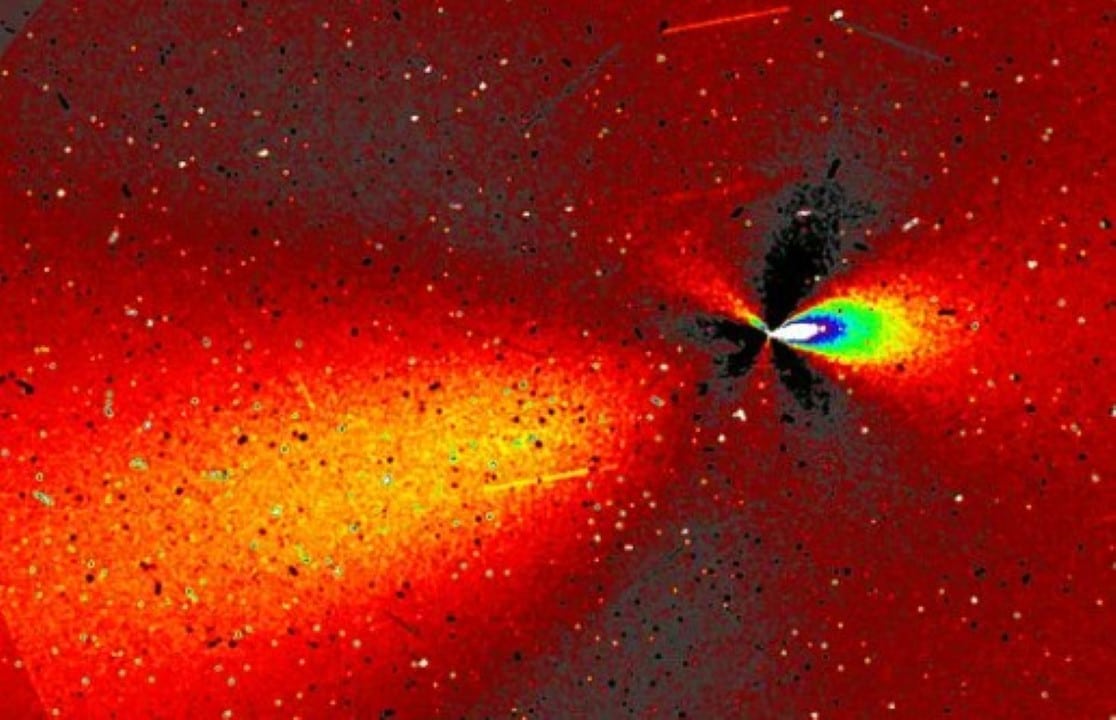
Symmetrical structure of the jets
Loeb described the internal configuration as consisting of three jets.
A jet points roughly away from Sol.
The other two are in lateral directions, separated by angles of approximately +/- 120 degrees.
This equal division of 360 degrees by three creates precise angular symmetry.
The orientation of the axes changes over time, possibly due to the rotation of the nucleus.
The estimated rotation period of 3I/ATLAS is about 16 hours.
Variations in the smaller jets occur on scales of thousands of kilometers, compatible with ice sublimation speeds.
Natural interpretation
The comet explanation associates the jets with pockets of ice on the surface of a rotating nucleus.
The solar jet forms the extensive anti-tail, reaching 100 thousand kilometers.
The activity of the lateral jets may result from heat conduction through the object’s body.
The anti-tail maintains coherence at scales ten times its width.
This suggests minimal misalignment with the axis of rotation, less than 6 degrees.
The alignment of the rotation axis with the solar direction has a low probability of random occurrence, estimated at 0.2%.
Alignment Questions
Precise geometric alignment between the axis of rotation and Sol persists over large distances.
This stability requires a small cone of precession around the axis.
Loeb questions whether this configuration results from natural gas dynamics.
Alternatively, it raises the possibility of an unnatural signature.
Future observations will help clarify the composition and speed of the jets.
Image processing
Toni Scarmato processed raw data released by NASA, ESA and STScI.
The images highlight the anti-tail in the lower left corner, directed towards Sol.
Zooming in on smaller scales reveals the three symmetrical inner jets.
The evolution between November and December shows changes in the dominance of the jets.
These details contribute to continuous monitoring of the object as it moves away from Sistema Solar.
3I/ATLAS continues to be observed by ground and space telescopes. Dados future spectroscopic scans could determine the speed and composition of the jets. The observed symmetry and alignment remain points of debate in the astronomical community.



