
US military action in Venezuela sparks international outcry and conditional support amid regional divide
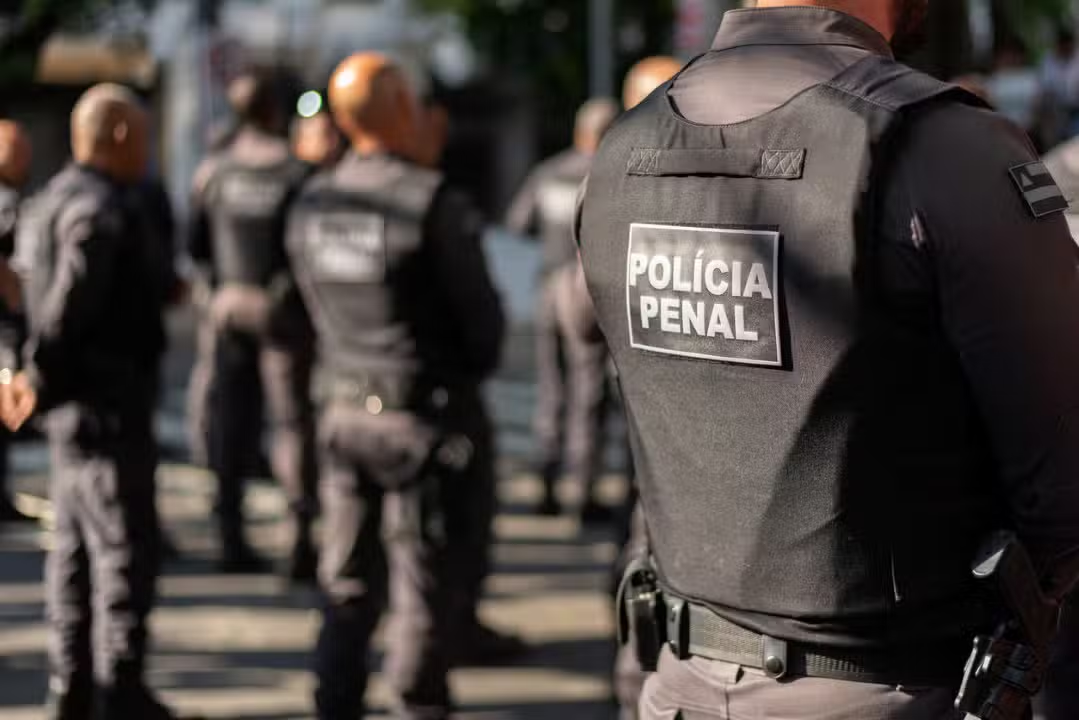
A United States military operation in Venezuela this Saturday (3) has elicited a wide spectrum of international reactions, ranging from outright condemnation and concerns over violations of international law to enthusiastic support for the intervention and the capture of the Venezuelan leader. This event quickly became a focal point for geopolitical tensions, particularly within Latin America, highlighting deep ideological divisions across the continent and beyond.
Leaders across Latin America swiftly responded, with many governments vehemently denouncing the action as a violation of sovereignty and international norms. Conversely, a notable segment expressed strong approval, viewing the intervention as a step towards freedom and stability in the region.
The operation’s timing and its implications for regional peace and security have prompted urgent calls for de-escalation and adherence to established international frameworks, even as some nations aligned themselves firmly with the United States’ action.
Latin American condemnation and calls for peace
Cuba’s President Miguel Díaz-Canel led the strong denunciations, criticizing what he termed a “criminal” US attack against Venezuela. In a post on X, he urgently demanded an international community reaction, asserting that the region’s declared “zone of peace” was being brutally assaulted by this aggressive action.
Mexico’s President Claudia Sheinbaum echoed these sentiments, also utilizing X to cite a crucial passage from the UN Charter. She emphasized that member states must refrain from the threat or use of force against the territorial integrity or political independence of any state, sharing an official declaration that explicitly “condemns and vehemently rejects” the US military operation.
Regional leaders express deep concern over unilateral actions
Colombia’s President Gustavo Petro articulated profound concern regarding the unfolding situation in neighboring Venezuela. He communicated that his government was closely monitoring the developments, stressing its firm position.
The Colombian government, Petro stated, rejects any unilateral military action that carries the potential to escalate the current situation or, critically, place the civilian population at undue risk. This highlights a regional apprehension about unauthorized interventions.
Chile’s outgoing President Gabriel Boric conveyed his government’s “concern and condemnation” over the US operation. Boric underscored that the persistent Venezuelan crisis must be resolved through sustained dialogue and robust support for multilateralism, explicitly not through violence or any form of foreign interference, advocating for peaceful diplomatic resolutions.
Uruguay’s government affirmed it was following the events with “attention and serious concern.” The Ministry of Foreign Affairs issued a statement unequivocally rejecting “the military intervention of one country in the territory of another,” emphasizing that states are obligated to abstain from resorting to the threat or use of force against another state’s territorial integrity or political independence, aligning with international legal principles.

Varied responses: Support for intervention emerges
In stark contrast to the widespread condemnations, President Javier Milei of Argentina, a known ally of US President Donald Trump, appeared to welcome the capture of the Venezuelan leader. His terse message on X, “Freedom advances! Long live freedom, damn it!”, signaled a clear ideological alignment with the interventionist approach taken by the United States. This reaction underscores a significant divide within the Latin American political landscape regarding the legitimacy and desirability of such operations.
Ecuadorian President Daniel Noboa similarly embraced the news, writing on X, “For all Chavista drug-trafficking criminals, your hour is coming. Your structure will completely collapse across the continent.” He further called upon Venezuelan opposition leaders and the broader public to actively resume control of their country, signaling direct support for the objectives underpinning the US military operation and a clear stance against the existing Venezuelan government.
Brazil warns of dangerous precedent and interference
Hours after the initial reports, Brazilian President Luiz Inácio Lula da Silva issued a strong condemnation, declaring that “the attacks on Venezuelan territory and the capture of its president crossed an unacceptable line.” He cautioned that such actions establish an “extremely dangerous” precedent for the international community, potentially undermining global stability and the rule of law. Lula emphasized that the maneuver “recalls the worst moments of interference in Latin American and Caribbean politics,” evoking historical periods of external intervention that destabilized the region. He also warned that these actions severely “threaten the preservation of the region as a zone of peace” and urged the international community to “respond firmly to this episode,” advocating for a unified and robust diplomatic stance against military interventions.
European nations urge de-escalation and international law adherence
Spain’s Prime Minister Pedro Sánchez called for immediate “desescalation” in Venezuela, urging all parties to respect international law and the fundamental principles enshrined in the United Nations Charter. Spain also reiterated its diplomatic position of not having recognized the results of the July 28, 2024, Venezuelan elections, consistently supporting initiatives aimed at achieving a democratic solution for the country.
The United Kingdom moved to distance itself from the operation, with Prime Minister Keir Starmer confirming that his government “did not participate in any way” in the US action in Venezuela. He emphasized the crucial necessity of respecting international law, reflecting a cautious and non-interventionist stance from London amidst the unfolding crisis.
Russia and Belarus condemn as “armed aggression”
From Moscow, the condemnation was unequivocal and frontal. The Russian Ministry of Foreign Affairs described the US action as an “act of armed aggression” and reaffirmed its “solidarity with the Venezuelan people.” It issued an urgent appeal to all involved parties to avoid any further escalation and to diligently seek a resolution through peaceful dialogue and diplomatic channels, stressing the imperative of de-escalation.
Belarus, for its part, also issued a categorical condemnation of what it referred to as “armed aggression.” This aligned its position with Russia, highlighting a joint stance against unilateral military interventions and advocating for the principles of national sovereignty and non-interference in internal affairs.
The European Union’s chief diplomat, Kaja Kallas, reiterated that the EU considers the Venezuelan leader to lack legitimacy, reflecting its ongoing political stance. However, Kallas also underscored the critical importance of respecting the principles of international law, indicating a nuanced approach that separates political legitimacy from adherence to international legal frameworks.
Broader international caution and monitoring
Across Asia, China advised its citizens against traveling to Venezuela “in the near future,” urging those already in the country to take extreme precautions, as reported by state media. Meanwhile, in the Caribbean, Trinidad and Tobago formally denied any involvement in the US military operation, asserting its commitment to maintaining peaceful relations with Venezuela. Other European nations like Belgium, the Netherlands, and Poland stated they are closely monitoring the situation and verifying the welfare of their citizens in the affected region.
Veja Tambem em Últimas Notícias

Conmebol define confrontos das oitavas da Libertadores em sorteio com seis clubes do Brasil

João Fonseca x Novak Djokovic em duelo decisivo pela terceira rodada de Roland Garros

27歳女性、末期がんと闘う恋人と感動の挙式:大学時代からの愛をSNSで共有し反響
Kenyan authorities detain 8 students after devastating dormitory fire kills 16 pupils
Conmebol define confrontos das oitavas de final da Libertadores com seis clubes do Brasil
French far-right leaders Le Pen and Bardella navigate policy differences amid strong poll numbers
Teenager charged for using police car as BMX ramp during Scientology speedrun in Brisbane CBD

Governo federal aprimora Bolsa Família em 2026 com novas regras e reforço nos benefícios sociais

Michael Schumacher at 57: A Decade of Private Recovery Continues, Formula 1 Legacy Endures in 2026
Desvendando o cometa interestelar 3I/Atlas: NASA revela novas análises sobre sua trajetória e composição
Delhi’s informal workers endure extreme 45C heatwave, prioritizing livelihood over health