
World’s most sensitive telescope finds no evidence of extraterrestrial life in 3I/ATLAS


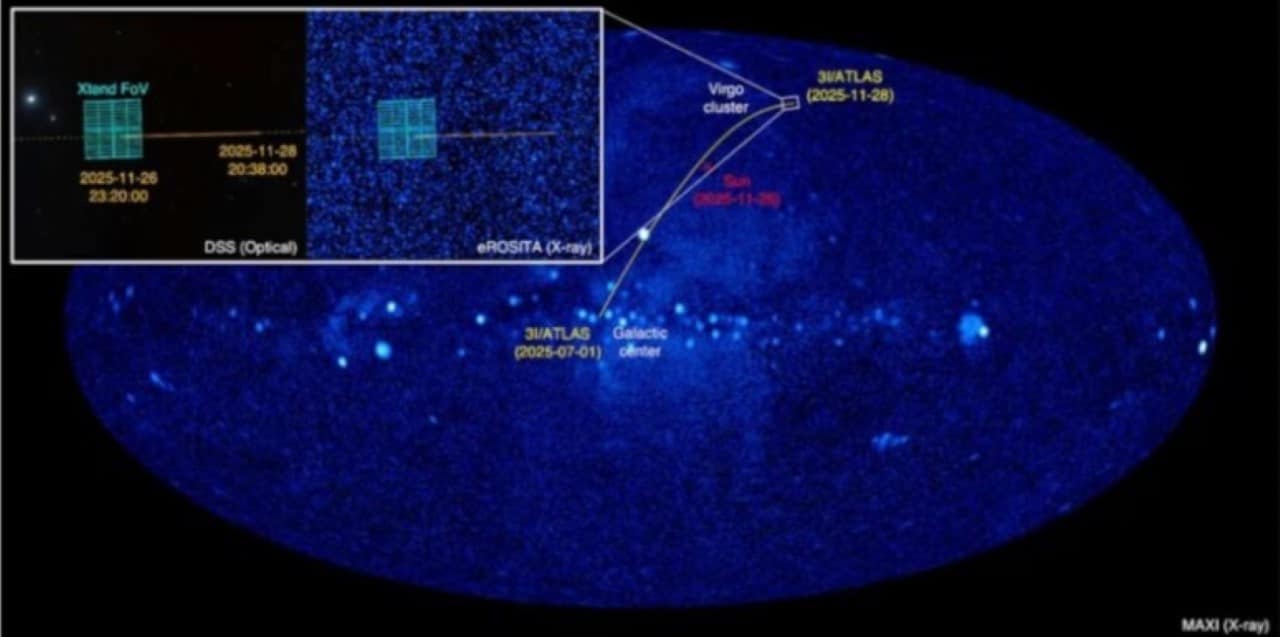
Astronomers from the Breakthrough Listen project carried out detailed observations of the interstellar object3I/ATLAS, the third confirmed to cross the Sistema Solar. The search for artificial radio signals took place on December 18, 2025, one day before the minimum approach to Terra, approximately 269 million kilometers away. The Green Bank radio telescope, at Estados Unidos, scanned the object in four frequency bands without detecting any reliable technosignature.
Initial analysis identified hundreds of thousands of signal candidates, but all turned out to be terrestrial interference after rigorous filtering. Nove remaining events were also attributed to human sources, reinforcing that the3I/ATLASdoes not emit detectable artificial transmissions. Essas observations represent the most sensitive search ever carried out on an interstellar object, capable of identifying transmitters with a minimum power of 0.1 watt.
- The object was discovered on July 1, 2025 by the ATLAS system.
- Its hyperbolic trajectory confirms origin outside of Sistema Solar.
- It presents typical comet characteristics, such as a coma and a non-elongated nucleus.
Details of observations made
The 100-meter radio telescope at Green Bank concentrated observations at the moment of closest proximity to the3I/ATLASto Terra. The scientists alternated pointing to the object and adjacent regions of the sky, eliminating local interference. Essa methodology ensured that only signals originating from the interstellar comet received consideration.
The data covered bands from 1 to 12 GHz, ideal for potential interstellar communications due to low absorption. Apesar of extreme sensitivity, equivalent to detecting a common cell phone at astronomical distances, no artificial narrowband signal emerged. Independent Estudos with other telescopes corroborated these negative results.
Unique characteristics of the object
O 3I/ATLASIt differs from previous interstellar visitors, such as ‘Oumuamua and Borisov, by its high speed of around 58 km/s and different chemical composition. Ele displays clear cometary activity, with ejections of gas and dust forming a visible coma. Observações Optical and infrared light reveals a compact nucleus, with a diameter estimated at a few kilometers.
Its extreme hyperbolicity indicates that the object will not orbit Sol and will return to interstellar space after the pass. Essa rarity offers a unique opportunity to study material formed in another star system. Dados collected include non-gravitational accelerations typical of ice sublimation.
Context of searches for technosignaturas
Projects like Breakthrough Listen have been monitoring interstellar objects since the discovery of ‘Oumuamua in 2017, motivated by the remote possibility of artificial probes. The absence of signals in the3I/ATLASaligns with scientific expectations of natural origin. However, the community remains vigilant on future visitors, given the scarcity of known samples.
Complementary observations involved telescopes such as MeerKAT and Allen Telescope Array, all of which had no artificial detections. The strategy includes ongoing analysis of archived data for subtle patterns.
Comparison with previous objects
Unlike ‘Oumuamua, which lacked a visible coma and generated debate, the3I/ATLASshows pronounced cometary activity from an early age. Comparado to Borisov, have higher speed and higher eccentricity, suggesting origin in a distant region of the galaxy. Essas differences enrich the understanding of planetary formation in other systems.
- ‘Oumuamua: speed of 26 km/s, without clear coma.
- Borisov: speed 32 km/s, moderate cometary activity.
- 3I/ATLAS: speed of 58 km/s, prominent coma and tail.
Continued scientific importance
The study of3I/ATLAScontributes to astrophysics by revealing composition of primordial material from another star. Análises spectroscopy detected molecules such as hydroxyl, consistent with natural processes. Future Pesquisas will follow the object as it moves away, extracting more data about its evolution.
The rarity of interstellar objects justifies global coordinated efforts. Missões spacers, such as Juice and Europa Clipper, captured additional views during the pass.
Data analysis procedures
Researchers processed terabytes of information with specialized algorithms for narrowband signals. Filtros removed human radio frequency contamination, common in observed bands. Nonsensing sets strict upper limits for artificial emissions from the object.
International collaborations ensured broad coverage of frequencies and methods. Public Resultados allow independent verification by the scientific community.
O 3I/ATLASit remains under optical monitoring while visible, with ground-based telescopes recording changes in brightness and structure. Sua safe passage reinforces the absence of risks to Terra, maintaining a minimum comfortable distance.



